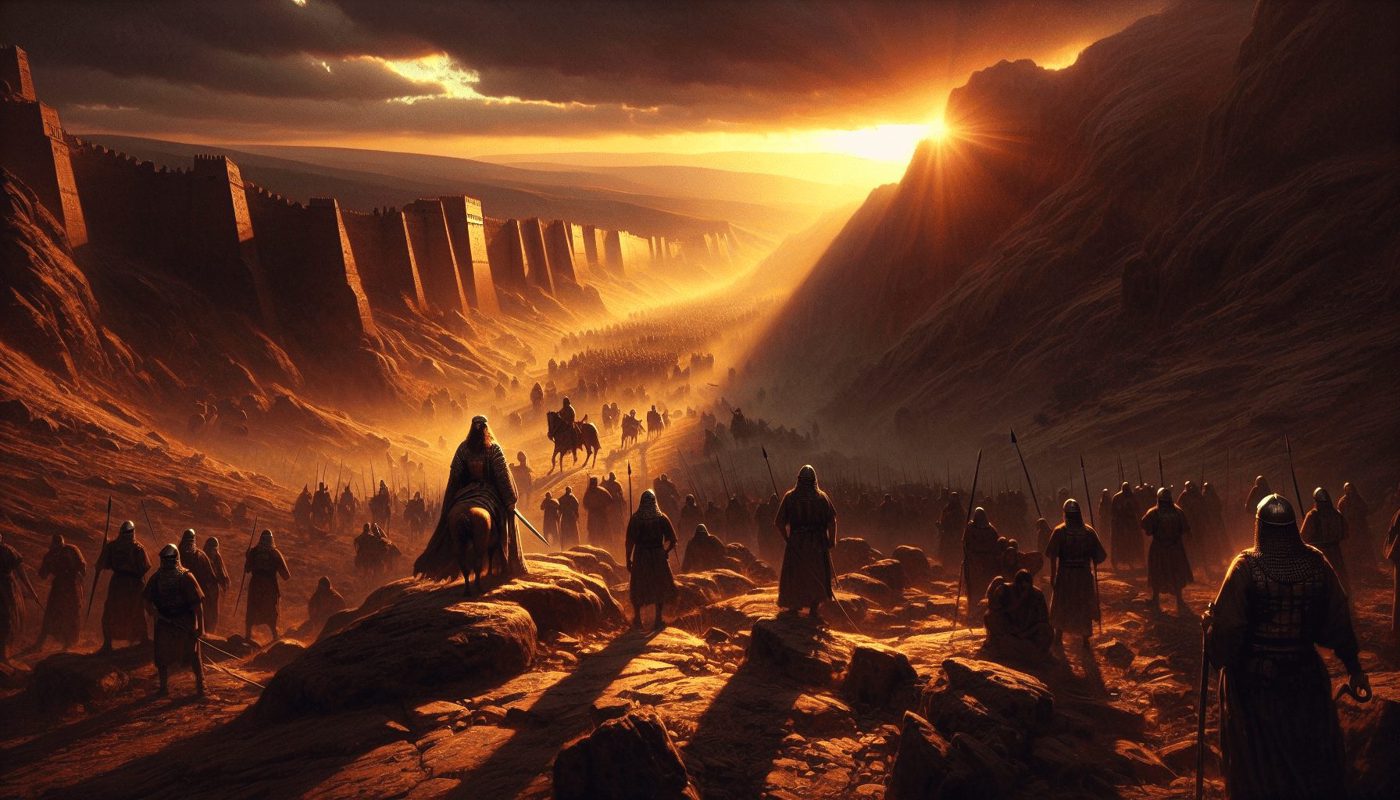
The Philistines fought against Israel on Mount Gilboa, and the men of Israel fled before them. The slain fell on the mountain, and the Philistines pressed hard after Saul and his sons. Jonathan, Abinadab, and Malchi-shua—all three of Saul’s sons—were killed in the fighting.
The battle turned heavy against Saul. The archers found him, and he was badly wounded by their arrows. In that moment, Saul spoke to his armor-bearer. He told him to draw his sword and thrust him through, so that the uncircumcised Philistines would not come and abuse him. But the armor-bearer refused, terrified. So Saul took his own sword and fell on it.
When the armor-bearer saw that Saul was dead, he also fell on his sword and died beside him. So Saul died, and his three sons died, and his armor-bearer died, and all his men died on that same day together.
The men of Israel who were on the other side of the valley and those beyond the Jordan saw that the army had fled and that Saul and his sons were dead. They abandoned their cities and fled, and the Philistines came and lived in those cities.
The next day, the Philistines came to strip the dead. They found Saul and his three sons fallen on Mount Gilboa. They cut off Saul’s head, stripped off his armor, and sent messengers throughout the land of the Philistines to carry the news to the house of their idols and to the people. They placed his armor in the temple of the Ashtaroth, and they fastened his body to the wall of Beth-shan.
When the inhabitants of Jabesh-gilead heard what the Philistines had done to Saul, all the valiant men among them arose. They traveled all night, took the body of Saul and the bodies of his sons from the wall of Beth-shan, and brought them back to Jabesh. There they burned them. Then they took their bones and buried them under the tamarisk tree in Jabesh, and they fasted for seven days.
No word from the Lord appears in this chapter. No prophet speaks. No priest intervenes. The silence that had already settled over Saul’s reign becomes absolute. The king who once stood taller than any in Israel ends his life alone on a mountain, surrounded by the bodies of his sons and his soldiers. His armor goes to a pagan temple. His head is carried as a trophy. The Philistines do not merely defeat Israel; they occupy the abandoned cities.
The men of Jabesh-gilead act out of memory. Saul had rescued them from the Ammonites early in his reign. They do not forget. They risk a night march into enemy territory to recover what remains of their king. They burn the bodies—an act that prevents further desecration—and bury the bones under a tree. They fast. That is the only honor Saul receives.
The chapter does not moralize. It does not explain why the battle was lost or why the Lord had departed from Saul. It simply records the end: a king dead by his own hand, a kingdom broken, a body nailed to a wall, and a handful of men who carried it away in the dark.
Comments
Comments 0
Read the discussion and add your voice.
Members only
Sign in to join the conversation
We keep comments tied to real accounts so the discussion stays clean and trustworthy.
No comments yet. Be the first to add one.