
The heat in the Temple courtyard was a physical weight, a blanket of still air heavy with the smell of burnt fat, old incense, and dust. Jeremiah’s shoulders ached. It was a deep, persistent ache, born not from labor but from the strain of carrying a word he never asked to bear. He could feel it there, lodged behind his breastbone, a hard, uncomfortable truth that scraped against his spirit with every breath.
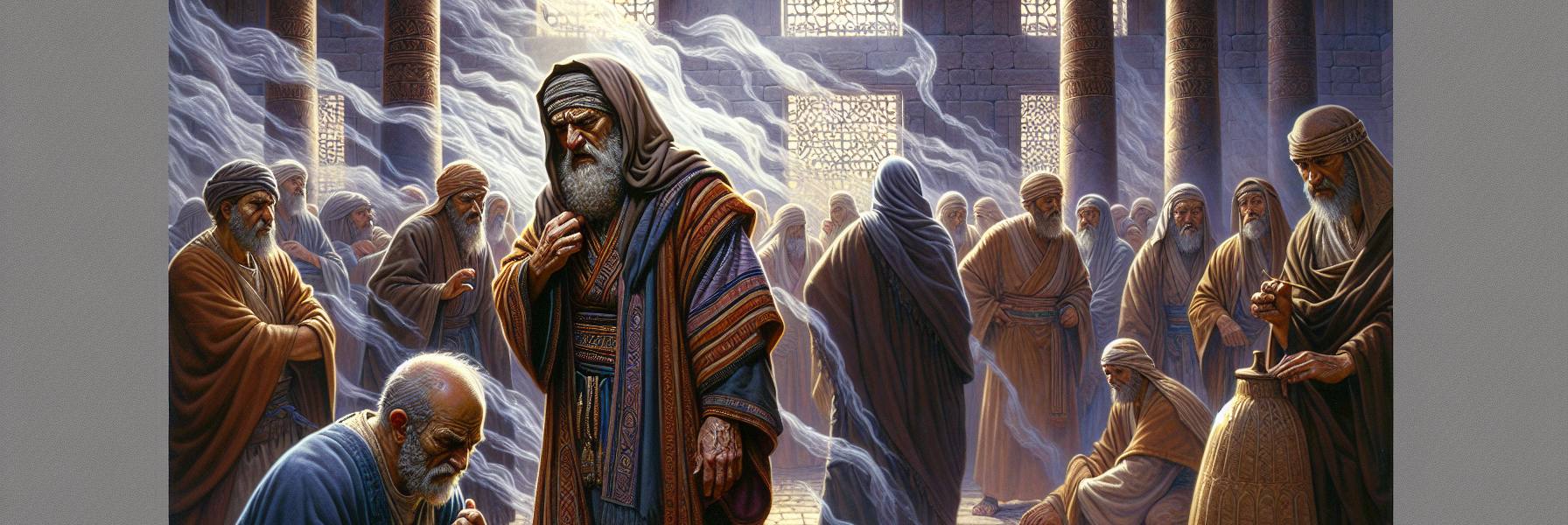
He saw Pashhur, son of Immer, the chief officer of the Temple, moving with a priestly swagger through the clusters of worshippers. Pashhur’s robes were finely hemmed, his face a mask of serene authority. He was a man who polished the vessel while ignoring the rot within. The word in Jeremiah’s chest flared, hot and insistent.
He didn’t shout at first. His voice was low, gravelly from disuse and strain, but it cut through the murmured prayers. “Thus says the Lord.” The few people nearest him flinched, as if struck. They knew that tone. It was the tone that preceded ruin.
Pashhur turned, his serene mask tightening into a frown of annoyance. Jeremiah continued, his eyes fixed on the priest but seeing beyond him, to a future painted in shades of ash and blood. “I am making you a terror to yourself and to all your friends. They shall fall by the sword of their enemies while your own eyes watch. And I will give all Judah into the hand of the king of Babylon. He shall take them captive to Babylon, and shall strike them down with the sword.”
The courtyard, moments before a place of busy ritual, fell into a stunned silence. To speak of defeat, of the sacred vessels of the Lord being carried off by a pagan king within these walls? It was more than blasphemy; it was a psychological violence. Pashhur’s face flushed a deep, furious crimson. This gaunt, troubled prophet was unraveling the careful order of his world with a few jagged sentences.
“Seize him!” Pashhur’s command broke the silence. Temple guards, heavy-set men with practiced hands, moved in. There was no ceremony to it. They grabbed Jeremiah’s arms, wrenching them behind his back. The prophet didn’t struggle. His body had gone slack, the word now spent, leaving him hollow and brittle. They dragged him not to a cell, but to the Upper Benjamin Gate, a place of very public shame.
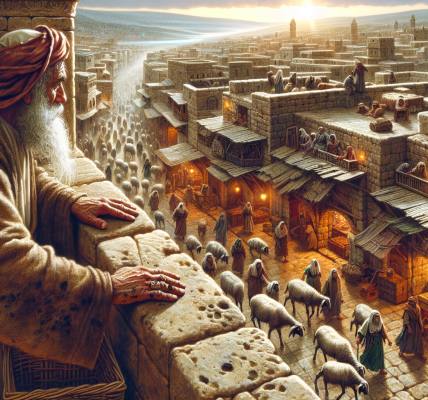
The stocks were old wood, worn smooth by the wrists and ankles of countless petty offenders. The guards forced his limbs into the holes. The fit was tight, pinching his skin. Then they slammed the upper beam down. The *thud* of the wood was final. A bolt slid home. He was trapped, bent forward in a ridiculous, painful posture of humiliation. Dust from the gate road coated his tongue. The sun, which had been merely hot before, now beat directly on the back of his neck. He could feel the gaze of the city upon him—merchants, pilgrims, women fetching water. They stared, some with pity, most with scorn, a few with vague unease.
He stayed there until evening, a public spectacle. The initial fire of the prophecy had died, and in its place crept a cold, familiar despair. His muscles screamed from the unnatural position. Thirst clawed at his throat. But worse was the interior void. Where was the confirming rush of the Spirit now? Where was the strength he was promised? There was only the wood, the dust, the mocking whispers, and the vast, silent sky.
When Pashhur finally ordered him released at dusk, it was not an act of mercy but a final dismissal. The bolt was drawn back. The upper beam lifted. Jeremiah crumpled to the ground, his limbs numb and useless, fiery needles shooting through them as blood returned. He had to push himself up with trembling hands. Pashhur stood over him, his shadow long in the setting sun.
“There,” the priest said, his voice dripping with contempt. “Perhaps now you will learn to keep your ill-omened words to yourself. You are not a prophet here. You are a nuisance.”
Jeremiah said nothing. He could only shuffle away, every step an agony, toward the lonely chamber he called home. The darkness inside was a relief. He collapsed onto his pallet, but sleep wouldn’t come. The silence was worse than the stocks. It was in the silence that the other voice began to speak—his own voice, the voice of a man betrayed.
It started as a whisper in his mind, then spilled from his cracked lips into the dark room. “You deceived me, Lord. I feel it. You were stronger, and you overpowered me. I have become a laughingstock. Everyone mocks me.” The words came in a ragged torrent, the carefully constructed faith of a lifetime crumbling under the weight of a single day’s shame. He saw their faces again—the sneers, the averted eyes. “For whenever I speak, I cry out. I shout, ‘Violence and destruction!’ The word of the Lord has brought me nothing but insult and reproach all day long.”
He rolled onto his side, drawing his knees up. The posture was childish, but he didn’t care. “If I say, ‘I will not mention him or speak any more in his name,’ then… then there is in my heart as it were a burning fire, shut up in my bones. I am weary with holding it in, and I cannot.” This was the true torture. Not the stocks, but this impossible duality. To speak was to be destroyed by men. To be silent was to be consumed from within by God. He was caught in a divine vise.
His prayer, if it could be called that, spiraled down into a blackness he had rarely allowed himself to touch. “Cursed be the day on which I was born! The day when my mother bore me, let it not be blessed! Cursed be the man who brought the news to my father…” He pictured the anonymous messenger running to his father’s house in Anathoth, shouting of a son. Why could that man not have been struck dumb? Why could he not have been like the cities the Lord overthrew? “Why did I come out from the womb to see toil and sorrow, and spend my days in shame?”
The words echoed in the bare room and faded. There was no answer. No heavenly comfort. No vision to steady him. Just the faint smell of his own sweat and the distant, indifferent sounds of the city at night. The despair was total, a well with no bottom.
He lay there for a long time, empty. But a peculiar thing happened as the deepest hour of the night passed. The frantic, self-pitying energy of his outburst drained away, leaving not peace, but a kind of stark clarity. The pain in his limbs was just pain. The silence was just silence. And the word, that fire in his bones, hadn’t gone out. It smoldered still, a low, persistent heat.
He hadn’t been answered, but he had been heard. The prayer of accusation, the curse on his own life—it had all been laid bare before the same Presence that had called him as a youth. And that Presence had not struck him down for his insolence. It had absorbed it.
Slowly, stiffly, he pushed himself up to sit on the edge of the pallet. His throat was parched. He fumbled for a water skin and drank. The physical world reasserted itself: the cool clay of the vessel, the rough weave of his blanket, the first grey hint of dawn at his small window.
Pashhur thought he had won. He thought the stocks and the ridicule would silence the divine word as one might silence a bothersome dog. But Jeremiah, in the awful clarity of his exhaustion, saw the truth. The word was not his to control, to deploy or retract based on comfort. It was a river that flowed through him. He could no more stop it than he could stop the dawn now creeping over the city walls.
He would speak again. He knew it with a certainty that felt like a sentence. The terror Pashhur feared would come to pass. Babylon *would* come. The violence and destruction he proclaimed were not curses from his mouth, but the bitter fruit of choices already made by kings and priests and people. His task was not to succeed, but to be faithful. To be the voice that spoke the truth of the coming storm, so that when it broke, a remnant might remember that they had been warned, and in that remembering, might one day seek the face of the God who, even in judgment, did not abandon his word, or the broken vessel who carried it.
He stood, his body protesting. He would go out today, back into the streets that hated him. Not because he was brave, but because he was compelled. The fire was still there, shut up in his bones. And he could not hold it in.