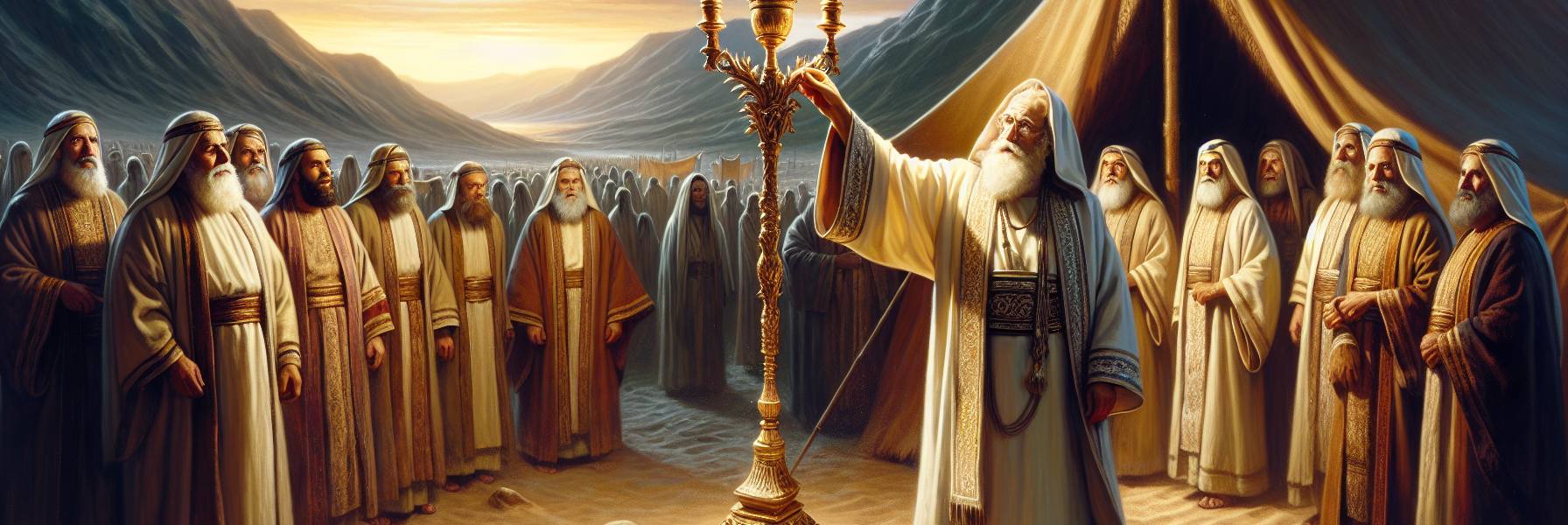

The dawn came slow and grey over the desert camp, the air still holding the night’s chill. I stood with the others, my kinsmen, just outside the Tent of Meeting. We were the Levites, a people set apart, yet on that morning we felt less like a chosen tribe and more like men awaiting a verdict. The fine, gritty dust of the wilderness had settled into the folds of our robes, a constant companion.
Moses had spoken the words to us all, but it was Aaron who moved now, his high-priestly garments a stark, beautiful contrast to the dun-colored world. He was an old man, weighted with office, but his hands were steady as he approached the great lampstand of pure gold. It stood there in the growing light, its seven branches like an almond tree caught in a moment of perfect, fiery bloom. We watched, a hushed crowd, as he trimmed the wicks. The lamps weren’t for the daylight; they were a promise for the dark. He lit them, each one catching with a soft *whoosh* and a flutter of light. The flames didn’t roar; they settled, six facing inward toward the central shaft, a community of light. The command, we knew, was that they burn continually. A small, perpetual dawn before the Lord. It was a silent lesson before the main event: light first, then service.
Then the real work began. They brought a bull, its hide dark and glossy, and a second for a sin offering. The noise of the beast, the smell of its fear, was sharp in the clean morning air. We were led forward, a sea of men from thirty to fifty. The water of cleansing was shockingly cold. They poured it over us from bronze basins, not a gentle sprinkle but a drenching torrent that soaked our hair and beards, plastered our linen tunics to our skin. It was a physical shock, a death to the ordinary. I shivered, not just from the cold, but from the sheer strangeness of it.
Next came the razor. They shaved every hair from our bodies. It was a deeply humbling thing, to be made so bare, so utterly exposed. The scrape of the flint against my scalp, my arms, was a sound of utter surrender. All the grime of the journey, the personal identity of beard and hair, it all fell into the dust at our feet. We were becoming blank pages.
Then the Levites were told to lay our hands upon the heads of the bulls. My palm felt the warm, living tremor of the animal’s skull, the coarse hair. In that touch was a transfer, a profound and terrible mystery. Our identities, our faults, our very lives, were being symbolically passed onto this creature. When the knife flashed and the bull sank down, a part of us died with it. The blood was caught, and Aaron’s sons, their hands already stained from the daily tasks, brought it to the altar. Some was dashed against its sides; some was smeared. The smell of blood, hot and metallic, mixed with the dry scent of the desert. The fat was burned, a sweet savour to the Lord, the smoke rising thick and straight in the still air.
But we were not the sacrifice. We were the living offering. Aaron did a thing then that I shall never forget. He presented us, all of us, standing there shivering and clean, before the Lord. He waved us, as if we were the sheaf of firstfruits, an offering waved in dedication. We were given, wholly and completely, from the people of Israel to the God of Israel. A chill that had nothing to do with the wet linen went through me. It was a transaction in the heavenly realm, and we were the currency.
Our work was laid out plainly. From that day, we were to attend to the Tent. The heavy, sacred pieces—the frames, the bars, the altars, the curtains—these were our charge. We would carry them when the cloud moved. We would guard them when the camp was still. Our service was a shield, placed between the holy things and the congregation, so that there would be no wrath. The phrase echoed: *to make atonement for the people of Israel, that there may be no plague among them*. Our labour was a thread in the fabric of their safety.
The ceremony ended not with a shout, but with a dispersal. The sun was high now, beating down on our bare heads. We were dismissed to our duties. I walked back toward my tent, my skin feeling new and strange under the sun, the smell of incense and burnt offering clinging to me. I was the same man, yet I was not. I had been washed, shaved, blood-sprinkled, and waved. My life was no longer my own. It was a hard truth, and a glorious one. That night, when I took my first watch near the Tabernacle court, I looked in at the golden glow of the lampstand. Those six flames, leaning in toward the center, burning against the vast blackness of the desert night. And I understood. We were to be like that. Not the source of the light, but its bearers, our lives oriented toward the holy, burning quietly, continually, for the sake of the people. It was a long service. It was a good one.