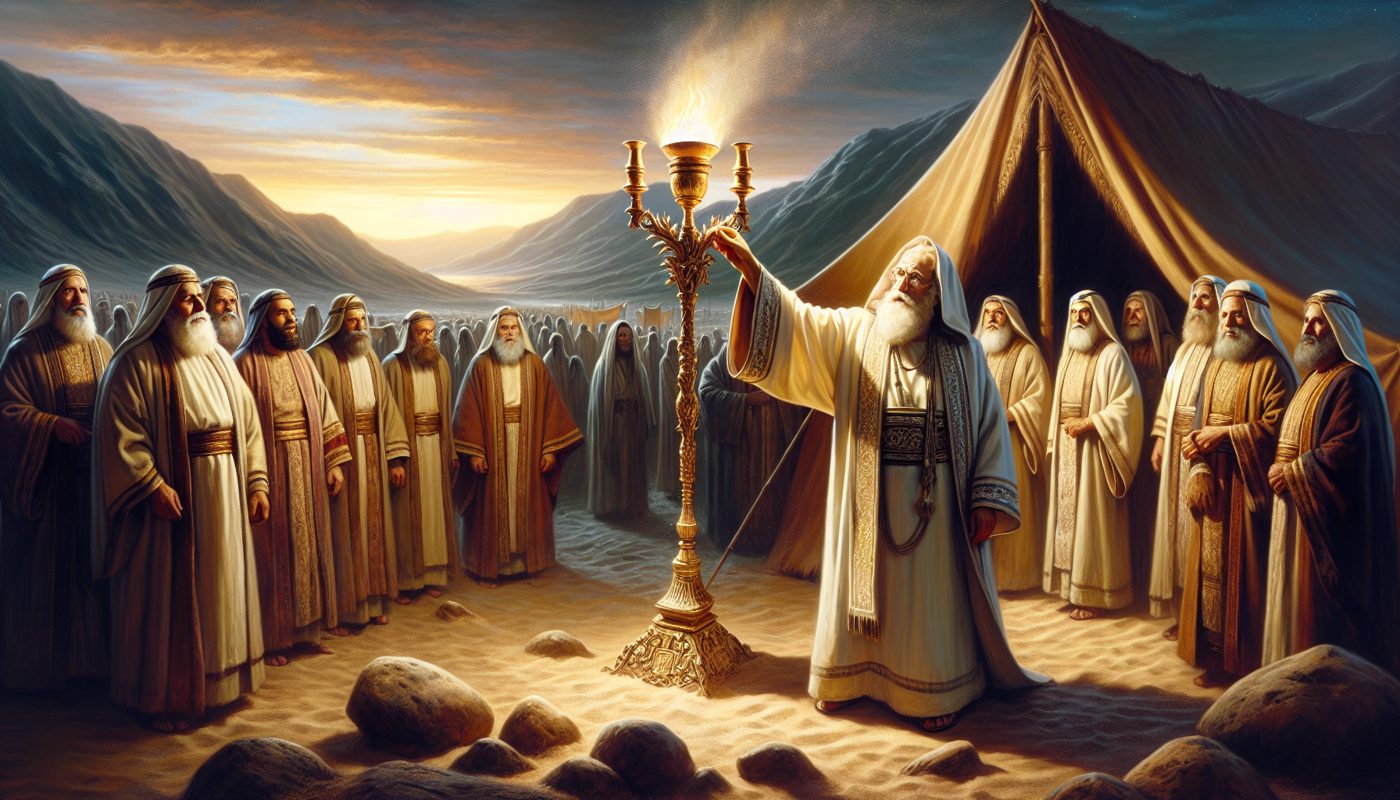
The chapter opens with a command about light. The Lord spoke to Moses and told him to instruct Aaron that when he lights the seven lamps of the golden lampstand, they must give light in front of it. Aaron did exactly that. The lampstand itself was beaten work of pure gold, from its base to its flowers, made according to the pattern the Lord had shown Moses on the mountain. The lamps were not for general illumination; they were positioned to cast their light forward, toward the table of showbread and the inner space of the tent. The command was precise, and the execution was immediate.
Then the Lord spoke again, this time about the Levites. Moses was told to take them from among the children of Israel and cleanse them. The cleansing was not symbolic. It involved sprinkling the water of expiation upon them, shaving all their flesh with a razor, washing their clothes, and making themselves clean. This was a physical purification that preceded any service. No man could approach the work of the tent without first being stripped of hair and dirt, as though the old life had to be scraped away.
After the cleansing, the Levites were to take a young bull with its grain offering of fine flour mixed with oil, and another young bull for a sin offering. Then the whole congregation of Israel was to be assembled. The Levites were to be presented before the Lord at the tent of meeting, and the children of Israel were to lay their hands on the Levites. This laying on of hands was not a blessing; it was a transfer. The people placed their hands on the Levites, and the Levites became their substitute before God.
Aaron then offered the Levites as a wave offering before the Lord, on behalf of the children of Israel. The Levites themselves laid their hands on the heads of the bulls. One bull was offered as a sin offering, the other as a burnt offering, to make atonement for the Levites. The atonement was not for the people directly; it was for the Levites, so that they could stand in the holy place without being consumed. The wave offering of the men themselves was a strange and solemn ritual. They were not bringing an animal to be waved; they were being waved, presented as living offerings before the Lord.
The Lord then stated the reason for this entire procedure. The Levites were to be separated from among the children of Israel, and they were to be the Lord's. They were taken instead of every firstborn who opens the womb among the Israelites. The Lord claimed the firstborn on the night he struck the firstborn in Egypt, and now he had taken the Levites as their permanent replacement. This was not a new idea; it was the execution of a standing claim. The Levites belonged to the Lord by substitution, and their service was their life.
The Lord gave the Levites as a gift to Aaron and his sons. They were to do the service of the tent of meeting and to make atonement for the children of Israel. The purpose was blunt: so that no plague would break out among the people when they came near the sanctuary. The Levites stood as a buffer between the holy God and the ordinary people. Without them, the congregation would risk death simply by approaching the tent. Their consecration was not a privilege; it was a dangerous duty.
Moses, Aaron, and the whole congregation did exactly as the Lord commanded. The Levites purified themselves from sin, washed their clothes, and Aaron offered them as a wave offering and made atonement for them. Only then did they go in to do their service in the tent of meeting. The chapter records that everything was done according to the command. There was no deviation, no complaint, no innovation. The ritual was followed as given.
The chapter closes with a second word from the Lord about the age limits for Levitical service. The men were to begin their work at twenty-five years old and were to cease from the heavy service at fifty. After fifty, they could still minister with their brothers in the tent of meeting, keeping the charge, but they were to do no more of the strenuous labor. The age limit was not about retirement in the modern sense; it was about preserving the sanctuary from the weakness of age. The work of the tent required strength, and the Lord set the boundaries plainly.
The entire chapter is a sequence of boundaries: the light must face forward, the men must be cleansed, the offerings must be made, the age must be measured. Nothing was left to the discretion of Moses or Aaron. The Lord gave the pattern, and the pattern was followed. The Levites were not volunteers; they were taken, cleansed, offered, and assigned. Their service was not a career; it was a substitutionary duty that kept the people alive.
Comments
Comments 0
Read the discussion and add your voice.
Members only
Sign in to join the conversation
We keep comments tied to real accounts so the discussion stays clean and trustworthy.
No comments yet. Be the first to add one.