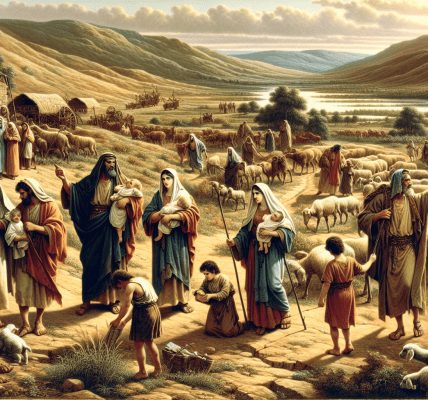

The dust of the north road was a fine, pale powder that rose in little puffs with each step, coating the worn leather of Elidad’s sandals and settling in the creases of his tunic. He walked slowly, his staff tapping a dry rhythm on the hard-packed earth. Around him, a scattered stream of other pilgrims moved in the same direction, a silent river drawn by a single, invisible pull. But for Elidad, this journey was not a yearly ritual; it was the first in ten long years. A decade of drought, of failed crops, of mourning a wife taken by fever, had built a wall between him and Zion. The prayers in his house in Asher had felt thin, like whispers against stone. It was the memory of a single verse, hummed by his mother in a forgotten childhood, that finally broke the dam: *How lovely is your dwelling place, O Lord of Hosts.*
His mind, as he walked, was not on the miles but on the spaces. He remembered not just the Temple itself, that glittering pinnacle, but the spaces in between—the courts, the gates, the very roads of Jerusalem. To a young man, they had seemed merely crowded. Now, he understood they were saturated. Every stone, every shadow, was a potential altar. The longing he felt was a physical ache, a deep thirst behind his breastbone. He envied, with a sorrowful smile, the sparrows he saw darting under the eaves of wayside inns. *Even the sparrow finds a home, and the swallow a nest for herself.* His own nest had felt empty. He wanted that simplicity: to be a bird allowed to nest in the very edges of God’s house, to be near, simply near, the evidence of the Presence.
The journey became a liturgy of weariness. The Valley of Baca wasn’t a place on any map his fellow travellers spoke of, but Elidad passed through it nonetheless. It was the stretch of road where the sun beat down without mercy, where his water skin grew light, and his old knees protested. This was the place of weeping, the *baca* of the psalm. But here, a strange thing happened. A family ahead of him, their clothes dusty and faces drawn, stopped by a seemingly dry wadi. The father, with patient hands, began clearing stones from a crevice. Others gathered. Within an hour, a tiny trickle, then a steady seep of water emerged, fed by some hidden spring. They drank, refilled their skins, and moved on, leaving the place a little better for those behind. *They go from strength to strength.* It wasn’t a sprint of zeal, Elidad realized. It was a patient, communal persistence. The strength to clear the stones for another. The strength to take another step after drinking. The valley of weeping became a place of springs because the pilgrims made it so, their shared hope calling forth the hidden water.
And then, on the third day, a change in the air. The landscape began to rise. The chatter among the pilgrims grew, not in volume, but in a different tone—a soft, eager hum. They began to sing the Songs of Ascents, their voices ragged but united. Elidad’s voice, unused and rough, joined them. He was no longer just a man from Asher; he was part of a body moving upward.
The first sight of the walls was a blow to his heart. He had to stop, leaning on his staff, his breath caught. There it was, the city on the hill, and within it, the glint of gold from the Temple mount. The longing sharpened, sweet and painful. He thought of the doorkeepers his psalm spoke of. He imagined them, those Levites, standing at the gates day after day. He had once thought theirs a mundane duty. Now he knew envy again. To be the one who opened the door, who stood on the threshold, who witnessed the flood of yearning faces entering in? *Better is one day in your courts than a thousand elsewhere.* He would trade all his years of quiet, barren survival for a single day of standing in that shadow, of hearing the distant choir, of smelling the incense that spoke of prayers reaching heaven.
The final ascent through the city gates, through the bustling, aromatic, noisy streets, was a blur. He was carried by the current. And then, he was there. He passed through the Court of the Gentiles, a roar of languages and commerce, and onward, as far as a son of Israel could go. He stood in the Court of Israel, facing the magnificent façade of the Holy Place. The afternoon sun bathed the white stone in a honeyed light. The air was thick with the smell of burning fat and grain offerings, a smell both brutal and sweet. The choir of Levites was singing, their voices weaving a tapestry of sound that seemed to hold up the very sky.
Elidad did not weep. He simply stood. The aching hollow behind his breastbone, the thirst of ten years, was being filled. Not with explanation, not with drama, but with a profound, quiet *thereness*. He was a sparrow who had finally found his eaves. He was a man standing in the courts of his God. The journey’s dust, the valley’s thirst, the weight of his years—it all fell into a new order. The Lord God was a sun, warming his stiff bones. He was a shield, and in that moment, Elidad felt a safety deeper than any wall could provide.
He looked down at his own dusty, calloused hands. He had brought a small offering, a pair of turtledoves. It seemed insignificant against the grandeur. But the psalm echoed in him, completed now by experience: *O Lord of Hosts, blessed is the one who trusts in you.* The blessing was not merely in the arrival, but in the trust that propelled the journey. It was in the strength found in the dry valley, in the shared water, in the stubborn step forward taken even when Zion was only a dream in a dry land.
As the sun began to lower, casting long shadows across the court, Elidad turned to leave. He was the same man, with the same losses, returning to the same drought-stricken farm. But he carried a new map within him. He had passed through the valley and found it could hold a spring. He had learned that his trust was not a destination, but the road itself. And he knew, with a certainty that would have to last another ten years, or until his last breath, that a day in this shadow was worth a lifetime of walking toward it. He shouldered his pack, now lighter than when he came, and joined the stream of people flowing back out into the world, taking the courts with him in his quiet heart.