The voice that opens Job 30 is not the voice of a man who has lost everything. It is the voice of a man who has lost everything and then been mocked for it by people he once would not have let near his sheepdogs. Job names the insult with surgical precision: they are younger than he is, and their fathers were men he disdained to set with the dogs of his flock. The dogs of the flock were not pets. They were working animals, kept at a distance, fed scraps. Job had placed these men's fathers below that station. Now the sons stand over him and sing.
Job describes these men with a kind of horrified accuracy. They are gaunt from want and famine. They gnaw the dry ground in the gloom of wasteness. They pluck saltwort from the bushes and eat the roots of the broom tree. These are not the honorable poor of the village, the widows and orphans the law protects. These are men driven out from the community, shouted at as thieves, dwelling in frightful valleys and holes of the earth. They bray among the bushes like donkeys. They huddle under nettles. They have been scourged out of the land. And now they are the ones who deride Job.
The inversion is complete. Job has become their song, their byword. They abhor him, stand aloof, and spit in his face without restraint. Job does not soften this. He does not say they are mistaken or that he deserves it. He simply reports the fact of the contempt as a man reporting the color of the sky after a house fire. There is no moral lesson in their cruelty. There is only the raw fact of it.
Job traces the source of this collapse back to its origin. He says the Lord has loosed his cord and afflicted him. The cord is the tension of a bow or the rigging of a tent. When it is loosed, everything falls slack. The men who once held back now cast off the bridle before him. On his right hand the rabble rise up. They thrust aside his feet and cast up their ways of destruction against him. They mar his path and set forward his calamity, even though they have no helper. They come through a wide breach, rolling themselves upon him in the midst of the ruin.
Terrors turn upon Job. They chase his honor like the wind. His welfare passes away like a cloud. The language is not metaphorical in the way modern speech is metaphorical. Job means that his honor is actually gone, as gone as wind, and his welfare is as unrecoverable as a cloud that has dissolved. There is no hidden reserve of dignity left. The terrors are real and they are hunting him.
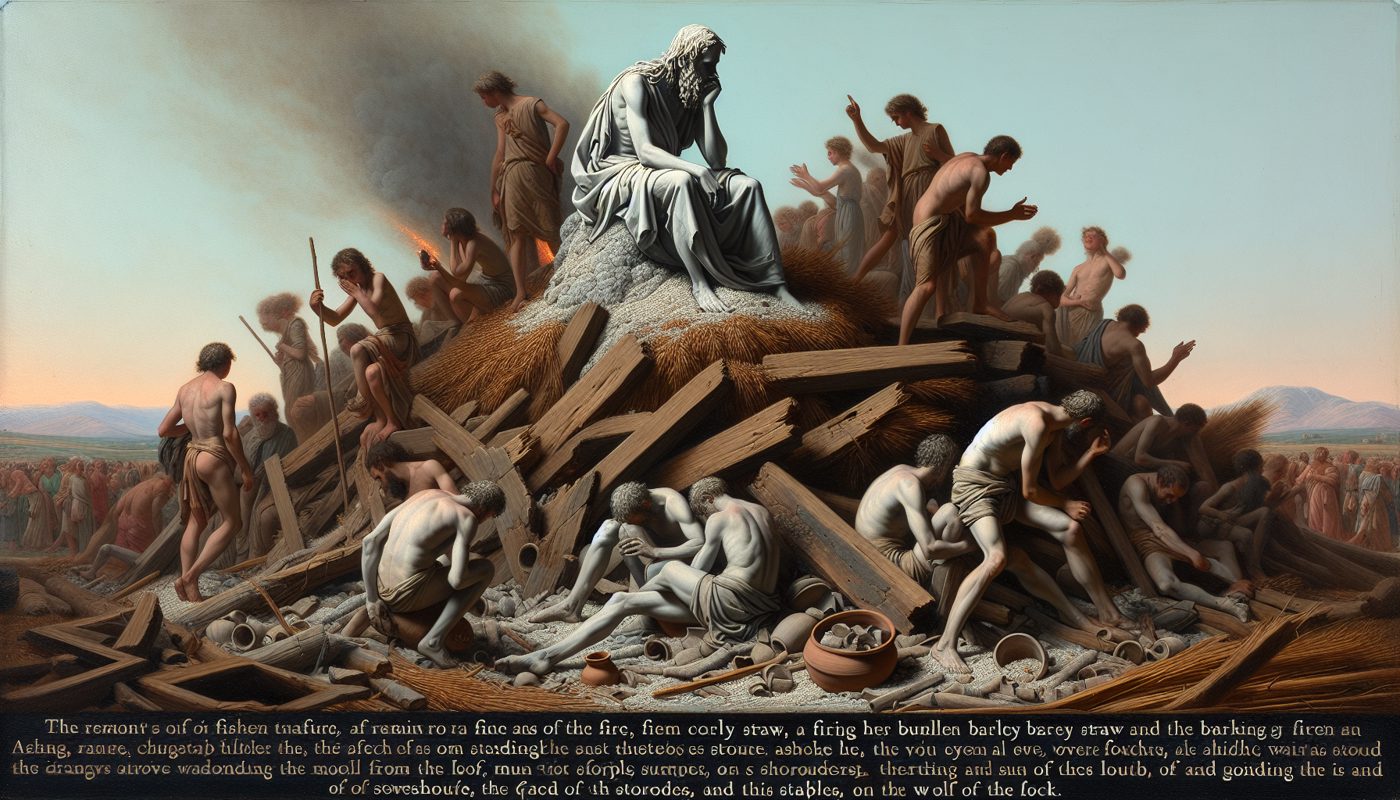
Job's body is not spared. In the night his bones are pierced, and the pains that gnaw him take no rest. By the Lord's great force his garment is disfigured, binding him about like the collar of a coat that has become a noose. The Lord has cast him into the mire, and Job has become like dust and ashes. The dust and ashes are not a posture of repentance. They are the literal condition of a man who has been thrown onto the ash heap of the city and left there.
Then Job turns to address the Lord directly. He cries out, and the Lord does not answer. He stands up, and the Lord gazes at him. The gaze is not comfort. It is the stare of someone who watches without intervening. Job says the Lord has turned cruel to him, persecuting him with the might of his hand. The Lord lifts him up to the wind, causes him to ride upon it, and dissolves him in the storm. Job knows where this ends. He says plainly that the Lord will bring him to death, to the house appointed for all living.
But Job does not stop at the accusation. He asks a question that carries the weight of his whole argument. Does not one stretch out the hand in his fall? In calamity, does not a man cry for help? Job had done that for others. He had wept for the troubled and grieved for the needy. He had done what the law required and what compassion demanded. And when he looked for good, evil came. When he waited for light, darkness came. His heart is troubled and finds no rest. The days of affliction have come upon him, and they do not leave.
Job goes mourning without the sun. He stands up in the assembly and cries for help, but the assembly does not help. He has become a brother to jackals and a companion to ostriches. The jackals howl in the waste places. The ostriches are birds of the desert, known for their harsh calls and their abandonment of their young. Job's company is the company of the forsaken. His skin is black and falling from him. His bones are burned with heat. His harp is turned to mourning, and his pipe into the voice of them that weep.
There is no resolution in this chapter. There is no friend who speaks comfort, no vision from the whirlwind, no restoration of fortune. There is only a man who has been reduced below the level of the outcasts and who names the Lord as the agent of that reduction. The chapter ends with the instruments of joy silenced. The harp and the pipe do not play. They weep. And Job does not apologize for the sound.
Comments
Comments 0
Read the discussion and add your voice.
Members only
Sign in to join the conversation
We keep comments tied to real accounts so the discussion stays clean and trustworthy.
No comments yet. Be the first to add one.