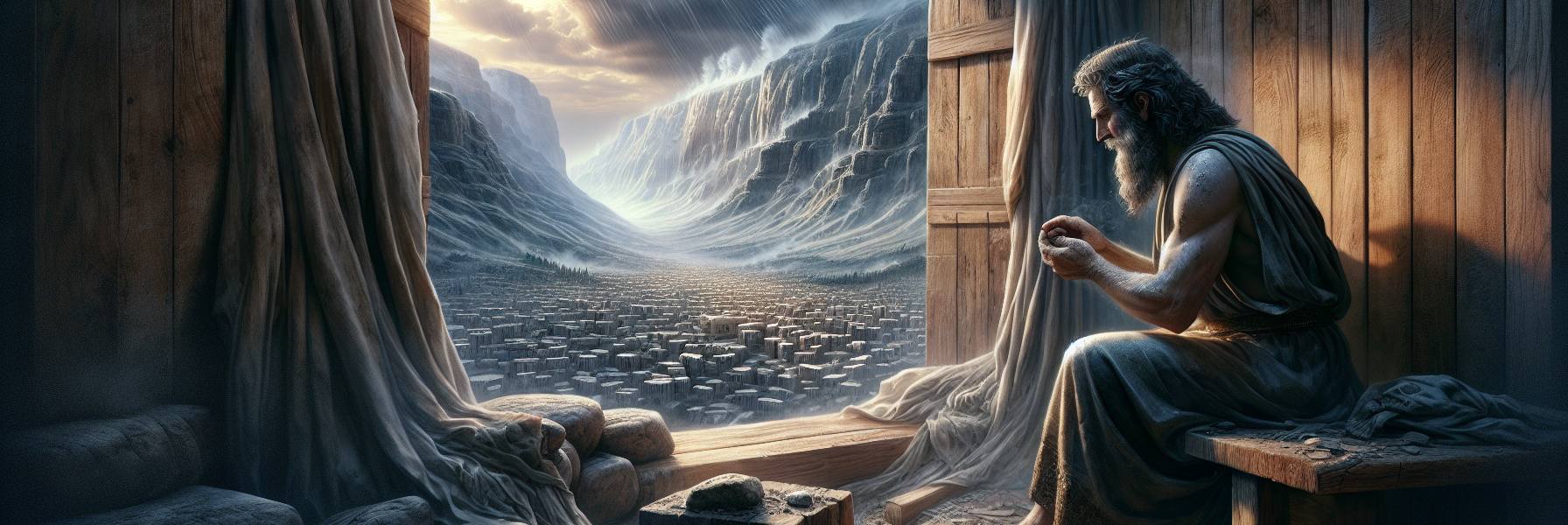

The cedar panels in his new house smelled of rain and resin, of Mount Lebanon. King David ran a calloused hand along the grain, feeling its cool, polished smoothness. From the high window, he could see the grey stones of the City of David tumbling down the ridge, the smoke of a thousand hearthfires rising in the still evening air. Peace, at last. A stillness that was not the stillness of the battlefield after the screaming, but the quiet of a breath held in contentment.
And it was this very quiet that unsettled him.
He was here, in a house of cedar, while the Ark of the Covenant dwelled behind curtains of goats’ hair, under a worn tapestry of a sky. The thought was a stone in his shoe, a burr caught in his royal robe. He found Nathan the prophet by the outer court, where the last of the sun warmed the white stone. Nathan was a man of thoughtful eyes and a calm presence, a steady flame in the volatile air of a court.
“Look,” David said, his voice low, gesturing not to the palace but to the view beyond, where the Tabernacle’s linen walls were just visible. “Here I am, living in this… this permanence. And the Ark of God sits in the middle of a tent.”
Nathan, caught in the wave of the king’s fervor, seeing the righteous discomfort in his face, nodded. The logic seemed impeccable, holy even. “Go,” he said, his tone carrying the weight of casual certainty. “Do all that is in your heart. For the Lord is with you.”
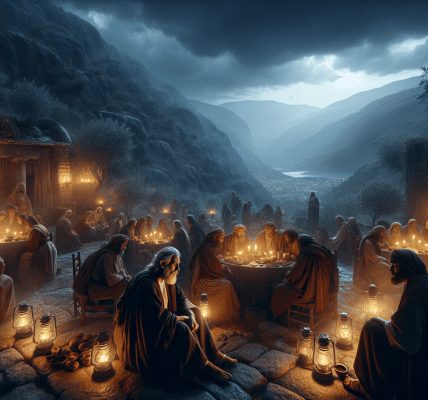
But the Lord’s thoughts are not our thoughts. That night, a different word came to Nathan, a word that turned the prophet’s comfortable assurance to dust. It was not a vision of grandeur, but a voice that spoke in the dark chamber of his sleep, a voice that pulled the tapestry of human plans apart thread by thread.
“Go,” the voice said, a command that now felt heavy as stone. “Tell my servant David: ‘Will you build a house for me to dwell in? I have not dwelt in a house from the day I brought the Israelites up out of Egypt to this day. I have been moving from tent to tent, from dwelling to dwelling. Did I ever say to any of the leaders I commanded to shepherd my people Israel, “Why have you not built me a house of cedar?”’
Nathan woke with the words burning like a coal on his tongue. He went to David in the morning, the king’s eager expectancy a painful contrast to the message he bore. He did not soften it with preamble.
“This is what the Lord of Hosts says,” Nathan began, and David, perceiving the shift, grew still. “It was I who took you from the pasture, from following the sheep, to be ruler over my people Israel. I have been with you wherever you have gone. I have cut off all your enemies from before you.”
David’s mind flashed with memories—the lion’s breath, the giant’s shadow, the cold nights hiding in caves from Saul. Not his own strength, but a Presence, a hand guiding, shielding.
“And I will make for you a great name,” Nathan continued, the words filling the cedar-paneled room, “like the names of the greatest on the earth. I will provide a place for my people Israel and plant them so they can have a home of their own and no longer be disturbed. No longer will the wicked oppress them as they have done from the day I appointed judges.”
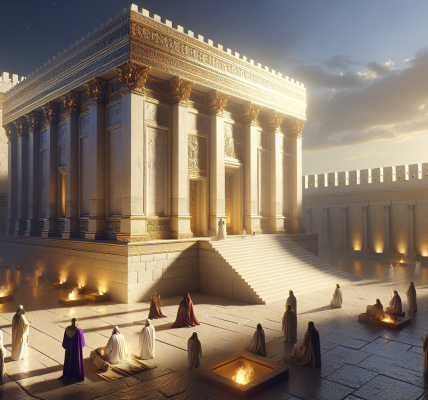
The promise was vast, geographic, historical. It was about land, and roots, and rest. David listened, his builder’s heart waiting for the blueprint, the command to begin hewing stone for the Temple.
But the word turned. “The Lord declares to you that it is He who will build *you* a house.”
David blinked. The metaphor was clear, yet staggering. A dynasty. A lineage.
“When your days are over and you rest with your ancestors,” Nathan said, his voice dropping into the solemn register of prophecy, “I will raise up your offspring to succeed you, your own flesh and blood, and I will establish his kingdom. It is he who will build a house for my Name.”
There it was. The correction, gentle as a surgeon’s knife. Not you, David. Your son. The house of God would be built by a man of peace, not a man of war whose hands were stained with blood, however righteously shed. The acknowledgement of David’s heart was there—God honored the desire—but the fulfillment was deferred, given a different shape.
The promise deepened, becoming a covenant that stretched into the unseen future. “I will be his father, and he will be my son. When he does wrong, I will punish him with a rod wielded by men, with floggings inflicted by human hands. But my love will never be taken away from him, as I took it away from Saul, whom I removed from before you.”
The steadfastness of it stole David’s breath. It was not a promise of perfection, but of faithfulness. A father’s discipline, yes, but a father’s irrevocable love.
“Your house and your kingdom will endure forever before me; your throne will be established forever.”
The words hung in the air, final, echoing into eternity. Nathan fell silent. The morning light had climbed higher, illuminating the dust motes dancing in the space between the prophet and the king.
David rose. He did not speak for a long moment. Then he left the cedar house, walking slowly, as if carrying something fragile and immense, back to the place where the Ark sat in its humble tent. He went in before the Lord and sat on the ground, the cool earth a stark contrast to his palace floors.
His prayer, when it came, was not a king’s decree, but the whisper of a shepherd stunned by the stars. “Who am I, Sovereign Lord, and what is my family, that you have brought me this far? And as if this were not enough in your sight, Sovereign Lord, you have also spoken about the future of the house of your servant. Is this your usual way of dealing with man, my Lord God?”
There was no answer but the quiet of the tent, the silent, terrifying, glorious proximity of the Almighty who needed no house, yet promised to make one for him. The builder’s plans had been swept away, replaced by a architecture of grace so profound it could only be received, not constructed. David’s house of cedar was just wood. God was building a house of flesh and blood, of promise and lineage, a house that would, one distant day, hold more than gold or incense. It would hold the hope of the world.
He stayed there on the ground until the shadows lengthened, a king undone and remade not by a crown, but by a covenant whispered in the dark to a prophet, a promise that would outlive cedar, outlive stone, outlive empires. The restlessness was gone. In its place was a quiet awe, and the deep, settling peace of a man who has learned he is not the master builder, but a living stone in a design too magnificent to comprehend.