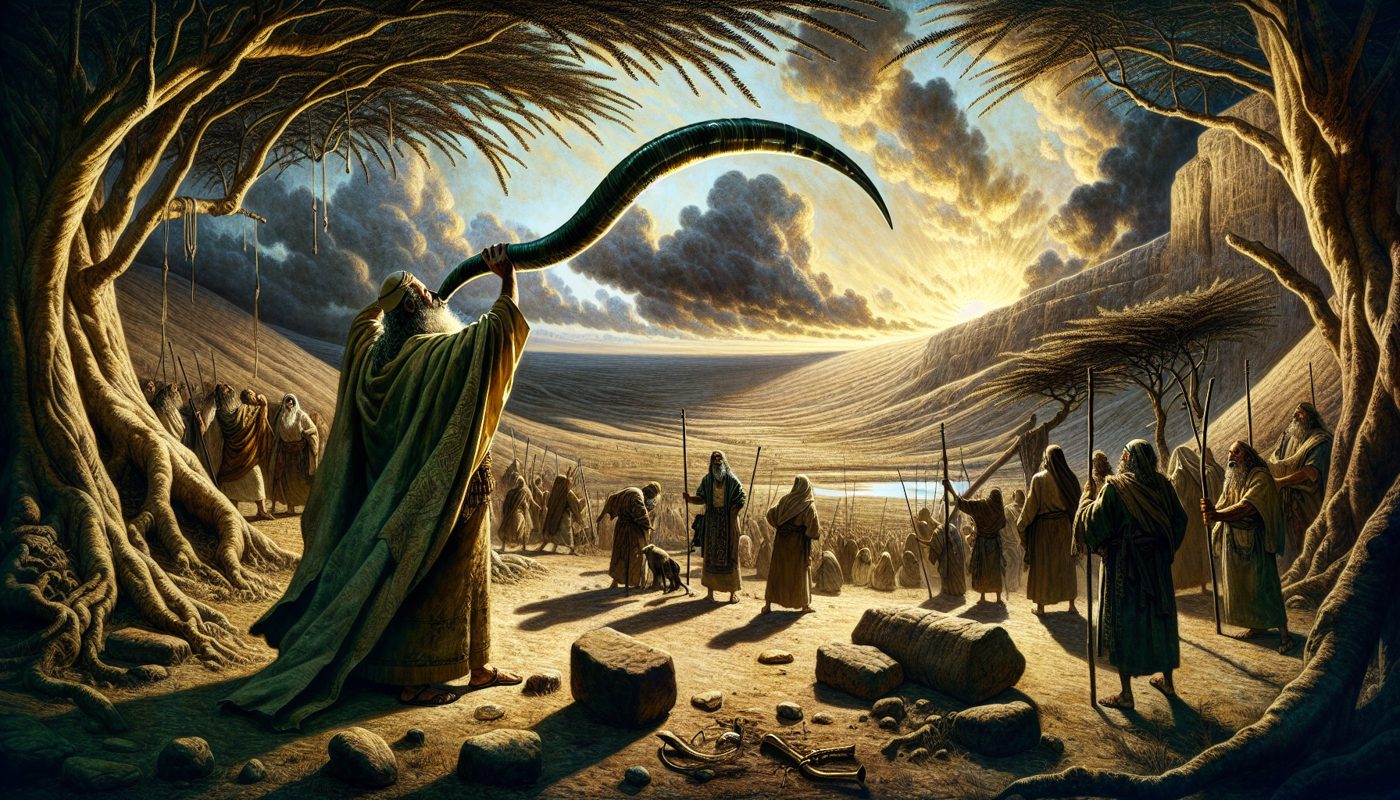
The seventh month arrived with a blast. Not a whisper, not a gradual call, but a commanded sound: the first day, a holy convocation, no servile work, a day of blowing of trumpets. The Lord gave the order through Moses, and the camp stopped. The text does not explain what the trumpets meant or how the people felt. It only says the day was set apart, and the offerings began.
On that first day, the burnt offering was one young bullock, one ram, and seven he-lambs a year old, all without blemish. With them came the meal offering of fine flour mingled with oil: three tenth parts for the bullock, two tenth parts for the ram, one tenth part for each lamb. And one he-goat for a sin offering, to make atonement. This was in addition to the burnt offering of the new moon and the continual burnt offering. The Lord did not simplify the calendar. He layered it.
On the tenth day, the convocation returned. No work. Afflict your souls. The burnt offering repeated the same animals: one bullock, one ram, seven he-lambs. The same meal offerings. One he-goat for a sin offering, besides the sin offering of atonement and the continual burnt offering. The tenth day was not a new invention. It was a second, sharper summons within the same month.
On the fifteenth day, the feast began. Seven days to the Lord. No servile work. But the offerings changed scale. On the first day of the feast: thirteen young bullocks, two rams, fourteen he-lambs. The number of bullocks was highest at the start. The meal offerings followed the same proportion: three tenth parts for each bullock, two tenth parts for each ram, one tenth part for each lamb. One he-goat for a sin offering. The continual burnt offering still stood beneath it all.
On the second day, the bullocks dropped to twelve. The rams stayed at two. The lambs stayed at fourteen. One he-goat. The same meal and drink offerings, according to the ordinance. The pattern was not random. It was a deliberate descent, day by day.
On the third day, eleven bullocks. On the fourth, ten. On the fifth, nine. On the sixth, eight. On the seventh, seven. Each day, the rams remained two, the lambs fourteen, the he-goat one. The meal and drink offerings followed the same rule. The numbers were fixed. The Lord did not leave the quantity to the worshiper's discretion. He specified the decrease.
On the eighth day, a solemn assembly. No servile work. One bullock, one ram, seven he-lambs. One he-goat for a sin offering. The feast ended not with a climax of quantity but with a return to the smaller scale of the first and tenth days. The bullocks had descended from thirteen to one. The pattern was complete.
The chapter closes with a summary: these are the offerings for the set feasts, besides vows, freewill offerings, burnt offerings, meal offerings, drink offerings, and peace offerings. Moses told the children of Israel all that the Lord commanded. The text does not record their response. It only records that the command was delivered.
The seventh month, then, was not a single event. It was a sequence: trumpets, affliction, and a week-long feast that diminished in bullocks but not in holiness. The Lord did not explain why the bullocks decreased. He did not explain why the rams and lambs stayed constant. He gave the ordinance, and the ordinance was enough.
Comments
Comments 0
Read the discussion and add your voice.
Members only
Sign in to join the conversation
We keep comments tied to real accounts so the discussion stays clean and trustworthy.
No comments yet. Be the first to add one.