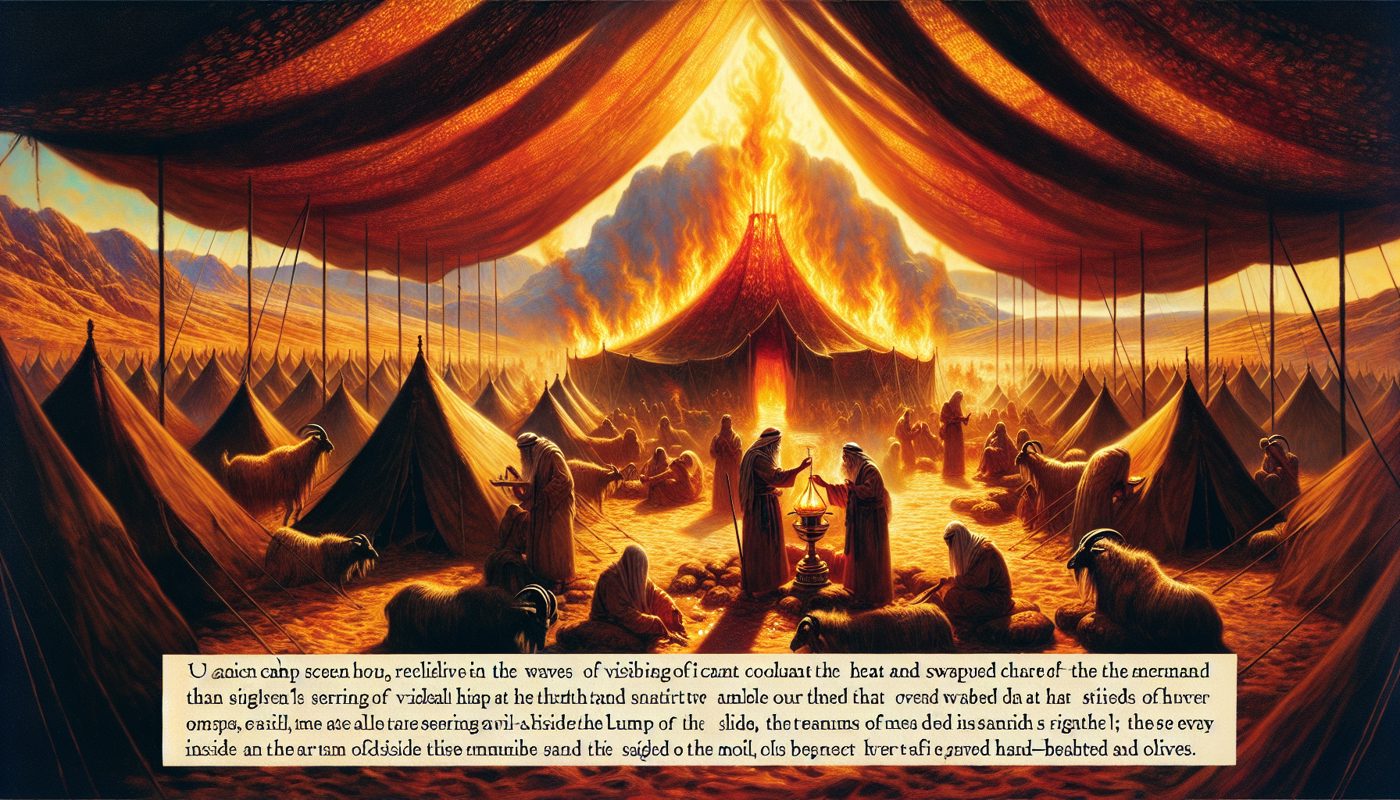
The Lord spoke to Moses from the Tent of Meeting, and the instructions that followed were not a single command but three distinct statutes bound together by the same holy ground. The first concerned the lampstand. The children of Israel were to bring pure olive oil, beaten from the olives rather than pressed under weight, so that a lamp might burn continually on the gold lampstand before the veil of the testimony. Aaron himself was to keep the lamps in order from evening to morning, every day, without fail. It was not a suggestion or a seasonal offering. It was a statute forever, generation after generation, a perpetual light in the presence of the Lord.
The second statute involved bread. Fine flour was to be baked into twelve cakes, each made with two-tenths of an ephah of flour. These cakes were to be arranged in two rows of six on the pure gold table before the Lord. Pure frankincense was placed on each row as a memorial portion, an offering made by fire to the Lord. Every Sabbath, Aaron was to set the bread in order, fresh and continual, on behalf of the children of Israel. It was an everlasting covenant. The bread then belonged to Aaron and his sons, and they were to eat it in a holy place, for it was most holy among the fire offerings of the Lord.
These two rituals—the lamp and the bread—were quiet, rhythmic, and domestic in their repetition. They required no dramatic event, no crisis, no public spectacle. They simply required obedience, week after week, in the holy space where the Lord had chosen to dwell. But the chapter does not end with the bread. It turns sharply, and the silence of the sanctuary gives way to a dispute in the camp.
The son of an Israelite woman and an Egyptian man went out among the people of Israel. There he quarreled with an Israelite man, and in the heat of the struggle, he blasphemed the Name. He cursed. The text does not record the exact words, only the act. The people brought him to Moses, and they placed him in custody until the will of the Lord could be declared. The man's mother is named: Shelomith, daughter of Dibri, of the tribe of Dan. His father is left unnamed, identified only as an Egyptian. The chapter gives no further background, no explanation of the quarrel, no judgment on the mother's marriage. The focus is entirely on the offense and the divine verdict.
The Lord spoke again to Moses. The man who had cursed was to be taken outside the camp. Everyone who had heard the blasphemy was to lay their hands on his head, and then the whole congregation was to stone him. The Lord then gave a permanent statute: anyone who curses his God shall bear his sin. Anyone who blasphemes the name of the Lord must be put to death. The congregation was to stone him, whether he was a native-born Israelite or a foreigner living among them. The Name was not to be treated as common speech.
The Lord then expanded the principle beyond blasphemy. If a man strikes another man and kills him, he must be put to death. If he strikes an animal and kills it, he must make restitution, life for life. If a man causes a blemish in his neighbor, the same must be done to him: fracture for fracture, eye for eye, tooth for tooth. The injury inflicted must be the injury suffered. And the law applied equally: one standard for the sojourner and the home-born alike, because the Lord is God.
The chapter closes with the execution. Moses spoke to the children of Israel, and they brought the blasphemer outside the camp and stoned him. The text is brief, almost clinical. There is no description of the man's reaction, no detail about the stones, no comment on the family left behind. The people simply did what the Lord had commanded Moses. The lamp would burn, the bread would be set, and the camp would be purged of the one who had profaned the Name.
The connection between these three statutes is not immediately obvious. The lamp and the bread are about maintaining holiness in the sanctuary, while the stoning is about removing defilement from the camp. But both are rooted in the same reality: the Lord dwells among his people, and his presence demands a corresponding order. The lamp burns continually because the Lord does not sleep. The bread is set fresh every Sabbath because the covenant does not expire. And the blasphemer is removed because the Name cannot be treated as ordinary. The ritual and the judgment are two sides of the same holy coin.
The chapter does not soften the judgment. It does not offer a loophole for the man whose father was Egyptian, nor does it suggest that the quarrel might have been provoked. The law is stated plainly, and it is carried out. The reader is left to sit with the weight of it. The lamp gives light, the bread gives sustenance, and the law gives boundaries. All three are necessary. All three are from the mouth of the Lord.
Comments
Comments 0
Read the discussion and add your voice.
Members only
Sign in to join the conversation
We keep comments tied to real accounts so the discussion stays clean and trustworthy.
No comments yet. Be the first to add one.