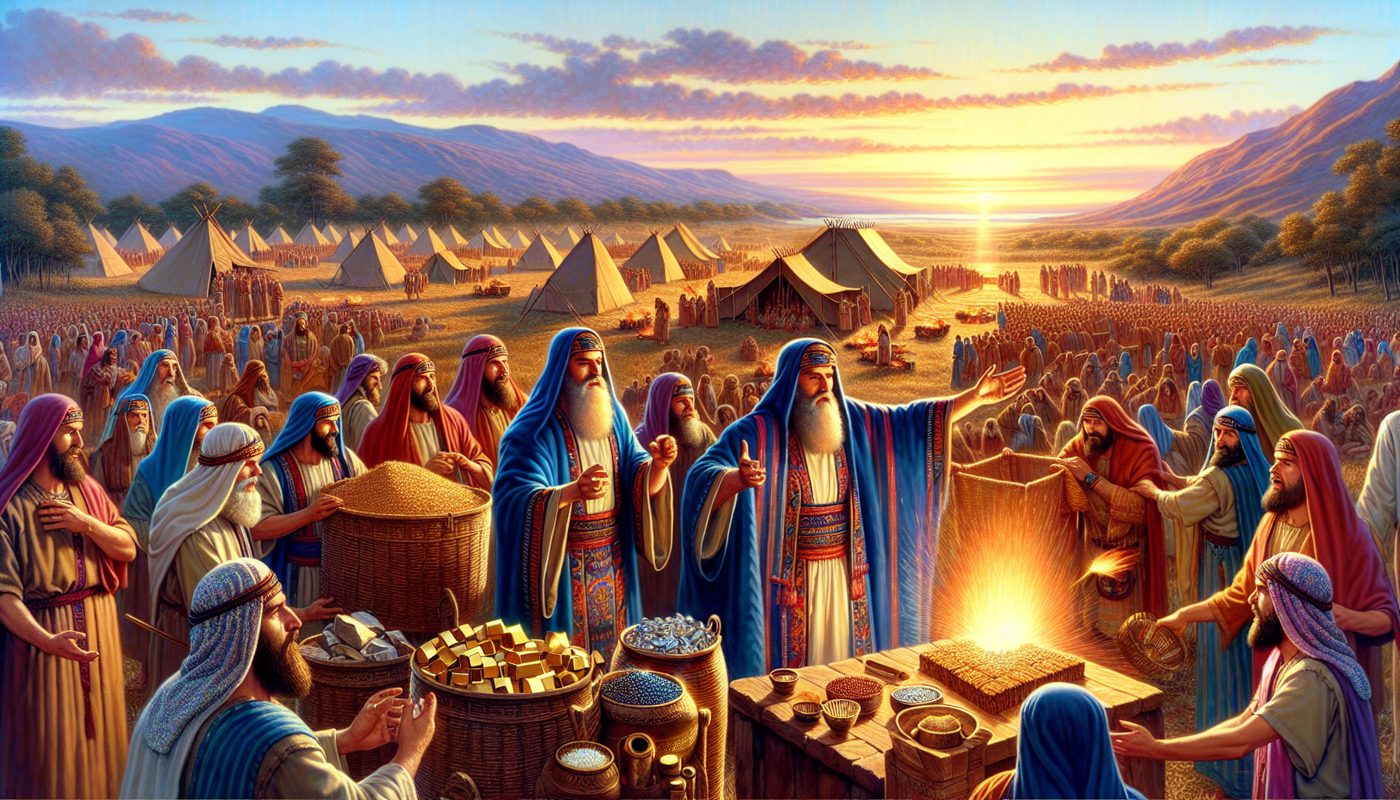
Exodus 36 opens with a problem that most building projects would envy: the people had brought too much. The freewill offerings that arrived every morning piled up so quickly that the craftsmen—Bezalel, Oholiab, and every wise-hearted man whom the Lord had filled with wisdom—had to stop working and go talk to Moses. They said plainly, “The people bring much more than enough for the service of the work which the Lord commanded to make.”
Moses responded by sending a proclamation through the camp: no man or woman should bring any more offerings for the sanctuary. The people were restrained from bringing. The text states it bluntly: “For the stuff they had was sufficient for all the work to make it, and too much.” That is the only moment in the Torah where a collection for the Lord had to be halted because the supply exceeded the need.
With the materials secured, the wise-hearted men began the actual construction. They started with the tabernacle itself, making ten curtains of fine twined linen dyed blue, purple, and scarlet, each one embroidered with cherubim by a skilled workman. Every curtain measured twenty-eight cubits long and four cubits wide—identical dimensions so that nothing would be mismatched when coupled together.
Bezalel coupled five curtains together into one set, and the other five into a second set. He attached fifty loops of blue thread along the edge of the outermost curtain in each set, then fastened them with fifty gold clasps. When the clasps were joined, the two sets became one unified tabernacle covering.
Above that inner layer, he made a tent of goats’ hair—eleven curtains, each thirty cubits long and four cubits wide. Five curtains were coupled together, and six separately. Again fifty loops were made on the edges, but this time the clasps were bronze, not gold. Over that tent he placed a covering of rams’ skins dyed red, and above that a covering of sealskins.
The structural frame consisted of upright boards of acacia wood. Each board stood ten cubits tall and one and a half cubits wide, with two tenons at the bottom. For the south side, twenty boards were set into forty silver sockets—two sockets per board. The north side received the same arrangement. For the western rear, six boards were made, plus two corner boards that were double at the bottom and joined at the top with a single ring. In total, eight boards for the rear, each with two silver sockets—sixteen sockets.
He made bars of acacia wood to hold the boards together: five bars for the south side, five for the north, and five for the rear. The middle bar ran from one end to the other through the center of the boards. He overlaid the boards with gold, cast gold rings to hold the bars, and overlaid the bars with gold as well.
Inside the tabernacle, he made the veil—blue, purple, scarlet, and fine twined linen, embroidered with cherubim by a skilled workman. He set it on four pillars of acacia wood overlaid with gold, with gold hooks and four silver sockets. Finally, he made a screen for the door of the tent, also of blue, purple, scarlet, and fine twined linen, but this one was the work of an embroiderer. It hung on five pillars overlaid with gold, their capitals and fillets gilded, and their five sockets cast from bronze.
The chapter never pauses to admire the beauty. It simply records that the people gave until they were told to stop, and then the craftsmen built exactly what the Lord had commanded—no more, no less. The gold, the silver, the bronze, the acacia wood, the linen, the skins, the clasps, the sockets—everything was measured, coupled, and assembled according to the pattern. The work itself became the restraint on the giving.
Comments
Comments 0
Read the discussion and add your voice.
Members only
Sign in to join the conversation
We keep comments tied to real accounts so the discussion stays clean and trustworthy.
No comments yet. Be the first to add one.