
The silence was the worst part.
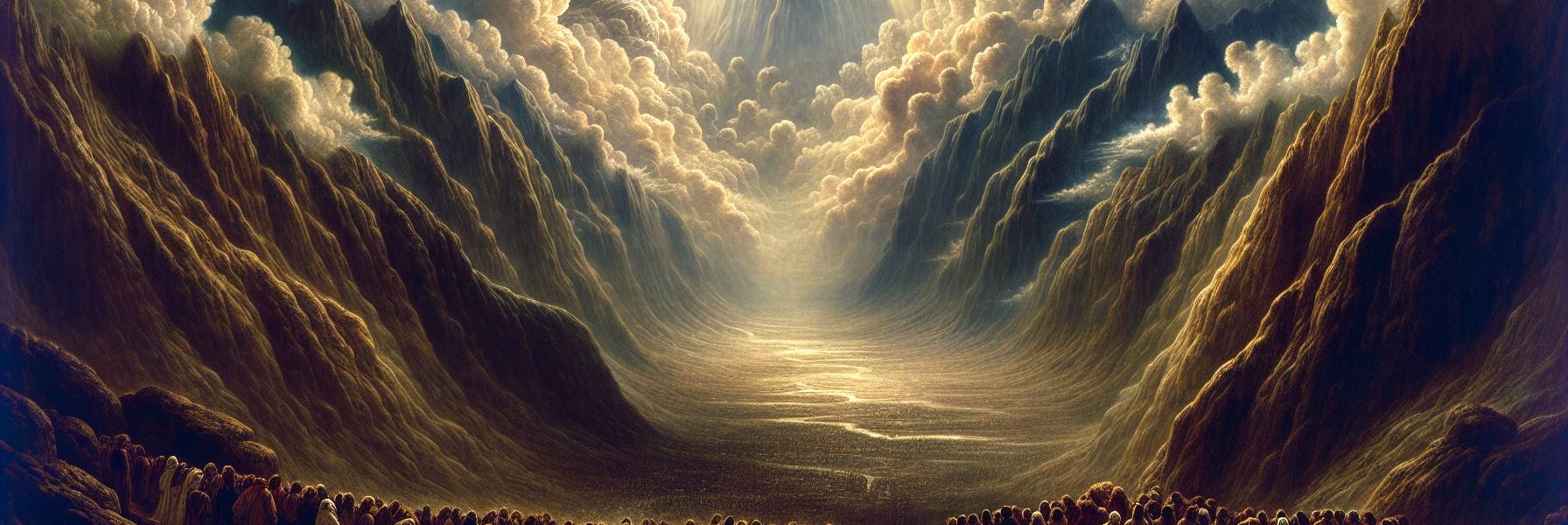
For forty days, the mountain had been a living thing—wreathed in a cloud that throbbed with a deep, unsettling light, trembling at its roots with a sound like a perpetual, low thunder. The air tasted of ozone and awe. Moses was up there, somewhere in that seething darkness, and the people had kept their distance, hearts in their throats.
But forty days is a long time to live on the edge of terror. The silence, when it finally settled, was heavier than the noise. It was a void. It pressed down on the camp, a physical weight of absence. Moses was not coming back. The man who spoke to God, who carried the thunder in his voice, had been consumed. This was the unspoken consensus that spread through the thousands by the third day of quiet. The God who had brought them out with a mighty hand had withdrawn it, leaving them stranded in this terrible wilderness with nothing but a memory of power.
They came to Aaron in clusters, their faces etched with a fear that was starting to curdle into something like resentment. Their words tumbled over one another. “Make us gods who will go before us. As for this Moses, the man who brought us up out of Egypt, we do not know what has become of him.”
Aaron looked at them, his brother’s brother, the smooth-tongued one left in charge. He saw the animal panic in their eyes, the way their hands clutched at nothing. He felt the vast, empty sky and the silent, accusing mountain. His own faith, so often bolstered by Moses’ unwavering certainty, was a thin reed in this wind. He feared the people more, in that moment, than he feared the God on the mountain. A riot here, now, would scatter them to the dunes and the predators.
“Take off the gold rings that are on the ears of your wives, your sons, and your daughters,” he heard himself say, his voice sounding strangely calm, “and bring them to me.”
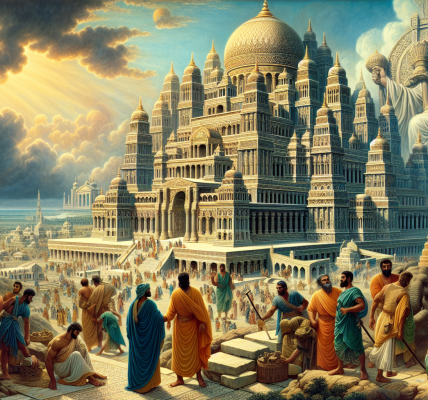
It was a delay, a task to occupy their frantic energy. He thought, perhaps, they would balk at parting with the last trinkets of their Egyptian wealth. He was wrong. The people stripped the gold from their families with a desperate alacrity, a hope of exchange—their tangible gold for a tangible god. The pile before Aaron’s tent grew, a gleaming, discordant mound of crafted suns and river reeds, of serpents and lotus flowers, all the iconography of a world they claimed to have left behind, melted down now into one anonymous, promising mass.
Aaron took it, his hands trembling not with piety but with a dreadful practicality. He fashioned it with a graving tool. He did not see the form of a bull from the Nile pastures, but something sturdier, older—a young bull, a calf, a symbol of virile strength from the Canaanite highlands they vaguely hoped to one day see. It was not meant to replace the Lord, he told himself in the frantic workshop of his mind. It was to be a seat, a focus, a *thing* to look at so they would not have to stare into the abyss of the silent mountain. “These are your gods, O Israel,” he announced as the work was set up, “who brought you up out of the land of Egypt!”
He saw the relief flood their faces. Something to see. Something to touch. A center for their lost community. He built an altar before it, seeking to channel this raw energy into a familiar shape. “Tomorrow shall be a feast to the Lord,” he declared, grafting the sacred name onto this new and dreadful project.
The feast began at dawn. It was not solemn. It was a release. The tension of weeks, of months, of a lifetime of slavery followed by a terrifying freedom, burst its banks. They brought burnt offerings and peace offerings. They sat down to eat and they rose up to play. But the “play” was not innocent. It was the riot Aaron had feared, now dressed in religious garb. It was a frenzied, chaotic revel, the music not of holy celebration but of raw, unrestrained id. The dancing lost its pattern, becoming something primal and suggestive. The air, which had been so still and silent, was now thick with the smells of roasting meat, spilled wine, sweat, and the metallic scent of the golden calf itself, glowing dully in the desert sun.
And the Lord said to Moses, on the mountain, “Go down, for your people, whom you brought up out of the land of Egypt, have corrupted themselves.”
The descent was a pilgrimage of wrath. Joshua, waiting partway down, heard the noise and thought it was the sound of war. Moses, his face still carrying the faint, terrifying afterglow of the Presence, knew better. “It is not the sound of shouting for victory, or the sound of the cry of defeat,” he said, his voice hollow, “but the sound of singing that I hear.”
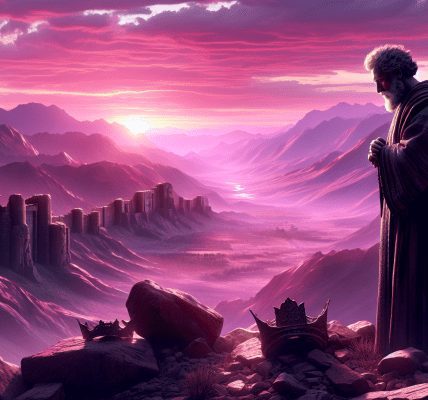
He came over the final ridge, the two tablets of stone in his hands—not mere rock, but something denser, inscribed by the very finger of God with the terms of a covenant. And he saw the calf, and the dancing. His anger burned hot, a white, righteous fury that mirrored the divine fury he had just been interceding against. His hands opened. The tablets fell from his hands and shattered at the base of the mountain. The sound they made was not the crack of ordinary stone, but a deep, final sundering, like the breaking of the world’s foundation.
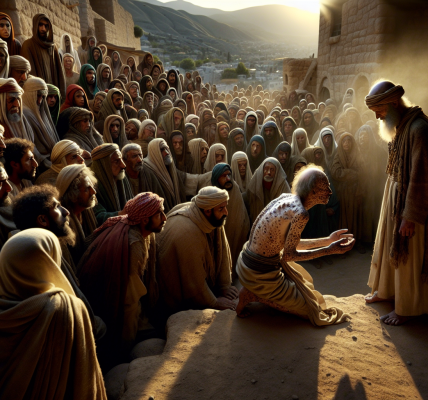
He strode into the camp, a lone figure of wrath. He seized the calf they had made, dragged it to a fire. He burned it, but gold does not burn; it melts. He took the grim, molten lump, ground it into a powder finer than desert dust, scattered it on the water, and made the people of Israel drink it. The taste of their own idolatry was a metallic grit on their tongues.
He turned on Aaron, his voice a lash. “What did this people do to you, that you have brought such a great sin upon them?”
Aaron’s response was the masterpiece of a terrified man, a jumble of truth and evasion. “Do not let the anger of my lord burn hot,” he pleaded, the political survivor re-emerging. “You know the people, that they are set on evil. They said to me, ‘Make us gods…’ And I said to them, ‘Let any who have gold take it off.’ So they gave it to me, and I threw it into the fire, and out came this calf.” The lie was breathtaking in its childishness, denying his own craftsmanship, making the horror sound like a magical accident.
Moses saw the people were naked, exposed not just physically in their revelry, but spiritually, stripped of the dignity of the covenant now lying in shards. He stood at the gate of the camp, his voice cutting through the hungover silence. “Who is on the Lord’s side? Come to me.”
It was the Levites who came, clustering around him, their faces ashen. What followed was a day of terrible, clarifying violence, a surgery performed with the sword to save the body. It was not celebrated. It was mourned. The camp was left in a stunned, bloodied silence, the sounds of revelry replaced by the low weeping of families torn apart.
The next day, Moses climbed the mountain again, his soul heavier than any stone tablet. His words to God were not a plea for the people, but a broken confession for himself. “Alas, this people have sinned a great sin. But now, if you will forgive their sin—and if not, please blot me out from your book that you have written.”
The answer came, a whisper of terrible grace. The guilty would bear their guilt. The journey would continue. But the Presence would no longer go among them in the same way, lest it consume them utterly in their frailty. The covenant was mended, but it was scarred. And when Moses came down again, his face shone with a light he did not know he carried, a reflected glory so frightening he had to veil it. They had wanted a god they could see, a god of gold. Now they had a leader whose very face was a blinding reminder of the God they could not see, and the distance, both bridged and widened, between holiness and the human heart.