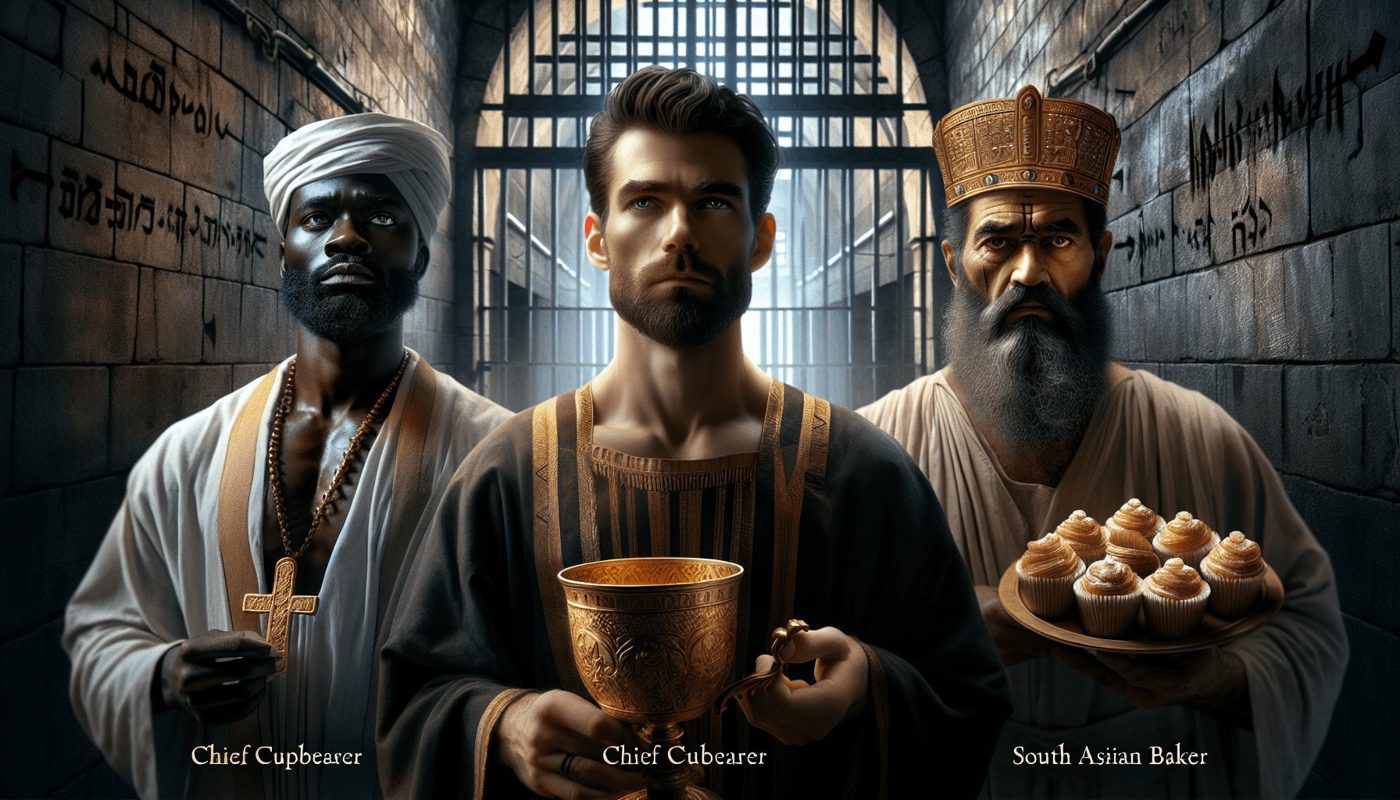
Two officers of Pharaoh, the chief cupbearer and the chief baker, found themselves in prison after offending their king. The captain of the guard, who had charge of Joseph, assigned the Hebrew slave to attend to them. For a season they remained in the same ward, bound by the king's displeasure.
One night both men dreamed, each a distinct dream with its own meaning. When Joseph came to them in the morning, he saw they were troubled. He asked why their faces were so sad. They answered that no one could interpret their dreams. Joseph replied that interpretations belong to God, and he asked them to tell him the dreams.
The chief cupbearer spoke first. In his dream, a vine with three branches budded, blossomed, and produced ripe grapes. He took the grapes, pressed them into Pharaoh's cup, and placed the cup in Pharaoh's hand. Joseph interpreted: the three branches were three days. Within three days Pharaoh would lift up the cupbearer's head and restore him to his office, where he would again give the cup into the king's hand.
Joseph then asked the cupbearer to remember him when things went well, to show kindness and mention him to Pharaoh, so he might be brought out of this house. He explained that he had been stolen from the land of the Hebrews and had done nothing to deserve the dungeon.
The chief baker, seeing the favorable interpretation, told his own dream. He carried three baskets of white bread on his head. In the uppermost basket were all kinds of baked food for Pharaoh, but birds ate them from the basket. Joseph gave the interpretation: the three baskets were three days. Within three days Pharaoh would lift up the baker's head—from off him—and hang him on a tree, where birds would eat his flesh.
On the third day, which was Pharaoh's birthday, the king made a feast for all his servants. He lifted up the head of the chief cupbearer and the head of the chief baker. The cupbearer was restored to his butlership and gave the cup into Pharaoh's hand. The baker was hanged, just as Joseph had interpreted.
The chief cupbearer did not remember Joseph. He forgot him.
The chapter ends with that silence. Joseph had spoken plainly, asked for nothing more than a mention, and received nothing. The cupbearer walked out of the prison into the light of the palace, and Joseph stayed in the dark. There is no divine intervention here, no sudden reversal, no angelic message. Only the precise fulfillment of the dreams and the bitter weight of a forgotten promise.
The story does not explain why the cupbearer forgot. It does not soften the blow. It simply records the fact, leaving the reader to sit with Joseph's continued waiting. The dreams were true, but the favor did not follow.
Comments
Comments 0
Read the discussion and add your voice.
Members only
Sign in to join the conversation
We keep comments tied to real accounts so the discussion stays clean and trustworthy.
No comments yet. Be the first to add one.