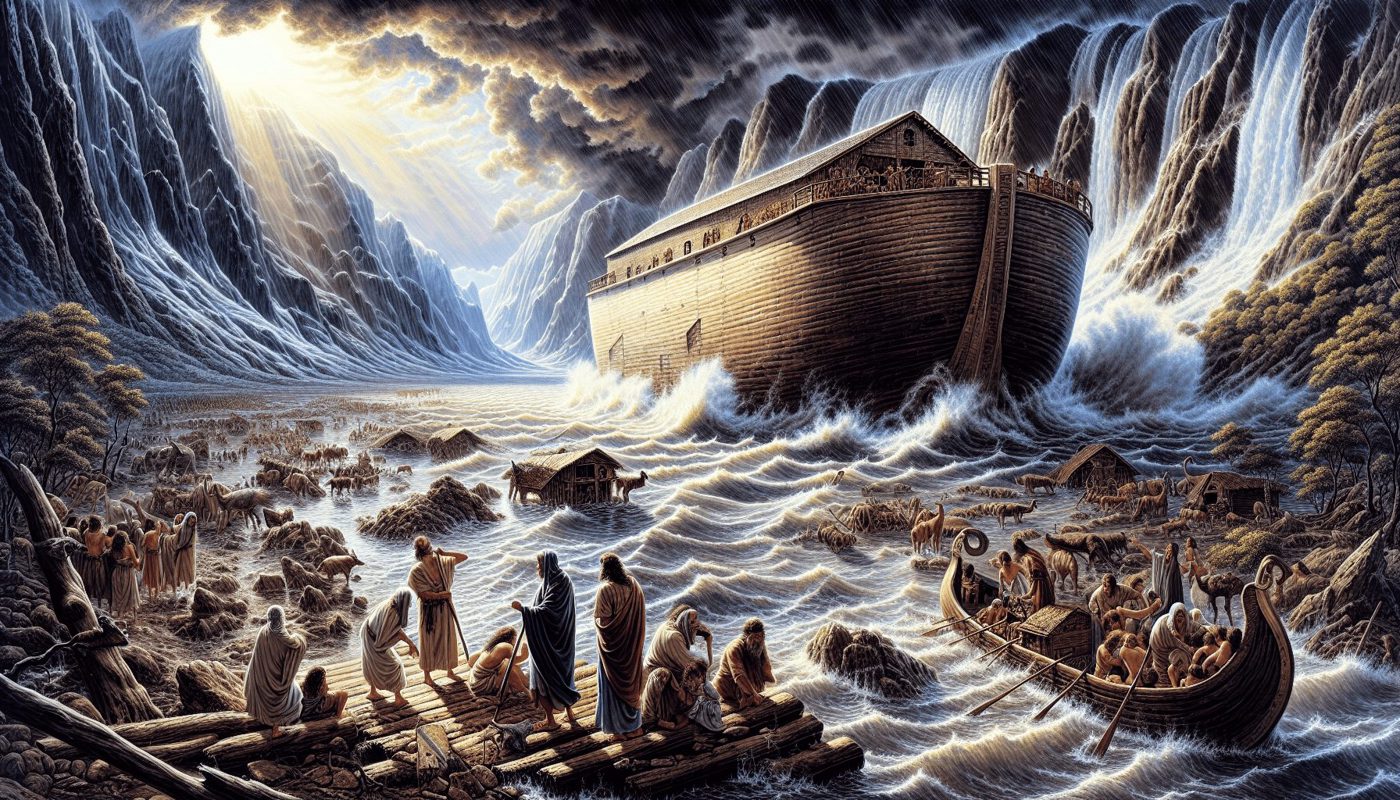
The flood had not ended in a single moment. It receded in stages, measured in months and days, and the text records each marker with the precision of a ship's log. In the seventh month, on the seventeenth day, the ark grounded on the mountains of Ararat. In the tenth month, on the first day, the mountain tops broke the surface. The waters did not vanish; they withdrew, slowly, as if the earth itself were being uncovered by a hand that knew exactly when to stop.
Noah did not leave the ark when the mountains appeared. He waited. He opened a window he had built into the vessel and sent out a raven. The bird flew back and forth, scavenging, never returning to the ark. It found enough on the emerging land to survive. Then Noah sent a dove, a bird that needs dry ground to rest. The dove found no place for its feet and came back. Noah reached out his hand, took the dove, and brought it back inside.
He waited seven more days. He sent the dove again. This time it returned at evening with an olive leaf freshly plucked in its beak. That leaf was not a symbol of peace in the way later ages would use it. It was evidence: the waters had dropped enough for trees to emerge, for leaves to grow, for the earth to begin producing again. Noah knew then that the flood was truly receding.
He waited another seven days. He sent the dove a third time, and it did not return. The dove had found dry ground to rest on, and it stayed there. Noah did not leave the ark yet. He waited until the first day of the first month of his six hundred and first year, when he removed the covering of the ark and looked out. The ground was dry. But he did not step out. He waited until the twenty-seventh day of the second month, when the earth was fully dry.
Then God spoke to Noah. The same voice that had shut him in now commanded him to go out: Noah, his wife, his sons, their wives, and every living thing that had been with him in the ark. The command was not simply to exit. It was to bring out every creature so that they might breed abundantly on the earth, be fruitful, and multiply. The ark had been a vessel of preservation; the dry ground was to become a place of renewal.
Noah obeyed. He and his family walked out, and every beast, every creeping thing, every bird, went out after their families. The text does not describe the scene as triumphant. It simply records that they went forth, each according to its kind, and the ark emptied onto a world that had been washed clean.
Noah built an altar to the Lord. He took from every clean animal and every clean bird and offered burnt offerings on that altar. The Lord smelled the pleasing aroma. Then the Lord spoke in his heart, making a decision that would shape the rest of human history. He said he would never again curse the ground because of man, even though the imagination of man's heart is evil from his youth. He would never again strike down every living thing as he had done.
The promise was not based on human improvement. It was grounded in the Lord's own resolve. He knew what humans were like, and he chose to sustain the world anyway. The seasons would continue: seedtime and harvest, cold and heat, summer and winter, day and night. The earth would remain stable, not because humanity deserved it, but because the Lord had made a decision in his own heart.
Noah stepped onto dry ground into a world that had been emptied and was now being repopulated. The flood had not changed human nature. The same heart that had filled the earth with violence before the flood was still there, in Noah and his sons. But the Lord had set a boundary. He would not destroy the earth again by water. The rhythm of creation would hold, and the altar on the mountain marked the place where that promise was first received.
Comments
Comments 0
Read the discussion and add your voice.
Members only
Sign in to join the conversation
We keep comments tied to real accounts so the discussion stays clean and trustworthy.
No comments yet. Be the first to add one.