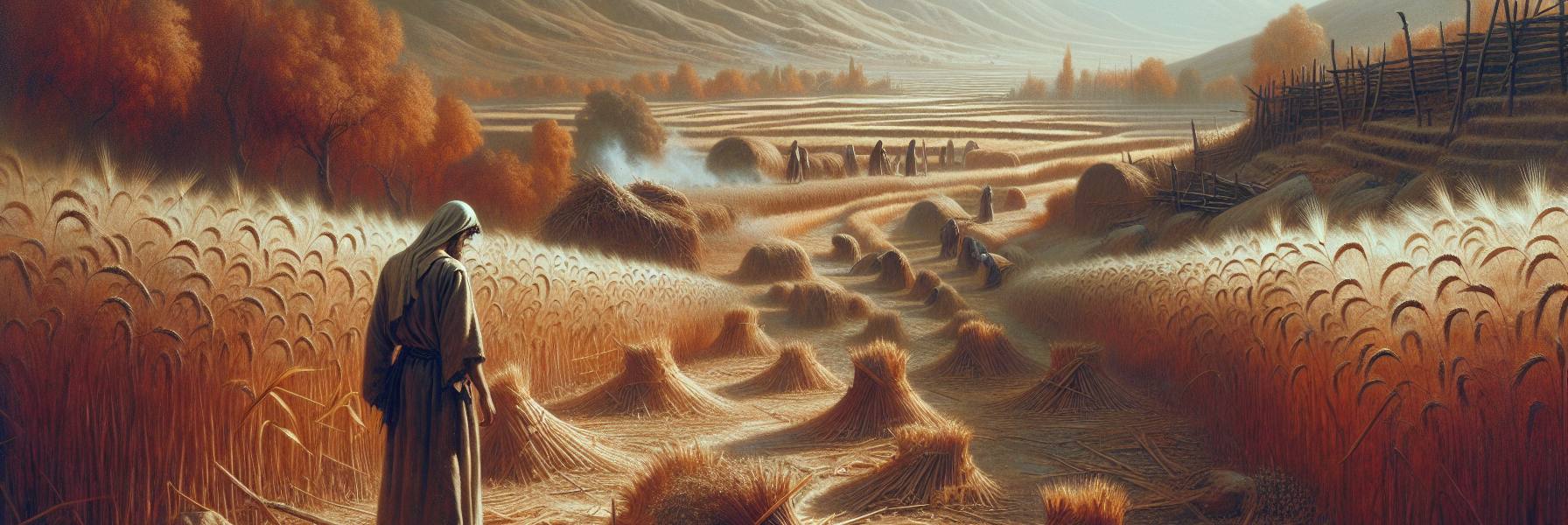

The memory of that last autumn in the hill country of Ephraim is a bitter root in my mouth, even now. The heat had broken, but not the drought. A brittle, copper light lay over the land, and the air smelled of dust and dry thyme. We were supposed to be rejoicing. The Feast of Ingathering was upon us, the threshing floors should have been heaped with grain, the vats bubbling with new wine. But the threshing floors were empty, silent places where the wind stirred only chaff and despair.
My cousin Micah, a man whose shoulders had once been broad from wrestling sheaves onto the cart, stood at the edge of his field. He didn’t look at the ruined barley, stalks stunted and heads blighted. He looked toward the high place at Bethel, where the smoke of a sacrifice still curled lazily into the pale sky. His voice was a dry rasp, not much louder than the rustle of the dead plants.
“They call it a feast,” he said, not to me, perhaps to the God he no longer understood. “But the Lord takes no pleasure in our gatherings now. The bread is mourning bread; all who eat it are defiled. It’s for our own stomachs only. It will not enter the house of the Lord.”
He was right. A pall hung over us, heavier than the heat. The festivities were a ghost of what they had been. The laughter was too sharp, the songs too forced. We ate, but the food tasted of ash. We’d played the harlot, as the prophet said, forsaking our first love for the baals of the land, for the politics of Egypt and Assyria, chasing after the wind of foreign alliances. We’d sown the wind for generations, and now we were reaping the whirlwind. The temple itself, the place of His presence, felt abandoned. It was as if the Shekinah had drawn back, a silent, grieving parent watching a child destroy itself.
The signs were everywhere, if you had eyes to see. In the shriveled grapes that wept no juice. In the young women who did not flower, their wombs still as stone. In the hollow eyes of the children, who seemed to sense the coming darkness. The prophet Hosea’s words echoed in the quiet places: *They shall not dwell in the Lord’s land*. It was no longer just a warning; it was a diagnosis. The sickness was in us, and the land itself was vomiting us out.
I remember the day the Assyrian traders came through, a small, grim caravan on the ridge road. They didn’t stop to barter. They looked at our fields, our listless people, with the cold appraisal of future landlords. A chill went through me that had nothing to do with the coming evening. Egypt had been a broken reed, piercing the hand that leaned on it. Assyria? Assyria was an iron net. We had become, in our folly, a silly dove, fluttering between them, lost and easily snared. The prophet’s lament was our national epitaph, written in advance: *Woe to them, for they have strayed from me! Destruction to them, for they have rebelled against me!*
The worst of it was the silence. Not a peaceful quiet, but the silence of a judge who has heard all the evidence and is now merely waiting to pronounce sentence. The prophets were not speaking visions of shalom anymore. They were watchmen set over a city already burning, their cries drowned by the crackle of the flames. They were fishers who cast their nets only to bring up the stinking, polluted catch of our own iniquity. There was a madness in the air, a spirit of deep confusion. Men who had been wise now championed folly. Leaders offered sacrifices to gods of bronze and stone, begging for rain from things that had no breath, while turning their backs on the fountain of living water.
And so the exile began, not with a single trumpet blast of invasion, but with a slow, relentless draining. First the hope went. Then the young men, conscripted or lost to despair. Then the sense of belonging. The land of milk and honey became a land of thorns and thistles, a mirror of our own inner desolation. We would be wanderers among the nations, strangers eating unclean food, our holy days forgotten, our songs unsung. The treasured children of Abraham would become a byword, a curiosity, their God a subject of mocking songs in taverns by the great rivers of the east.
Sometimes, in the deep watch of the night, I think I hear it—not the shout of a victor, but the low, terrible groan of a husband betrayed, a father wounded. *Ephraim is stricken; their root is dried up; they shall bear no fruit.* It was the grief of Holy Love, choosing for a time to wear the mask of the Avenger. The love was still there, underneath the necessary, terrible wrath. That was the most devastating truth of all. Our punishment was not the caprice of a distant deity, but the dreadful, intimate consequence of spurning a love so fierce, so faithful, it would rather see us broken and remade than let us peacefully rot in our adultery.
That last autumn taught me this: God’s judgement is not the opposite of His love. It is its darkest, most mysterious expression. And in the empty threshing floor, in the silent high place, in the barren womb, His rejected love echoed louder than any festival choir ever had.