The chapter opens with a vision of a king who reigns in righteousness and princes who rule in justice. This is not a description of any current throne in Jerusalem. It is a picture of what is missing, what is promised, and what the land has not seen. The man who comes with that reign will be a hiding place from the wind, a covert from the tempest, streams of water in a dry place, the shade of a great rock in a weary land. The language is concrete. It names the conditions of the land—wind, tempest, dryness, weariness—and offers not an idea but a person who functions as shelter.
Then the chapter shifts to what that shelter produces in the people. The eyes of those who see will not be dim. The ears of those who hear will listen. The heart of the rash will understand knowledge. The tongue of the stammerers will be ready to speak plainly. These are not cosmetic changes. They are the restoration of human capacity. The fool will no longer be called noble, nor the churl said to be bountiful. The labels will match the reality. The chapter insists that words and worth will realign.
The reason for this realignment is that the fool and the churl have been misnamed. The fool speaks folly and works iniquity, practicing profaneness and uttering error against the Lord. He makes empty the soul of the hungry and causes the drink of the thirsty to fail. The churl devises wicked devices to destroy the meek with lying words, even when the needy speaks what is right. These are not abstract sins. They are the sins of those who control food, water, and speech in a time of scarcity. The chapter does not name the officials, but it names their crimes.
The noble, by contrast, devises noble things and continues in them. The chapter draws a hard line. There is no middle ground. There are those who use their position to starve the hungry and silence the needy, and there are those who act with nobility. The chapter does not explain how to become noble. It simply states that nobility persists in noble things.
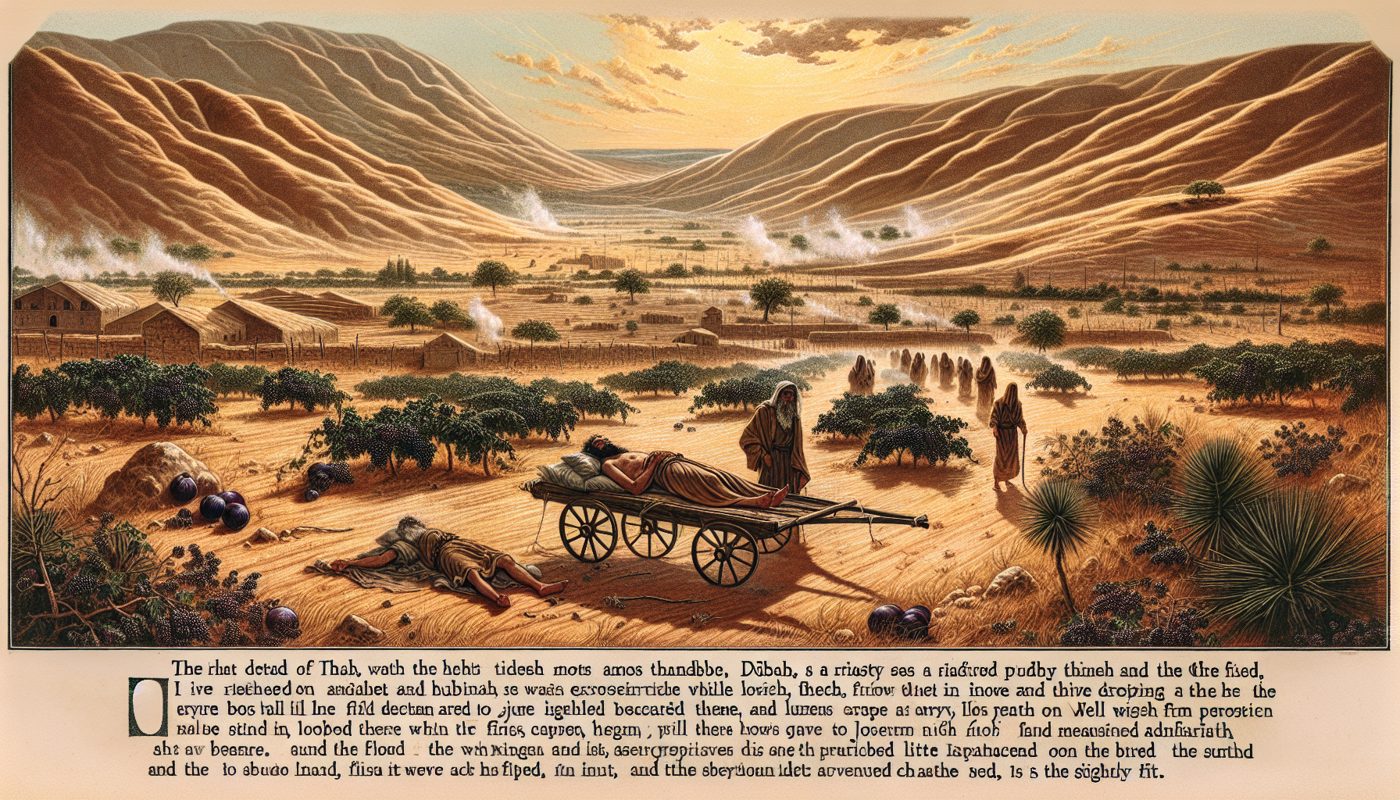
Then the prophet turns to the women who are at ease, the careless daughters. He tells them to rise up and hear his voice. He gives them a timeline: days beyond a year. The vintage will fail. The ingathering will not come. He tells them to tremble, to strip themselves, to put on sackcloth. They will beat their breasts for the pleasant fields and the fruitful vine. The chapter does not soften this. It does not explain why the women are singled out. It simply records the command to mourn before the collapse arrives.
The collapse is described in physical terms. Upon the land of the Lord's people will come up thorns and briers, upon all the houses of joy in the joyous city. The palace will be forsaken. The populous city will be deserted. The hill and the watchtower will become dens forever, a joy of wild asses, a pasture of flocks. The city that was full of noise and commerce and power will be empty. The chapter does not say how long this will last. It says it will last until something happens.
That something is the Spirit poured out from on high. When that happens, the wilderness becomes a fruitful field, and the fruitful field is esteemed as a forest. Then justice dwells in the wilderness, and righteousness abides in the fruitful field. The chapter does not say that the city is rebuilt. It says that the wilderness and the field become the places where justice and righteousness live. The geography of blessing shifts. The work of righteousness is peace, and the effect of righteousness is quietness and confidence forever. The people will abide in a peaceable habitation, in safe dwellings, in quiet resting places.
But the chapter does not end there. It adds a final note of judgment and blessing. It will hail in the downfall of the forest, and the city will be utterly laid low. And then, without transition: Blessed are those who sow beside all waters, who send forth the feet of the ox and the ass. The blessing is not for the city dwellers who trusted in palaces and officials. The blessing is for the sower, the one who works with the land and the animals, who sows where water is available. The chapter ends with a farmer's image, not a king's.
The chapter holds together a promise of a righteous king and a coming devastation that clears the ground for that king. It does not explain how the two fit in time. It simply sets them side by side. The king who shelters, the city that falls, the Spirit that falls, the sower who is blessed. The chapter does not resolve the tension. It lets the reader sit with it.
Comments
Comments 0
Read the discussion and add your voice.
Members only
Sign in to join the conversation
We keep comments tied to real accounts so the discussion stays clean and trustworthy.
No comments yet. Be the first to add one.