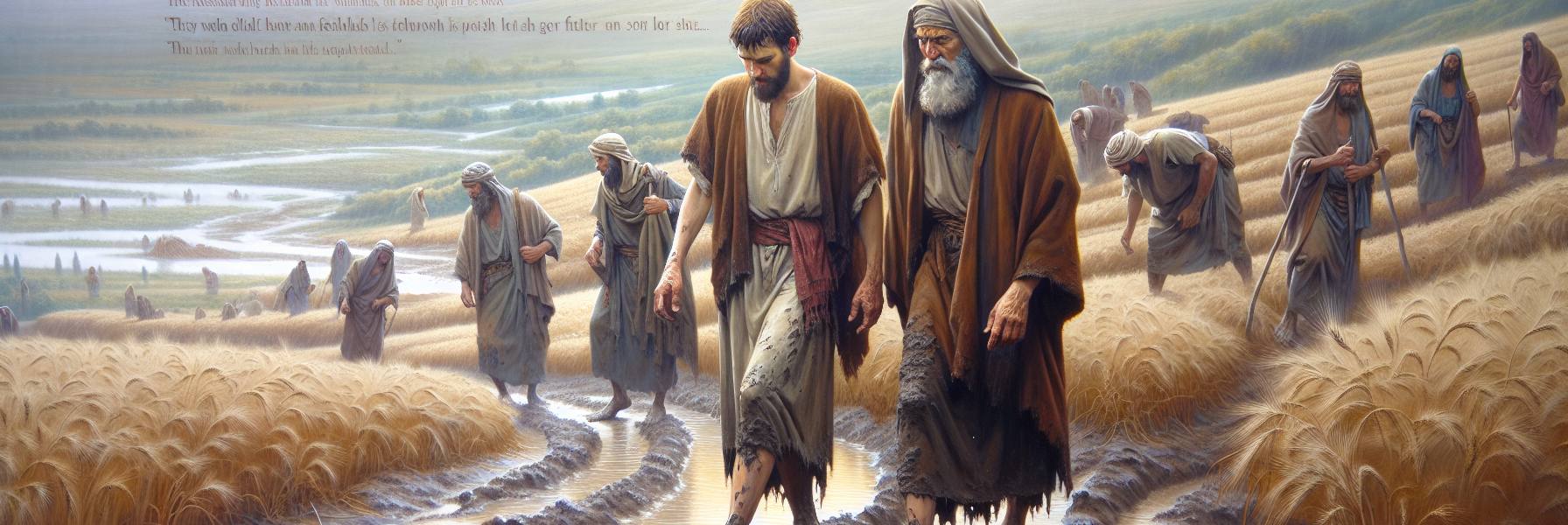

The rain had finally stopped, but the mud remained. It clung to the sandals of the men coming down from the hills, a thick, sucking clay that mirrored the heaviness in Jotham’s heart. He walked slowly behind his father, Elidad, the silence between them louder than the morning’s quarrel.
The verse from his morning reading echoed in his mind, unbidden: *A foolish son is ruin to his father.* He winced. The dispute had been over the north field, left fallow for a season. Jotham, seeing the early market prices for barley, had urged immediate sowing. Elidad, with the patience of a man who has outlasted three droughts, had refused. The discussion had curdled into argument, Jotham’s voice rising sharp and impatient, his father’s growing quiet and still. Now, they were going to see their neighbor, Zibeon, to borrow a ploughshare. It was a walk of shame.
They passed the well where the women gathered. Jotham caught the eye of Mara, Zibeon’s daughter. Her look was not unkind, but it held a question. He glanced away, his face hot. He knew what was said about him: clever, but hasty. A young man of knowledge, but not yet of understanding. Another fragment surfaced: *Desire without knowledge is not good, and whoever makes haste with his feet misses his way.*
Zibeon’s house was not as prosperous as theirs. The whitewash on the walls was thin, the courtyard packed earth, not stone. Yet Zibeon himself emerged with a smile that seemed to smooth the very air. He greeted Elidad with a deep respect that had nothing to do with wealth.
“My friend,” Zibeon said, clasping Elidad’s arm. “The ploughshare is yours. For as long as you need.”
Elidad offered payment. Zibeon waved it away. “What are neighbors for? Did you not send your son with a lamb when my own was sick last winter?”
Jotham remembered that. He had grumbled about the errand, the loss of a good animal. He saw now the economy of kindness that functioned silently, beneath the surface of silver and barley. *What is desired in a man is steadfast love.* The words settled in him like a stone sinking into a pond.
As they turned to leave, Zibeon’s brother, Korah, slouched against the gatepost. His tunic was stained, his eyes dull with yesterday’s wine.
“Lending again, Zibeon?” Korah’s voice was a sneer. “To those who have more than you? You’ll be ploughing your field with a stick.”
Zibeon’s smile didn’t fade, but it grew sorrowful. “Better a dry crust with peace, brother, than a house full of feasting with strife.”
Korah spat into the mud and shuffled away. The contrast was stark, a living proverb: *A lazy man buries his hand in the dish and will not even bring it back to his mouth.* Jotham saw the truth of it—Korah’s poverty was not of circumstance alone, but of spirit. His brother’s generosity, however, seemed to make him richer, not poorer.
The walk home was quieter, but the silence was different. The weight had shifted from Jotham’s shoulders to his mind. He watched his father’s steady back, the way his feet found firm ground even in the mire.
“Father,” he said, the word feeling new on his tongue. “About the north field.”
Elidad slowed, but didn’t stop.
“I was… hasty. I did not consider the soil. It needs the rest. You were right.”
Elidad stopped then. He looked at his son, not at the field or the sky, but directly into his face. The lines around his eyes were deep, etched by sun and years of judgment calls. *Many are the plans in the mind of a man, but it is the purpose of the Lord that will stand.* Jotham understood, suddenly, that his father’s caution was not fear, but a kind of listening—a patience to discern a purpose larger than the next market price.
“It is a hard thing,” Elidad said, his voice low, “to govern one’s own spirit. Harder than taking a city. Your knowledge is a good tool, Jotham. But it is a poor master. A false witness will not go unpunished, and he who breathes out lies will not escape. This is true not just in court, but in a man’s own soul, when he testifies to himself about his own wisdom.”
They walked on, the borrowed ploughshare resting on Elidad’s shoulder. As they neared their land, they saw old Naomi, the widow from the ridge, struggling with a bundle of kindling. Without a word, Elidad handed the ploughshare to Jotham and went to her. He took the heavy bundle, hefting it onto his own shoulder, and began walking with her toward her small hut. Jotham stood, holding the iron blade, watching.
His father did not look like a great man in that moment. He looked like a servant. And yet, in the economy Jotham was just beginning to comprehend, he looked like a king. *Whoever is generous to the poor lends to the Lord, and he will repay him for his deed.*
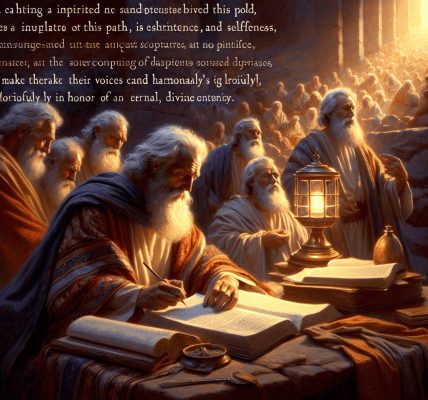
That evening, Jotham took his scroll and read the words of Proverbs 19 once more. But now, they were no longer just ink. They were the sucking mud, the sorrow in Zibeon’s smile, Korah’s stained tunic, the weight of a widow’s firewood on his father’s back. Each sentence was a face, a consequence, a quiet, relentless truth.
*The fear of the Lord leads to life,* the scroll ended. *And whoever has it rests satisfied; he will not be visited by harm.*
Harm had visited today, in the form of his own shame. But it had been a healing visitation. As the lamp flickered, Jotham felt not the satisfaction of a full stomach or a fat purse, but a different kind of fullness. It was the satisfaction of a path seen clearly, however hard the walking. He blew out the lamp, the images of the day settling in the dark. They were his commentary now, written not on parchment, but on the tablet of his own heart.