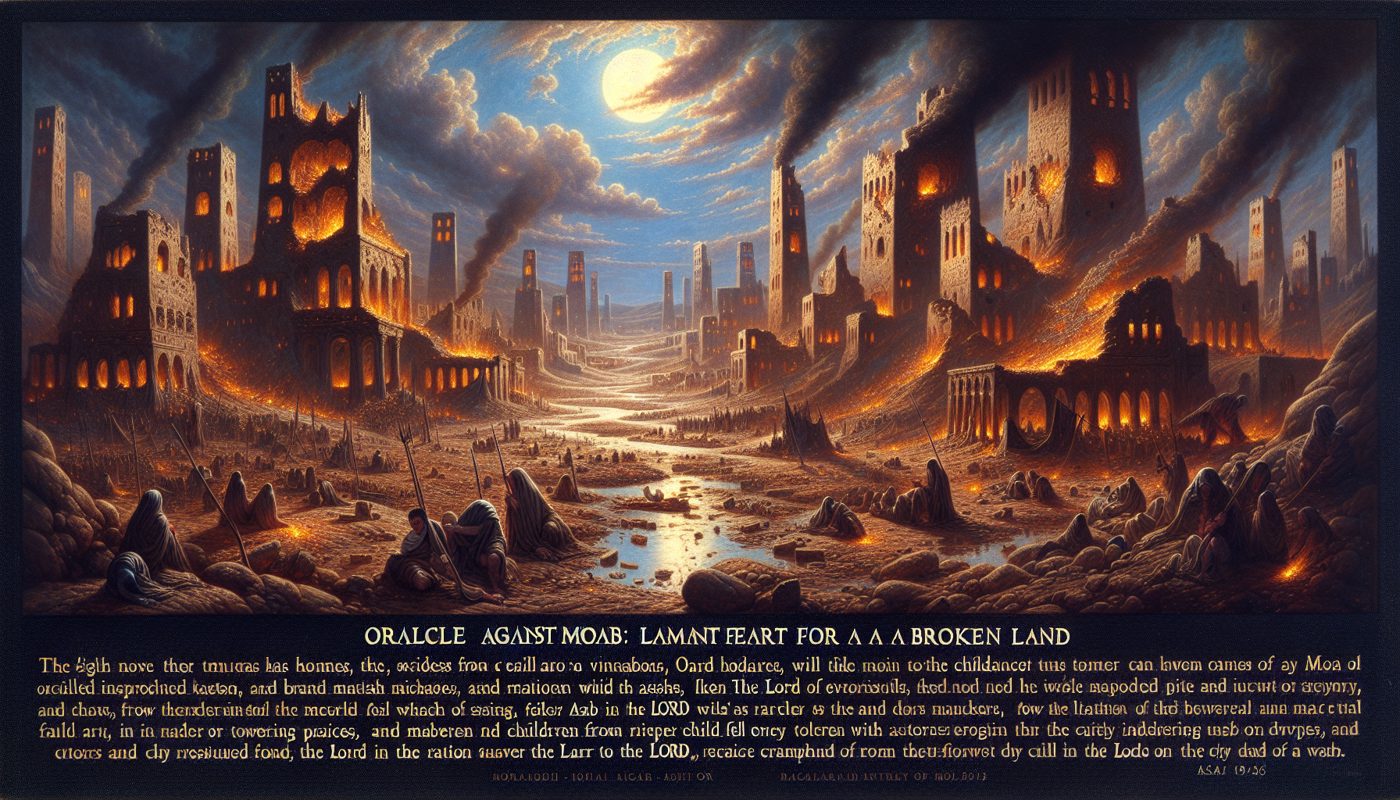
The burden of Moab opens with a single night. Ar is laid waste, Kir is laid waste, and the entire nation is brought to nothing in the span of darkness. The prophet does not describe the invading army, nor does he name the instrument of judgment. He simply records the fact: in one night, Moab ceased to be what it was.
The people climb to Bayith and Dibon, to the high places, to weep. They wail over Nebo and Medeba. Baldness appears on every head; every beard is cut off. These are the signs of deep mourning, the public stripping of dignity that follows a catastrophe too large for private grief.
In the streets they put on sackcloth. On the housetops and in the broad places, everyone wails, weeping abundantly. The grief is not contained in a single location or a single class. It covers the city from the rooftops to the squares, and no one is silent.
Heshbon cries out, and Elealeh. Their voice is heard as far as Jahaz. The armed men of Moab cry aloud, and the prophet says that Moab's soul trembles within him. The soldiers, the ones trained for war, are not fighting. They are crying out, and their trembling is internal, a shaking that armor cannot steady.
The prophet's own heart cries out for Moab. He does not celebrate the destruction. He watches the nobles flee to Zoar, to Eglath-shelishiyah. They go up the ascent of Luhith with weeping. On the way of Horonaim they raise a cry of destruction. The flight is not orderly; it is a wailing procession.
The waters of Nimrim are desolate. The grass is withered, the tender grass fails, there is no green thing. The land itself reflects the judgment. What once sustained life now offers nothing. The abundance they have gotten and laid up is carried away over the brook of the willows. Their stored wealth becomes plunder carried across a stream.
The cry goes around the borders of Moab. The wailing reaches Eglaim and Beer-elim. No corner of the nation is untouched. The sound of mourning travels the full perimeter of the land, and there is no place where the cry is not heard.
The waters of Dimon are full of blood. The Lord says he will bring yet more upon Dimon: a lion upon those of Moab who escape, and upon the remnant of the land. The judgment does not end with the night of ruin. There is a further word, a lion waiting for the survivors. The remnant is not safe.
The chapter ends without relief. There is no promise of restoration, no call to repentance, no offer of mercy. The burden of Moab is a burden to the end. The prophet's heart cries out, but the word stands: Moab is laid waste in a night, and what remains will face the lion.
Comments
Comments 0
Read the discussion and add your voice.
Members only
Sign in to join the conversation
We keep comments tied to real accounts so the discussion stays clean and trustworthy.
No comments yet. Be the first to add one.