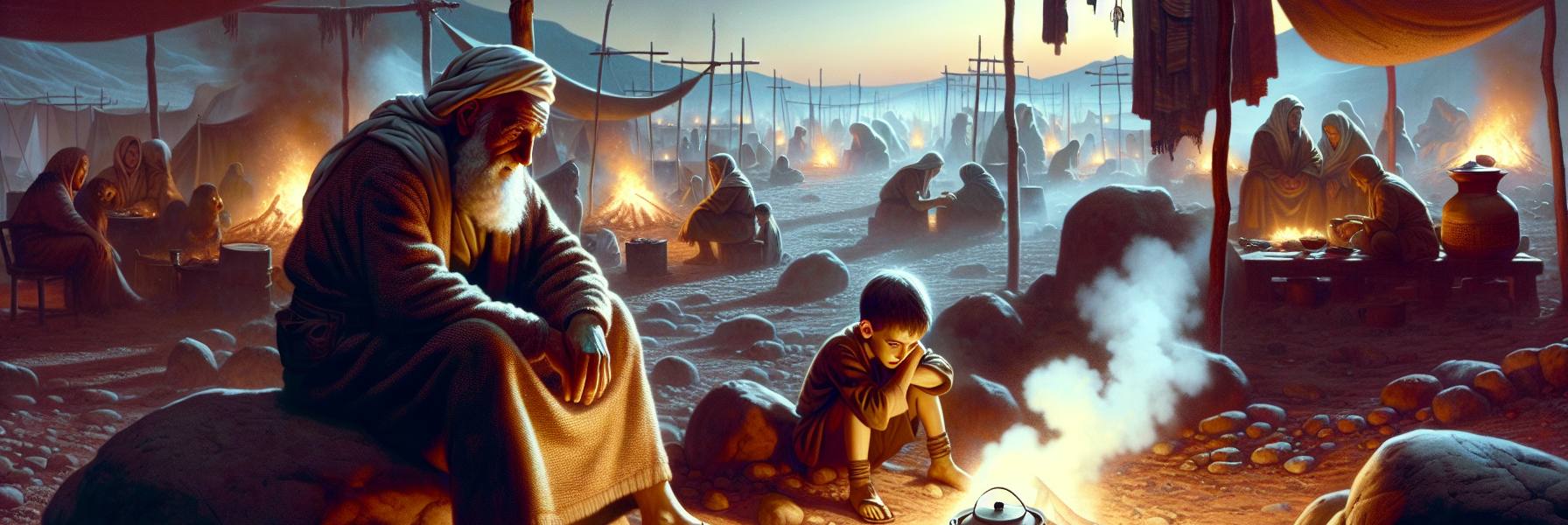

The heat hadn’t broken with the setting sun. It rose from the flinty ground in waves, carrying the scent of dust and crushed sage, of animals and humanity, a vast camp breathing in the dusk. Eliab shifted his weight on the low rock, his bones aching in a way they hadn’t a decade ago. Before him, the sprawl of Israel was a constellation of cookfires, the murmur of voices a constant hum beneath the canopy of stars.
His grandson, Jamin, sat cross-legged in the dirt, idly poking at the embers of their own small fire. The boy’s brow was furrowed. “Grandfather, why did Zimri’s family have to bury their entire flock today? The sickness took them all. It’s a ruin.”
Eliab sighed, a long, slow release. The question wasn’t about sickness. It was about the rules, the lines drawn in the sand of this wilderness. He looked at the boy, at the firelight playing on his earnest face, and he saw his own son, lost to a fever in Egypt. Memory was a physical thing here, a ghost in the tent flaps.
“It wasn’t just sickness, Jamin,” Eliab said, his voice gravelly from the dry air. “It was confusion. They let the sheep and goats forage near the burial grounds, near the dead acacia trees. The animals ate things… things that make the meat turn strange. They became unclean. To eat them would be to swallow death itself.”
He paused, letting the night sounds fill the space. A donkey brayed somewhere, a child cried out in sleep. “You remember the words Moses spoke today? From the Law?”
Jamin nodded, reciting dutifully, “You are a people holy to the Lord your God. Out of all the peoples on the face of the earth, the Lord has chosen you to be his treasured possession.”
“And what does a treasure do?” Eliab asked, not unkindly.
“It… it stays separate. It is kept carefully.”
“Yes. But we are not gold or silver in a box. We are living people. So how does a living people show they are set apart? In part, by what they put into their mouths. By what becomes part of their very flesh and blood.”
Eliab leaned forward, the fire warming his knees. “Think of the creatures Moses named. The ones we may eat. The cleft-footed, cud-chewing animals—the sheep, the goat, the gazelle. Clean, solid creatures. They eat from the clean grasses and leaves. Their ways are orderly. Then think of the pig, rooting in the mud with its solid hoof, eating filth. It is a creature of confusion. To eat it is to welcome that confusion into yourself. We are not to be a people of mixed-up boundaries. We are to know the difference between life and death, between the clean and the profane.”
Jamin poked the fire again, sending up a shower of sparks. “But the birds… the list is so long. The griffon vulture, the black vulture, the osprey… how are we to know them all?”
A smile touched Eliab’s worn face. “You learn. Your father will teach you. Just as I am teaching you now. The eagle, the carrion-eater, it lives on death. We are a people fleeing death, Jamin. We are walking away from the house of slavery, from the stink of the Nile’s plagues. We do not carry the taste of death with us. The heron, stalking the marshes, the hoopoe with its foul nest—these are not for us. Our food must be as our lives: chosen, deliberate, pointing toward life.”
He reached for a waterskin, took a small sip, and offered it to the boy. “And it is not only about refusing. It is also about giving. About the tithe.”
Jamin made a face. “The grain, the new wine, the olive oil. The firstborn of the herds. It is so much to set aside.”
“Ah,” Eliab said, his eyes crinkling. “But have you been to the Place? The one the Lord will choose?”
The boy shook his head. They were still in the wilderness. The Place was a promise, a future city on a hill they had never seen.
“I have not seen it either,” Eliab confessed. “But Moses has described it. And when we go, you will take that tenth of all your increase, and you will journey there. And there, in the presence of the Lord, you will eat it. You, and your sons, your daughters, your servants. You will feast before Him. If the journey is too long, you turn your tithe into silver, and you arrive with heavy coins, and you buy whatever your heart desires—oxen, sheep, wine, strong drink—and you eat it there with rejoicing. Do you see? The law is not a chain. It is an invitation to a feast. It makes the eating holy. It turns a meal into worship.”
He looked out over the camp, a sea of flickering lights against the profound dark of the desert. “And every third year, the tithe stays here. It is stored in our own gates, for the Levite who has no inheritance, for the sojourner, the fatherless, the widow. So that they may eat and be satisfied. The food that keeps us separate, Jamin, is the very same food that binds us together. It reminds us we were slaves. It reminds us to care for those with nothing.”
A silence fell between them, comfortable and full. The stars wheeled overhead, ancient and cold. But the camp below was warm, alive with the smell of roasting grain and clean meat.
“So Zimri’s flock…” Jamin began.
“Was a hard lesson,” Eliab finished. “A lesson in boundaries. To be holy is to pay attention. To look at an animal and see more than meat. To see a story. A clean story or an unclean one. We are telling a story with our lives, boy. With our flocks, our fields, our kitchens. The story is that we belong to God. And every bite we take is a sentence in that story.”
Jamin nodded, his earlier frustration gone, replaced by a kind of solemn understanding. He looked at their meager pot of boiled lentils and goat meat with new eyes. It was no longer just supper. It was a declaration.
Eliab placed a gnarled hand on the boy’s shoulder. “Come. Let us eat. And as we eat, we will remember.” They ate in quiet contentment, the laws of Deuteronomy 14 no longer a list of restrictions on a scroll, but in the taste of the food, in the shared silence, in the vast, starry reminder that they were, inexplicably, chosen. And holiness, for that night, smelled like woodsmoke and stew, and felt like a grandfather’s hand on a young boy’s shoulder.