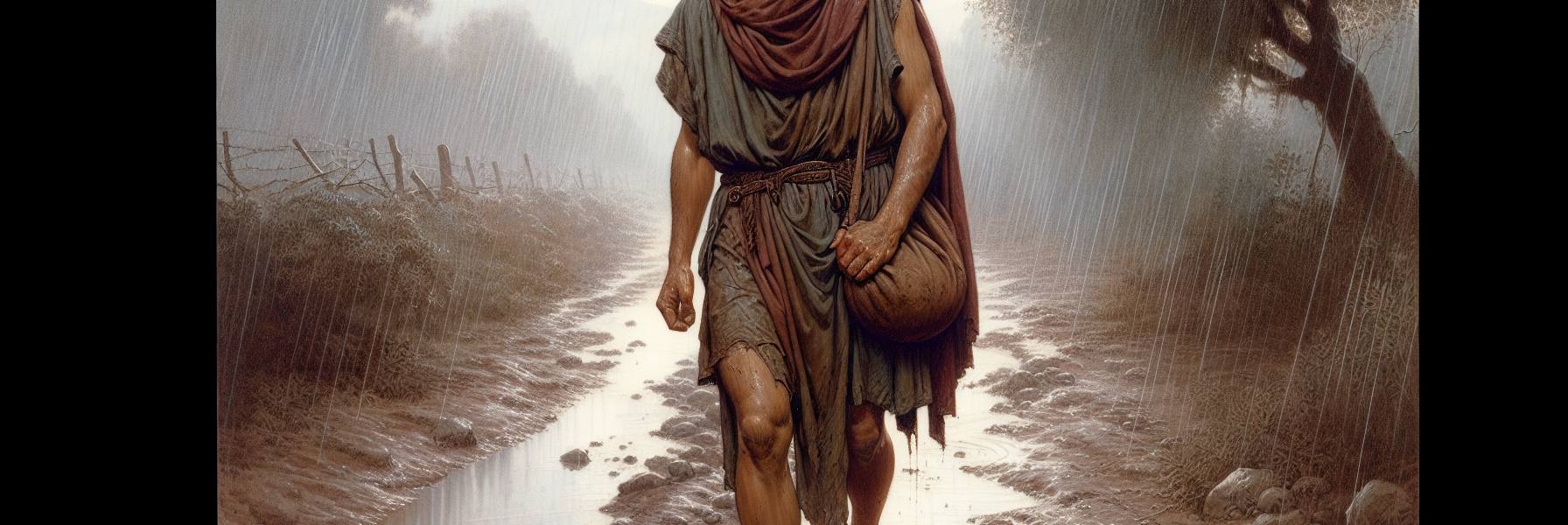

The rain had finally ceased, but the mud remained. It clung to the hem of Aquila’s cloak and sucked at his sandals with each step along the road to Cenchreae. He was tired in a way that went beyond the miles from Corinth; it was a weariness of spirit, a grit in the soul. The letter, a weight in his pouch, felt heavier than the pack on his back.
It had been read aloud in the dim, oil-lit room of Priscilla’s house just two nights prior. The words of the Apostle, so familiar and yet so jarring, had hung in the air like woodsmoke. *“As servants of God we commend ourselves in every way…”* Aquila replayed the phrases in his mind, his own life a poor reflection of the list that followed. *In great endurance, in troubles, hardships, and distresses.*
His troubles felt small, shamefully so. Not beatings or riots, but the quiet, grinding hardship of a leatherworker whose hands ached, whose profits dwindled under the weight of Corinth’s tariffs and a rival shop’s slander. A customer, Marcus, a wealthy merchant, had just that week torn a finished harness, complaining of shoddy work, refusing payment. Aquila had bitten back a retort, his throat tight. That was his hardship: a swallowed insult, a ledger bleeding coins.
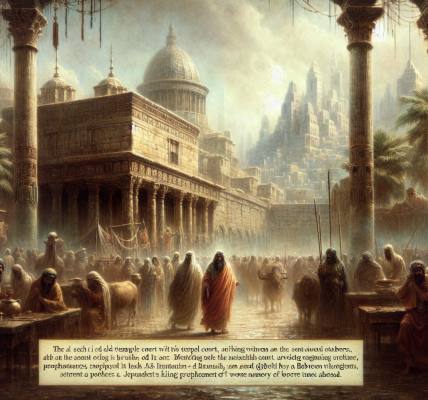
The path wound down toward the eastern port. The smell of salt and fish, of cedar resin and damp stone, began to cut through the earthy scent of wet clay. Cenchreae bustled, a symphony of shouted Greek and Aramaic, of creaking pulleys and bleating sheep bound for sacrifice. He was here to purchase a special hide from Syria, a transaction that required haggling he dreaded.
In a shadowed alcove between two granaries, he saw her. A woman, her face lined not with age but with a profound exhaustion, sat rocking a bundle of rags. Her eyes, when they met his, held a hollowed-out look he recognized. It was the look of someone who had run out of tears. Without a word, Aquila knelt, placing a small loaf and a single silver coin beside her. Her fingers, cold and rough, brushed his hand. No speech was needed. It was a moment of *genuine love*, a phrase from the letter that now felt less like a concept and more like a faint, responding pulse in his own chest.
The transaction for the hide was as unpleasant as feared. The trader, a sharp-eyed Phoenician named Belos, inflated the price, citing “risks at sea.” Aquila’s protest was mild, lawyerly. He cited market rates. Belos smirked, spreading his hands. “Take it or leave it, craftsman. Truth is, I have another buyer.” It was a lie, transparent as glass. Aquila felt the old heat rise in his cheeks, the desire to accuse, to unleash the righteous anger he supposedly wielded as a “weapon of righteousness.” Instead, he heard a whisper in his memory: *in truthful speech and in the power of God.* The power of God. Here, now? It felt like nothing. It felt like losing.
He paid the inflated price, the coins leaving his hand with a sense of failure. As he turned to go, Belos, perhaps sensing a vulnerability he could exploit, called after him. “They say you follow the crucified god of the Jews. A god of slaves and fools. Does he tell you to be a fool with your money, too?”
Aquila stopped. The insult to his Lord was a physical blow. He turned, and for a second, the image of Paul flashed in his mind—not the powerful speaker, but the man they had once pulled, bruised and bleeding, from the gutter after a mob had left him for dead. The man who got up and walked back into the city.
“He tells me to be honest,” Aquila said, his voice quieter than he intended. “Even when it costs me. May your profit bring you peace, Belos.” The words tasted strange, not sweet, but clean, like well-water after vinegar.
The walk back to Corinth was longer. The sun broke through, steaming the landscape. He thought not of the Apostle’s triumphs, but of the inventory: *genuine, yet regarded as impostors; known, yet regarded as unknown; dying, and yet we live on; beaten, and yet not killed; sorrowful, yet always rejoicing; poor, yet making many rich; having nothing, and yet possessing everything.*
Having nothing. He felt that. The coin for the hide was gone. The profit from Marcus’s harness was gone. And yet… he possessed the letter. He possessed the memory of the woman’s fingers on his hand. He possessed the clean, hard shape of the words he had left with Belos, words that felt, for the first time, like a kind of armor, not of iron, but of something more fragile and more durable.
He arrived home as the lamps were being lit. Priscilla was waiting, her face etched with concern. “Marcus came,” she said. “The merchant. He brought payment. Full payment. And an apology. He said… he said he tested the harness on his most stubborn mule and it held. He said your quietness shamed him.”
Aquila stood in the doorway, the dust of the road on him, the smell of leather and salt and earth. He did not feel triumphant. He felt stripped bare, a vessel that had been scoured. He had commended himself that day—not in eloquence or power, but in the pathetic, ordinary arsenal of a struggling saint: in a moment of pity, in a transaction of painful honesty, in a swallowed retort that later bore a strange fruit. He had been, in his small, mud-stained way, a servant of God. The day’s losses and gains settled in him, not as a balance, but as a single, complex truth.
He took his wife’s hand. “We have nothing,” he said softly, not with despair, but with a dawning, bewildered wonder. “And we possess everything.”
Outside, the Corinthian night deepened, holding both darkness and stars. The day of salvation, it seemed, was not a distant event, but this very day, this difficult, mundane, and sacred now.