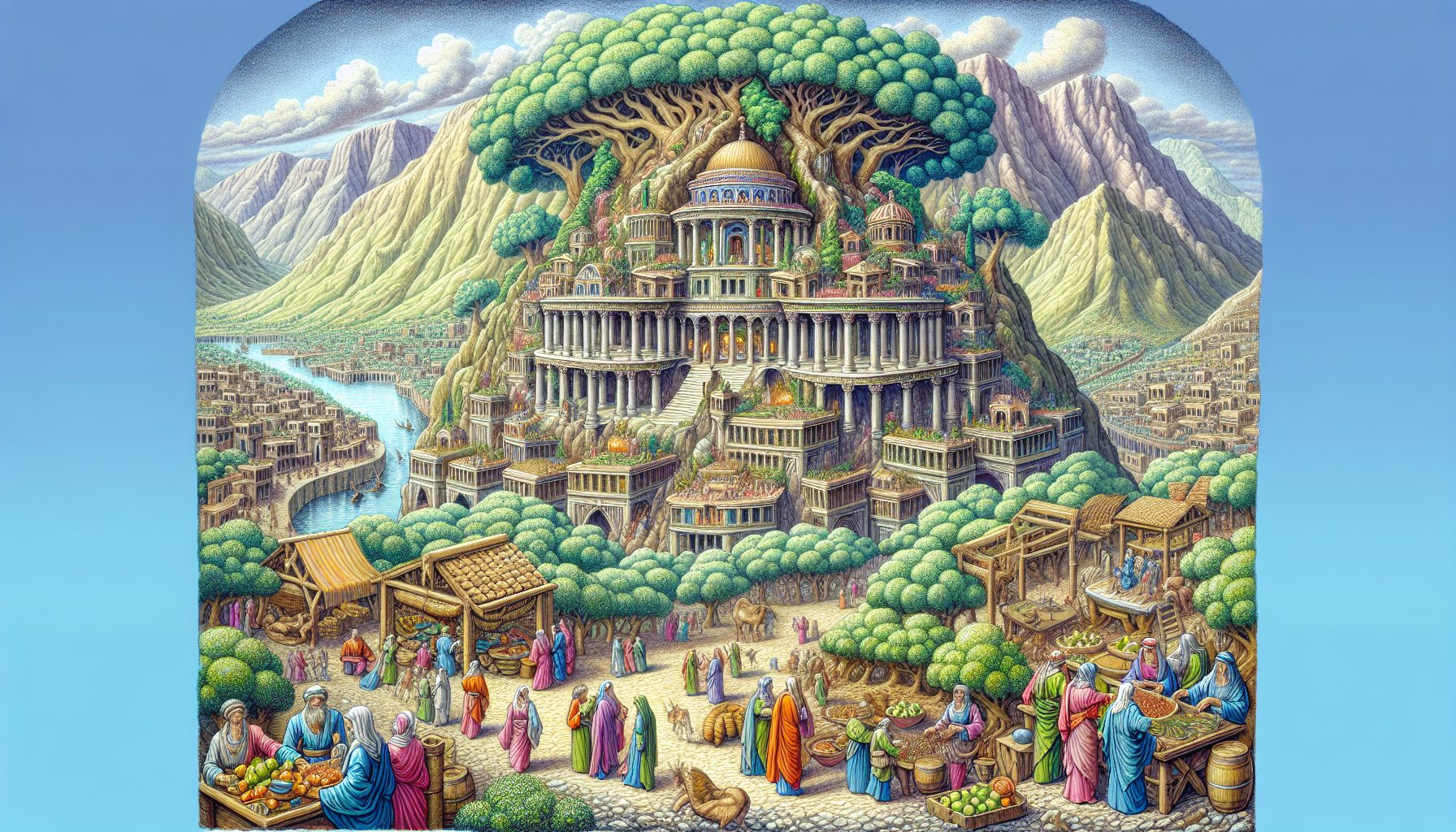
The heat in Shechem that summer was a thick, woolen blanket. It pressed down on the olive groves and shimmered over the quarried limestone of the city walls, carrying the mingled scents of dust, animal dung, and baking bread. In the house of Baal-Berith, the god of the covenant, the air was cooler, stained blue with incense smoke. It was here, amid the votive offerings and the silent, watching idols, that Gaal son of Ebed decided to speak.
He had come with his kinsmen, a restless band looking for opportunity. The wine was plentiful, and the men of Shechem, feeling a familiar itch of discontent, were drinking deeply. Their city was powerful, a crossroads, but they chafed under the memory of Gideon—Jerubbaal—and the shadow of his son who now presumed to rule them.
“Who is Abimelech,” Gaal slurred, his voice rising to fill the hushed sanctuary, “and who are we of Shechem, that we should serve him? Is he not the son of Jerubbaal? And is not Zebul merely his appointed officer? Serve the men of Hamor, our father! Why should we serve this upstart?”
The words, seditious and sweet, hung in the smoky air. They found fertile ground. The men murmured, old grievances surfacing like stones in a ploughed field. They remembered the seventy pieces of silver from the temple treasury, given to Abimelech to hire reckless, rootless men. They remembered the single stone at Ophrah, where Abimelech’s brothers, seventy sons of Gideon, were slaughtered. All but one. Jotham, the youngest, had hidden himself.
Zebul, the city ruler appointed by Abimelech, heard the talk. His face, usually a mask of placid administration, tightened. He sent messengers climbing the steep road to Arumah, where Abimelech held court. The message was plain: Gaal son of Ebed and his kin had stirred up Shechem against you. Now, come by night.
While Gaal drank and boasted, Abimelech moved. He divided the men who followed him—these “worthless and reckless” men he had hired with sacred silver—into four companies. They moved through the moonlit hills like wolves, taking up positions in the fields around Shechem.
Dawn came, pearly and soft. Gaal, his head pounding from the night’s excess, walked out with Zebul to the city gates. He squinted into the growing light. The shapes in the distant fields resolved from mist into men.
“Look,” Gaal said, a note of confusion in his voice. “People are coming down from the mountaintops.”
Zebul, standing beside him, allowed himself a thin, cold smile. “The shadows on the mountains,” he replied, his tone dismissive. “You mistake them for men.”
But the shapes kept coming. A second company appeared on the road by the Diviners’ Oak.
“Look,” Gaal insisted, anxiety sharpening his words. “More people are coming down from the center of the land. And one company is coming from the direction of Elon-meonenim.”
Then Zebul turned to him, the mask of loyalty falling away. “Where is your mouth now,” he spat, “you who said, ‘Who is Abimelech that we should serve him?’ Are these not the men you despised? Go out now and fight them.”
Gaal, sobered and terrified, led the men of Shechem out. The battle was a brief, brutal affair in the morning haze. The fields, ripe with grain, were trampled into mud. Gaal’s forces were driven back to the very gates of the city, and many fell before Zebul himself slammed the gates shut, barring Gaal’s retreat. Gaal and his kin fled, broken, and were seen no more in Shechem.
But Abimelech’s vengeance was not satisfied with a single victory. He remained in Arumah, and the men of Shechem, fickle as the wind, returned to their old ways, raiding the caravans that passed through the hills. They set ambushes on the high roads, thinking their king distant and unaware.
Abimelech learned of it. He took his men and once more swept down upon the city. This time, he took it. He fought his way through the streets, stone by stone. The resistance was fierce but disorganized. By the day’s end, the city was his. He killed the people, tore down the buildings, and sowed the ruins with salt—a curse of barrenness upon the place that had both crowned and betrayed him.
Yet a final stronghold remained. The citizens, or what was left of them, had fortified the temple of El-Berith, their covenant god, in the innermost citadel. They believed, perhaps, that the stone walls and the sanctity of the place would protect them.
Abimelech saw the strong tower from a distance. He did not order a direct assault. Instead, he led his men to the forested slope of Mount Zalmon. There, with their axes, they cut down branches. Each man shouldered his bundle of green wood. They walked back to the citadel in a grim, silent procession and piled the wood against the doors of the stronghold. The air, which had carried the scent of battle, now filled with the smell of crushed leaves and sap.
They set it alight.
The fire took hold, crackling through the green wood with a sound like laughter. Smoke billowed, thick and black. Inside the tower, a thousand people—men and women, lords of Shechem and their families—were trapped. The heat became unbearable, the smoke suffocating. Every soul within perished.
It was then, flushed with this terrible victory, that Abimelech turned his attention to the nearby town of Thebez. They too had defied him. He besieged it, took it with ease, and the people fled to their own strong tower within the city. As he had done at Shechem, Abimelech advanced to the tower door to set it ablaze.
But Thebez was not Shechem.
A woman stood on the roof of the tower. In her hands was not a weapon of war, but a common household tool: an upper millstone, used for grinding grain. It was a heavy, thick disk of stone. She watched the figure of the king below, striding forward, arrogant and certain. She leaned over the parapet.
The stone fell. It did not strike his helm or his armored shoulder. It found the vulnerable space between, crushing the crown of his skull.
Abimelech fell, a sack of broken bones. He knew immediately the wound was mortal. The shame of it—to be killed by a woman, by a millstone—flooded what remained of his consciousness. He saw his armor-bearer standing over him, horror etched on his face.
“Draw your sword,” Abimelech gasped, the words bubbling through the blood in his mouth. “Kill me, so they cannot say, ‘A woman killed him.’”
The young man did not hesitate. He thrust his sword through the king’s heart.
And so the men of Israel who followed him saw their leader dead. They simply turned away. They disbanded, melting back into the hills and to their own homes. The fire of ambition that had burned so fiercely, lit with temple silver and fed by fratricide, guttered out on the dirt of Thebez.
In the quiet that followed, the memory of another voice returned, thin and prophetic, from the beginning of the tale. It was the voice of Jotham, the lone survivor, shouting from the heights of Mount Gerizim. He had told the trees a story, a fable of the bramble, the most worthless of plants, offering shade. *Let fire come out of the bramble,* Jotham had cried, *and devour the cedars of Lebanon.*
The fire had come. It had devoured Shechem. And in the end, it had consumed the bramble king himself. The cycle was complete, a grim lesson written not on scrolls, but in blood, salt, and smoke. God had repaid the wickedness of Abimelech, and the curse of Jotham had found its terrible, fitting end.