
The Tabernacle stood finished, a whisper of ordered beauty in the stark embrace of the wilderness. The smell of acacia wood, finely ground flour, and the sharp, clean scent of anointing oil hung in the air, a new perfume for a people on the move. It was a day suspended in time, the day Moses completed setting it all up, consecrating it and all its furnishings. A holy quiet settled, broken only by the shift of sand underfoot and the distant lowing of herds.
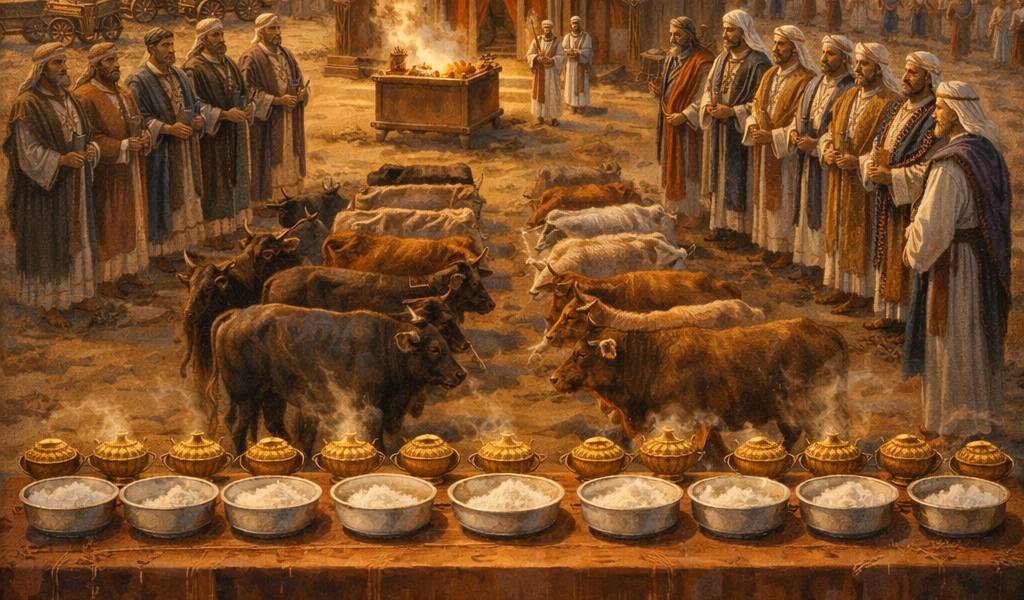
Then the leaders of Israel came forward. Not as a clamoring crowd, but with a deliberate, heavy gravity. These were the heads of their fathers’ households, the chiefs of the tribes, the ones who had overseen the registration. What they brought before Moses wasn’t plunder or personal tribute. It was a communal offering, a collective breath held and then released in tangible form.
Six covered carts, twelve oxen—the sound of their wooden wheels grinding on the desert floor was a new sound in this place of footfalls and hoofbeats. A practical gift, for a practical need. How does holiness move? It moves on carts, pulled by strong, patient beasts. The Lord’s word came to Moses, a quiet directive in the midst of the spectacle: distribute them, give them to the Levites for the service they are charged with.
So Moses gave. Two carts and four oxen to the sons of Gershon, for their load was vast—the curtains, the coverings, the screens of the court. Four carts and eight oxen to the sons of Merari, whose burden was the heavy, structural bones of the sanctuary: the frames, the bars, the pillars, the sockets of bronze. But to the sons of Kohath, the ones entrusted with the most sacred objects—the ark, the table, the lampstand, the altars—he gave none. Theirs was to carry on shoulders sanctified by proximity, bearing the holy things on poles, a walking reverence.
Then the offerings began. Not all at once, but in a solemn, day-by-day procession, a liturgy stretched across time. The Lord instructed that each tribal leader should come, one prince for each day, to present his offering for the dedication of the altar.
The first day, Nahshon son of Amminadab, of the tribe of Judah. He brought his offering into the new space before the Tent. It was a weight of silver and of devotion: one silver dish whose heft was 130 shekels, one silver bowl of 70 shekels, both full of fine flour mixed with oil for a grain offering. A golden dish, small but dense, of 10 shekels weight, full of incense. Then the animals: one young bull, one ram, one male lamb a year old, for a burnt offering; one male goat for a sin offering; and for the sacrifice of peace offerings, two oxen, five rams, five male goats, five male lambs a year old.
It was a wealth laid bare on the desert ground. The silver caught the harsh sun, the gold winked it back, the animals stood in patient, unknowing lines. And Aaron’s sons, still new in their consecrated garments, their hands still learning the sacred motions, received it all. They took the blood and dashed it against the sides of the bronze altar. They laid the portions on the fire. The smell of it—seared meat, rich grain, sweet incense—began to soak into the fabric of the place, a smell that would never fully leave.
The next day, Nethanel son of Zuar, prince of Issachar. He brought forward an identical offering. The same weights, the same numbers. And the day after that, Eliav son of Helon, of Zebulun. And so it went, for twelve days.
A modern reader might skim the list. The repetition in the scroll of Numbers can feel like a bureaucratic record. But to stand there in the mind’s eye is to feel something else entirely. It was not monotony; it was a rhythm. It was not redundancy; it was equality. Each tribe, regardless of its size or future destiny, presented the same costly gift. The Levites, who had no territorial inheritance, served at the altar that these gifts dedicated. It was a profound levelling before holiness. The dish from the tribe of Simeon, offered on the fourth day by Shelumiel son of Zurishaddai, was not less than the first. It was its own complete act, its own full-throated “yes” to the God who had brought them out.
Day after day, the smoke rose. The priests’ arms grew tired from the lifting, the slaughtering, the sprinkling. The court of the Tabernacle became a place of constant, careful activity. The sound of the offerings was the sound of a people investing everything in this fragile, mobile point of contact with the divine. They were not building a temple; they were funding a relationship.
On the twelfth day, Ahira son of Enan, of the tribe of Naphtali, brought his offering. The last silver dish, the last golden dish of incense, the last set of animals. And with that, the great procession was complete.
The tally, when finally listed at the end, is almost overwhelming in its physicality: twelve silver dishes, twelve silver bowls, twelve golden dishes; the silver weighing over 2,400 shekels, the gold 120; the animals summing to twelve bulls, twelve rams, twelve male lambs, with their grain offerings, twelve male goats for sin, and for the peace offerings, twenty-four bulls, sixty rams, sixty male goats, sixty male lambs.
But this was not an inventory for a warehouse. It was the arithmetic of consecration. Each number a multiple of twelve, the symbol of a whole people. This was the foundation laid not in stone, but in sacrifice. The altar, once cold bronze, was now thoroughly seasoned by fire and fat and faith.
And when it was done, when the last echo of the bleating goat had faded and the final wisp of incense had merged with the desert sky, Moses went into the Tent of Meeting to speak with Him. And he heard the voice. It spoke from above the mercy seat that was on the ark of the testimony, from between the two cherubim. It was a voice that knew the weight of every silver dish, that had counted each grain of flour. It was the voice of the One who had received it all. The offerings were complete. Now, the speaking could begin.