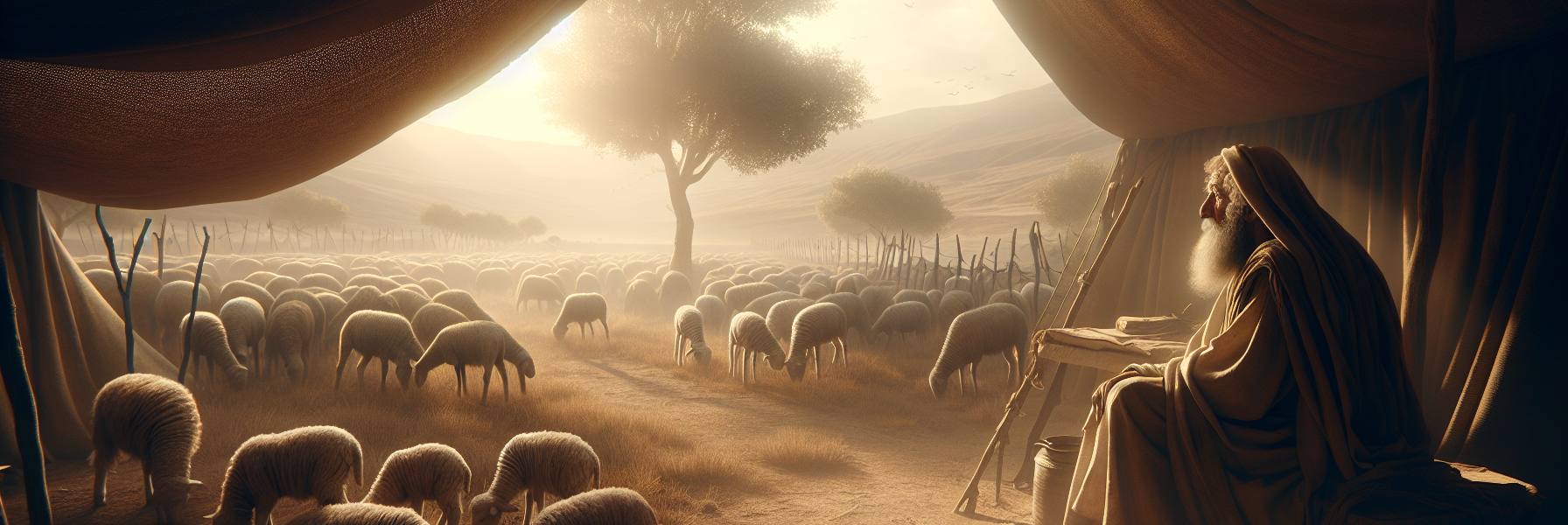

The heat had settled into the bones of the land, a dry, persistent thing that made the very air taste of dust. Abram sat in the entrance of his tent, his ninety-nine years a weight he felt in his knees, in the slow beat of his heart. The camp around him was quiet in the afternoon stillness, the flocks huddled in whatever shade they could find. Sarai was inside, the rustle of her movements a familiar sound. Their shared silence, after all these decades, was a country they both inhabited, mapped with hopes deferred and a promise that hung, unfulfilled, like a strange star.
It was then that the Presence came. Not with thunder, not with spectacle, but as a deepening of the stillness, a focus in the light. Abram did not startle. He had walked with this voice too long for that. He simply bowed his head, his forehead nearly touching the sun-baked earth, the grit of it pressing into his skin.
“I am God Almighty,” the voice said, and the words were not sound so much as a vibration in the marrow. “Walk before me and be blameless.”
Abram’s breath caught. *Blameless*. The word echoed through the chambers of his memory—the half-truth in Egypt, the desperate plan with Hagar, the years of navigating a world by his own cunning. He saw it all, laid bare in that single, merciful command. It was not an accusation, but an invitation to a new path.
“I will establish my covenant between me and you,” the voice continued, “and I will multiply you exceedingly.”
Abram remained prostrate, the promise washing over him, old and yet utterly new. Then came the change, a shift in the very grammar of his destiny.
“No longer shall your name be called Abram, but your name shall be Abraham, for I have made you the father of a multitude of kings.”
The new name—*Abraham*—settled into him. It felt foreign on the silent tongue of his mind, a mantle too vast for one old man. Father of a multitude. He saw not children, but nations; not a single heir, but dynasties springing from his own worn body.
The covenant was spelled out with a clarity that left no room for his old calculations. The land of Canaan, all of it, was to be an everlasting possession. And the sign of this binding promise was to be carved into the flesh of every male belonging to his household.
“Every male among you shall be circumcised,” the voice instructed, the terms intimate and severe. “You shall circumcise the flesh of your foreskins, and it shall be a sign of the covenant between me and you. He who is eight days old among you shall be circumcised…So shall my covenant be in your flesh an everlasting covenant.”
Abraham felt the specificity of it like a physical touch. This was no abstract pact. It was to be remembered in the body, in pain and healing, a mark on the very mechanism of the promise itself. It spoke of generations, of a line that would remember, of a God who claimed not just souls, but the physical, continuing story of a people.
Then the voice turned to Sarai, still inside the tent, unaware of the conversation that was reshaping her world.
“As for Sarai your wife, you shall not call her name Sarai, but Sarah shall be her name. I will bless her, and moreover, I will give you a son by her.”
At this, Abraham finally pressed his face fully into the dust, a choked sound escaping him. Not Hagar’s son, though Ishmael was beloved. But Sarah’s. Sarah, whose womb was a sealed tomb, whose laughter at the very idea would be a private, bitter thing. The thought was so absurd, so beautifully impossible, that it bypassed his reason and struck directly at the raw nerve of his faith.
He found his voice, a rasp in the quiet. “Oh, that Ishmael might live before you!”
It was a plea, a bargain from the old way of thinking. If this incredible thing with Sarah was the true path, what of the son he already had, the one born of human effort and desperation? Could the promise not rest on him?
God’s response was immediate, gentle yet unwavering. “No, but Sarah your wife shall bear you a son, and you shall call his name Isaac. I will establish my covenant with him as an everlasting covenant for his offspring after him.” Ishmael was not forgotten. He would be blessed, made a great nation. But the covenant, the line of the promise, would run through Isaac, the son of laughter yet unborn.
Then the Presence lifted, as gradually as it had come. The ordinary sounds of the camp filtered back—a distant bleat, the murmur of a servant. The sun was lower in the sky, casting long, angular shadows.
Abraham rose stiffly. His body ached, but his mind was a clear, still pool. That very day, he called Ishmael, now thirteen, and every male born in his household or bought with his silver. He took the flint knife himself, his old hands steady. There was no ceremony beyond the grim, necessary act. The covenant was not in words alone now; it was in the gasp of pain, the binding of wounds, the quiet, shared suffering of obedience. He himself was circumcised, the mark of the promise set upon his own body, a seal on his ninety-ninth year.
Later, in the tent, he looked at Sarah. She was kneading dough, her hands strong and capable. He spoke her new name into the dim space. “Sarah.”
She looked up, her eyes questioning. He did not explain the conversation with the Divine. He simply said, “The promise is for us. For you and me.” He saw the doubt flicker, then a fragile, terrifying hope she quickly veiled. He understood. They were two old people, marked now in a new way, carrying a future too heavy to hold, waiting for the sound of a baby’s cry that would be, itself, a kind of laughter at the impossible. The wait continued, but the ground of it had shifted. It was no longer a hope held in the mind, but a covenant carved in the flesh, a story written in scars and stars.