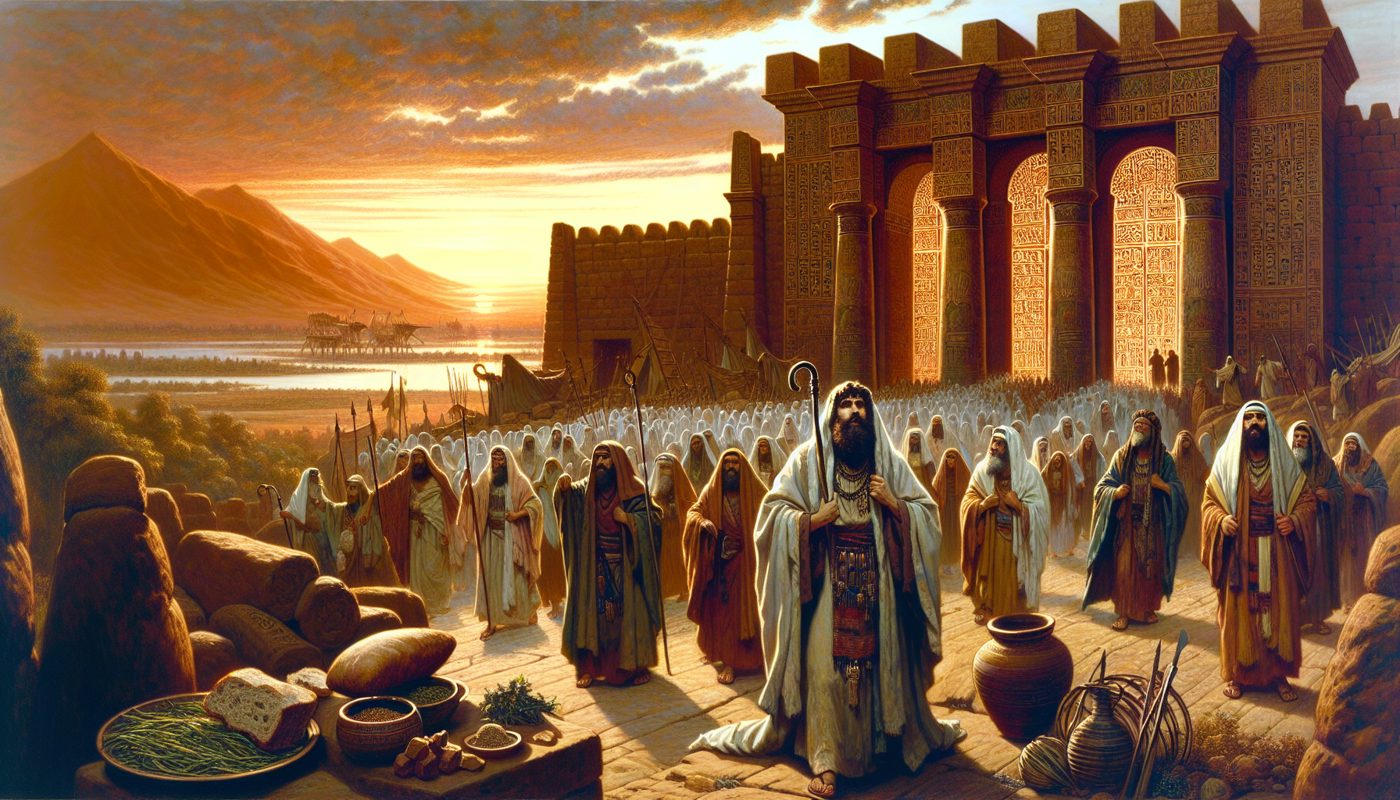
The chapter opens with a command that cuts through the noise of the exodus. The Lord tells Moses to sanctify every firstborn, both of man and of beast, because they belong to Him. This is not a suggestion. It is a claim of ownership rooted in the night the firstborn of Egypt died. The chapter does not describe that night again. It assumes the reader remembers. What it does is press the consequence: the firstborn of Israel are spared, and therefore they are the Lord's.
Moses then speaks to the people, and his speech is a command to remember. He tells them to mark the day they came out of Egypt, out of the house of bondage, because the Lord brought them out with a strong hand. No leavened bread is to be eaten. The month is Abib, the month of the barley harvest, the month of departure. The instruction is precise: seven days of unleavened bread, a feast on the seventh day, and no leaven seen anywhere in their borders. The ritual is tied to the land they have not yet entered, a land flowing with milk and honey promised to their fathers.
The purpose of the ritual is not merely obedience. It is a teaching device. The father is to tell his son, on that day, that this is because of what the Lord did for him when he came out of Egypt. The feast becomes a sign on the hand and a memorial between the eyes, a physical reminder that the law of the Lord is to be in the mouth. The chapter does not explain how this works. It simply states that it shall be so, and that the ordinance is to be kept year after year.
The same logic applies to the firstborn. When the Lord brings them into the land of the Canaanites, as He swore to their fathers, they are to set apart every firstborn male of womb and beast. The firstling of an ass, an unclean animal, must be redeemed with a lamb. If not redeemed, its neck is broken. The firstborn of sons must be redeemed. The chapter gives the answer the father is to give when the son asks what this means: by strength of hand the Lord brought us out of Egypt, and when Pharaoh would not let us go, the Lord slew all the firstborn in Egypt. Therefore the firstborn of Israel are sacrificed to the Lord, but the sons are redeemed.
The chapter then shifts from law to narrative. Pharaoh has let the people go, but God does not lead them by the short route through the land of the Philistines. The reason is given plainly: God said the people might repent when they see war and return to Egypt. So He leads them about, by the way of the wilderness toward the Red Sea. The chapter notes that the children of Israel went up armed out of Egypt. The detail is spare but deliberate. They are not a helpless mob. They are equipped for what lies ahead.
Moses takes the bones of Joseph with him. The chapter does not explain the backstory. It simply reports that Joseph had made the sons of Israel swear an oath, saying that God would surely visit them, and they were to carry his bones up out of Egypt. The bones are a physical link to the promise. They are a witness that the God of Joseph is the God of the exodus.
The people journey from Succoth to Etham, at the edge of the wilderness. And then the chapter gives the image that has defined this moment ever since. The Lord goes before them by day in a pillar of cloud, to lead them the way, and by night in a pillar of fire, to give them light. The cloud and the fire do not appear as a metaphor or a vision. They are a visible, continuous presence. The chapter closes with a plain statement: the pillar of cloud by day and the pillar of fire by night did not depart from before the people.
The chapter does not describe the people's fear or their faith. It does not invent a scene of Miriam humming or children clutching their parents' hands. It gives the commands, the reason for the commands, the route, the bones, and the pillars. The editorial pressure is on the claim of the firstborn and the visible guidance of the Lord. The cloud and the fire are not a symbol of a journey of faith. They are the Lord leading a people who have been claimed by blood.
Comments
Comments 0
Read the discussion and add your voice.
Members only
Sign in to join the conversation
We keep comments tied to real accounts so the discussion stays clean and trustworthy.
No comments yet. Be the first to add one.