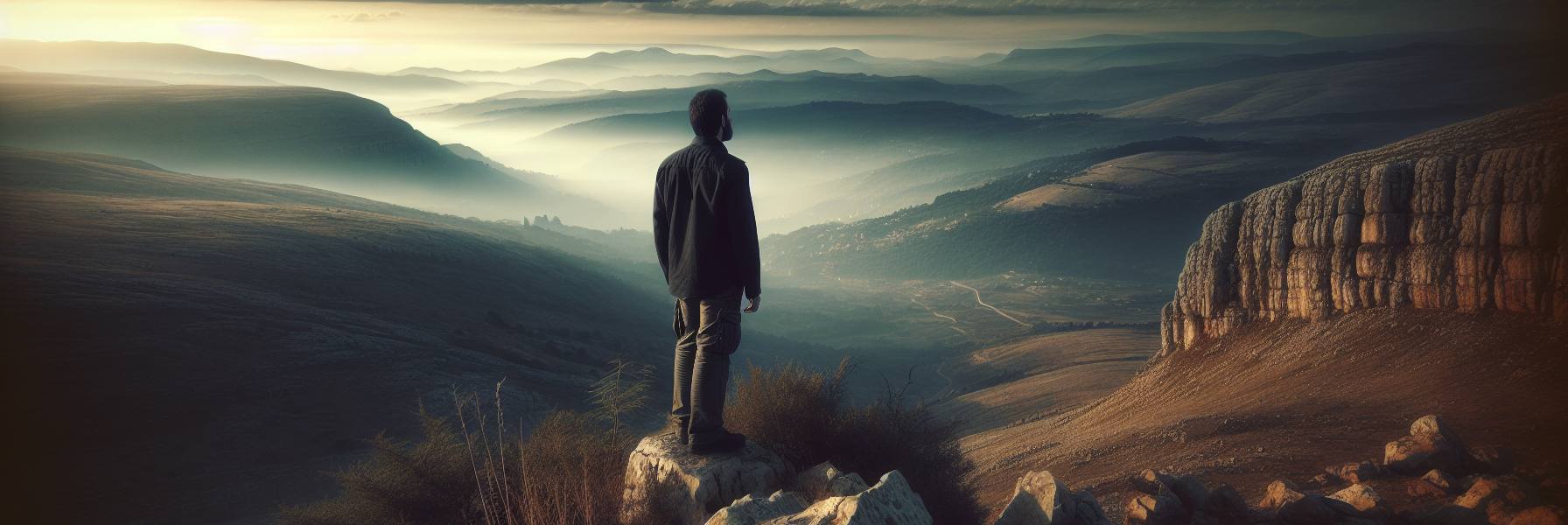

The air in the high place tasted of cedar resin and old stone. Eliab had come here, to this rocky shoulder overlooking the vast plain, to be alone with his thoughts and with the silence. From here, he could see the distant, hazy line of the Great Sea, and to the north, the dark, brooding shoulders of the mountains of Lebanon, their peaks still crowned with the last stubborn patches of winter snow. The world felt immense, ancient, and utterly still.
He’d been pondering the old words, the ones about giving unto the Lord glory and strength. It was easy to say in the quiet of the tent, by the light of a single lamp. Here, under the vast bowl of the sky, the words felt different. They demanded something. They demanded a recognition that matched the scale of the creation sprawled before him.
The first change was not a sound, but a feeling. A deep, almost sub-audible hum seemed to vibrate up through the soles of his sandals, through the very rock he sat upon. The stillness became not peace, but a held breath. Then, from the direction of the sea, a line of cloud appeared, not white and benign, but the color of bruised iron, low and racing inland as if pursued.
It was upon the waters first. He saw the distant sea, a moment ago a sheet of hammered silver, suddenly churned into a chaos of white. The voice arrived not as a single crack, but as a rolling, layered peal that began somewhere beyond the horizon and traveled the length of the sky to crash over the hills behind him. It was not mere sound; it was a physical presence, a pressure in the chest. *The voice of the Lord is upon the waters*, Eliab thought, the scripture rising unbidden. This was no metaphor. The God of his fathers was speaking, and His vocabulary was the thunder.
The storm did not approach; it occupied. The iron cloud-mass swallowed the sun, and the world fell into a eerie, green-tinged twilight. The wind came next, not as a breeze but as a wall, howling through the passes and gorges of the northern mountains. It tore at the ancient cedars of Lebanon. Eliab watched, mesmerized, as entire trees, giants that had stood for centuries, did not just bend but *splintered*. The sound was a sickening, granular crackle that rode underneath the roar of the wind. The Lord was breaking the cedars, yes, but it was not a tidy snapping. It was a violent, creative unmaking, as He made Lebanon itself skip like a young bull, the very mountains trembling under the onslaught.
Then the fire came. Not the fire of lightning from above, but a strange, blue-white fire that danced along the ridge lines, that clung to the shattered stumps of cedar—the fire of the storm itself, a manifestation of a power so raw it turned air into light. The voice of the Lord, he understood now, was also a consuming fire.
The storm moved south, down the spine of the land. It carved its way through the wilderness of Kadesh, a place of bare rock and thirst. There, the voice took on a different quality. The thunder became a dry, percussive hammering, echoing in the canyons, shaking loose slides of scree and dust. It was the voice that could shatter rock, not with moisture, but with pure, concussive force. The wilderness, a place that seemed to defy life, was itself powerless before this utterance.
Eliab had sunk to his knees, his face pressed against the cold stone. He was not afraid in the way one fears a bandit or a wild beast. This was the terror of insignificance, the awe that comes from witnessing a force so far beyond your own category of being that it redefines reality around you. The rain, when it finally came, was not a gentle shower. It was a torrential, vertical flood that fell with such weight it seemed the sky had turned to water. It filled the wadis in moments, turning dry gullies into raging, brown torrents. In the valley below, through the curtains of rain, he saw the oak trees writhing, stripped of their early spring leaves, and the forests laid bare.
And then, as suddenly as it had come, the voice changed.
The rolling, world-shattering peals withdrew. The wind dropped from a scream to a sigh. The rain softened to a steady, hushed patter. The storm, having traversed the entire landscape from sea to desert, was moving on, its power spent, its proclamation made.
In the sudden, ringing quiet, Eliab lifted his head. The air was washed clean, smelling of wet earth and broken evergreens. And there, in the temple of this now-quiet world, every living thing seemed to be whispering one word: *Glory*.
It was in the drip of water from a thousand leaves. It was in the distant rumble of floodwaters subsiding. It was in the profound, grateful silence of the creatures emerging from their shelters. The Lord had not been *in* the storm, Eliab realized. The Lord’s voice *was* the storm. And now, in the aftermath, He was here too, in the peace. The mighty God who could shatter cedars and shake the wilderness was also the one who sat, serene and eternal, as King over the flood—and over the stillness that followed. He was King forever.
A weak sun broke through the thinning clouds, painting the drenched world in gold and steam. Eliab rose, his clothes soaked, his limbs trembling not from cold but from revelation. He would return to the camp. He would speak of strength and glory. But now he knew the true meaning of the prayer he had mumbled this morning. The Lord would give strength to His people. The same strength that shaped the mountains and commanded the sea. And the Lord would bless His people with peace. Not the absence of the storm, but the profound, unshakable quiet that comes after you have heard the Voice, and have lived to understand its final, merciful word.