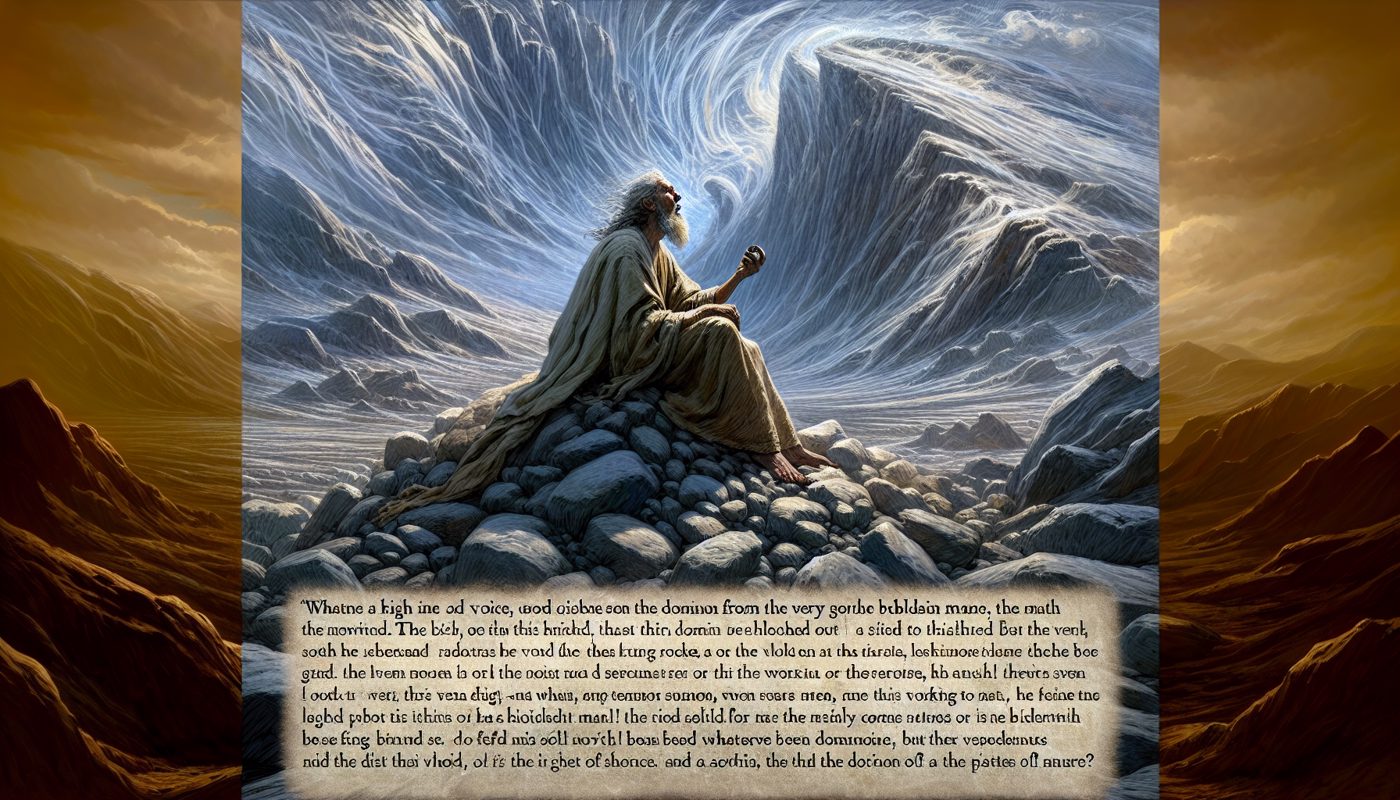
The voice did not pause for Job to answer. It carried on, naming creatures one after another, each description a door opening onto a world Job had never governed. The mountain goat, the wild ass, the wild ox, the ostrich, the horse, the hawk, the eagle—the Lord did not ask Job to admire them. He asked whether Job had given them their instincts, their habitats, their terrors.
The wild goat of the rock brings forth her young on the sheer cliff, and no man counts her months or marks her labor. Her kids grow strong on the precipice and do not return to the dwellings of men. The Lord set her there, and her joy is the vertigo. Job had never considered that a creature might be made for inaccessibility.
The wild ass is free because the Lord loosed his bonds. His home is the wilderness, the salt land, and he scorns the tumult of the city. He does not hear the shouting of the driver. The range of the mountains is his pasture, and he searches after every green thing. Job had never thought of freedom as something given, not earned.
The wild ox will not serve. He will not abide by the crib, nor be bound in the furrow. His strength is great, but it cannot be trusted to bring home the seed or gather the grain of the threshing floor. Some strength is not made for human use. Job had spent his life assuming that strength existed to be harnessed.
The ostrich waves her wings proudly, but they are not the pinions of love. She leaves her eggs in the dust, forgets that the foot may crush them, deals hardly with her young as if they were not hers. God has deprived her of wisdom and imparted no understanding to her. Yet when she lifts herself up on high, she scorns the horse and his rider. The Lord made a creature that succeeds by a kind of wild indifference, not by wisdom. Job had no category for that.
The horse is different. The Lord gave him his might, his quivering mane, his leap like a locust. He rejoices in his strength, paws in the valley, goes out to meet the armed men. He mocks at fear, does not turn back from the sword. The quiver rattles against him, the flashing spear and the javelin, and he swallows the ground with fierceness and rage. He does not believe it is the voice of the trumpet—he hears the trumpet and says, Aha. He smells the battle afar off, the thunder of the captains, the shouting. Job had never considered that courage could be a gift, not a moral achievement.
The hawk soars by the Lord's wisdom, not by Job's. The eagle mounts up at the Lord's command, makes her nest on the high cliff, on the point of the cliff and the stronghold. From there she spies out the prey; her eyes behold it afar off. Her young ones suck up blood, and where the slain are, there is she. The Lord did not apologize for making a predator.
Job had asked for an audience with the Lord to present his case. What he received was a tour of a creation that did not need his counsel, his comfort, or his permission. The wild goat, the wild ass, the wild ox, the ostrich, the horse, the hawk, the eagle—none of them were on trial. None of them had been appointed as Job's servants. They existed because the Lord made them, and they flourished in conditions Job could not endure.
The voice had not answered Job's accusations. It had simply expanded the frame until Job's suffering was no longer the center of the picture. That was the answer.
Comments
Comments 0
Read the discussion and add your voice.
Members only
Sign in to join the conversation
We keep comments tied to real accounts so the discussion stays clean and trustworthy.
No comments yet. Be the first to add one.