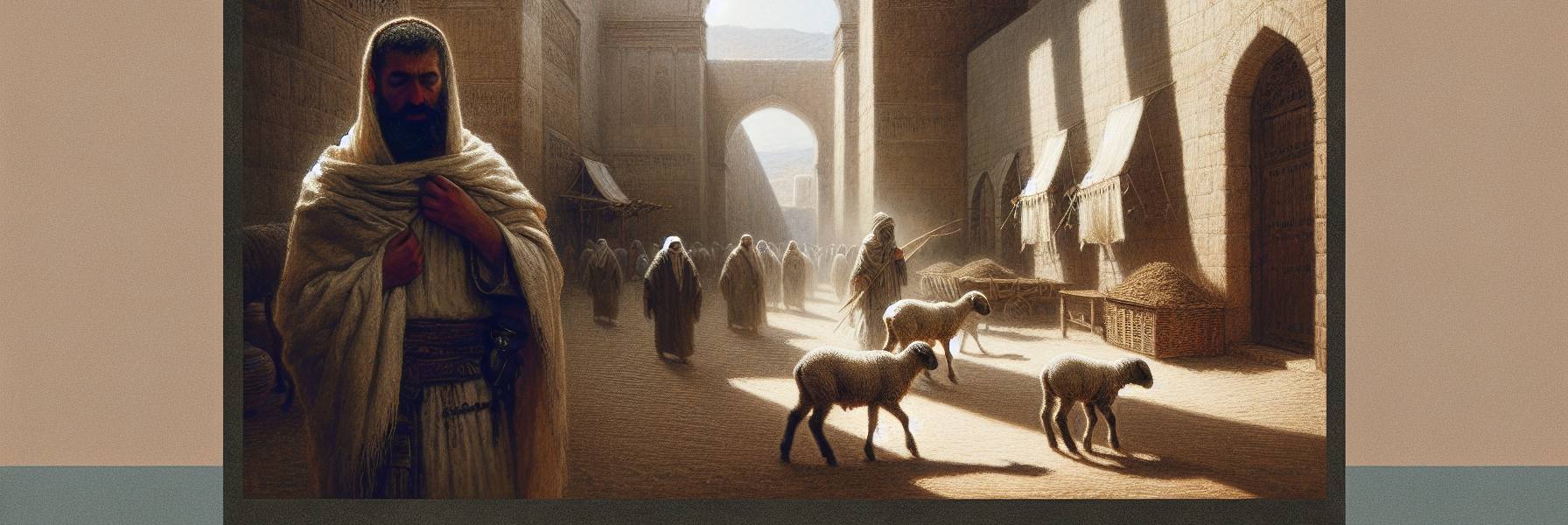

The air in the courtyard was thick, a tapestry of scents both sacred and mundane. It carried the dry, earthy smell of the desert beyond the linen curtains, mixed with the sharp, aromatic smoke of yesterday’s offerings that seemed to have seeped into the very fabric of the Tabernacle itself. Nadab, the priest on duty, felt the grit of fine sand between his teeth. He shifted his weight, the linen of his ephod scratching faintly against his tunic. Morning had broken, but the sun was still low, casting long, distorted shadows from the great bronze altar.
He saw the man approaching from the gate of the courtyard. Not a prince or a chieftain, but a herdsman from the look of him, shoulders broad from labour, face lined not with age but with a kind of weary resolve. In his arms he carried a young bull, unblemished, its coat a deep, rust-red. The animal was calm, its nose occasionally twitching towards the unfamiliar scents. It was this calmness, Nadab thought, that spoke volumes. This was no last-minute, frantic selection. This animal had been known, kept apart, perhaps fed from the man’s own hand. A choice possession.
The man, named Eliazar, stopped before the priest. No words were exchanged for a moment. The silence was not empty; it was heavy with intention. Then Eliazar spoke, his voice rough but clear. “I bring an offering. An ‘olah. A burnt offering to the Lord.” The word ‘olah—meaning “that which ascends”—hung in the air between them.
Nadab nodded, his eyes already assessing the bull. His gaze was not that of a butcher, but of a guardian of thresholds. He walked slowly around the animal. He looked for any defect, any flaw that would render it unworthy of becoming smoke and ascent. A split hoof, a clouded eye, a patch of mange. He found none. The bull stood, a picture of sturdy, unmarred life. “It is acceptable,” Nadab said, the formal phrase tasting of dust and ritual.
What happened next was the heart of it all, a transaction invisible to the eye but felt in the soul. Eliazar, the herdsman, stepped forward. He did not simply point to the animal. He placed his hands, work-hardened and strong, firmly upon the bull’s head, between its ears. He leaned his weight into the act. In that moment, it was as if a conduit opened. The identification was complete. This was *his* offering. His life, his gratitude, his need for atonement, his simple, wordless yearning for the Holy—all of it was transferred onto the life of this flawless creature. The bull, in its silent innocence, became his substitute. Nadab watched, understanding the theology in the man’s trembling knuckles.
Then Eliazar, his own hands still warm from the animal’s hide, took the flint knife Nadab offered. His movement was swift, practiced, but his jaw was tight. He drew the blade across the bull’s throat. It was a grievous, profound act. The blood, shockingly bright and vital in the morning light, fountained out. Nadab moved instantly, catching the rush in a basin of bronze. The sound was not one of violence, but of solemn, dreadful release. Life, contained in the blood, was being yielded up.
Nadab, now in his priestly office, took the basin. He moved to the four horns of the great altar, splashing the blood against their sides in a rhythmic, staining motion. The bronze drank it in, dark and slick. The altar, the point of meeting between God and man, was now implicated. The blood of the substitute now sanctified the very instrument of its consumption.
The work that followed was hard, physical, and deeply symbolic. Eliazar, with Nadab’s sons assisting, skinned the bull. The hide, a valuable thing, was set aside for the priest—a practical provision woven into the law. Then, with careful hands, they dismembered the carcass. Not hacked, but parted at the joints. The pieces were laid out: the head, the fat, the legs, the inner parts, all washed clean with water from the laver, the cleansing of the mundane before the holy fire.
Nadab himself arranged the wood upon the altar, then laid the pieces upon it. The innards, wrapped in the fat, were placed atop the pile. It was a reconstruction of a life, now ordered for divine consumption. Finally, he took a burning torch from the fire that was never to go out, and set it to the wood.
The fire took hold with a hungry crackle. The scent changed. The rich, coppery smell of blood was overtaken by the greasy, pungent aroma of burning fat and flesh. This was not the smell of a cook-fire; it was sharper, more profound, a scent of totality. Thick, grey smoke, heavy with the essence of the offering, began to coil upwards in a steady column. Nadab and Eliazar stood back, their faces warmed by the blaze, watching the smoke rise. It climbed, a vertical prayer, through the clean desert air towards the endless blue.
An ‘olah. A whole burnt offering. Nothing was kept back, not a portion for the priest or the offerer to eat. All of it—hide, meat, entrails, all of it—was given over to the fire, and the fire transformed it into smoke, which ascended. It was a gift of total surrender, a life completely given, an atonement wholly consumed.
Eliazar watched until the fire settled into a bed of glowing embers. The tension had left his shoulders. He said nothing. He simply turned and walked back towards the courtyard gate, the smell of smoke clinging to his clothes. Nadab remained, tending the altar. He knew the theology: a soothing aroma to the Lord. But standing there, the heat on his face, the gritty ash settling on his arms, he thought not in grand terms, but in the particular. He thought of the man’s hands on the bull’s head. He thought of the complete surrender rising in that column of smoke. And for a moment, the vast, terrifying holiness of God felt as close and as real as the warmth of the dying fire.