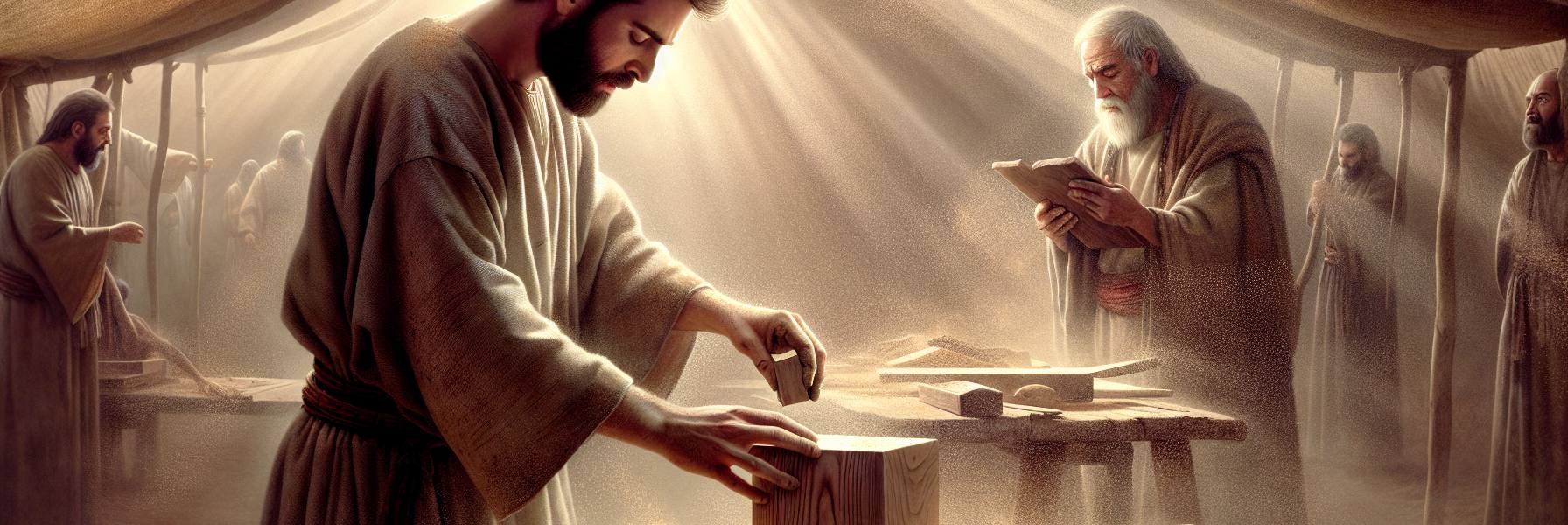

The air in the tent was thick with dust motes, dancing in a single slat of harsh sunlight that cut through the gap in the canopy. Bezalel wiped his brow with the back of his wrist, leaving a smudge of fine acacia sawdust on his temple. The wood in his hands was smooth, almost warm to the touch, a small square plinth that felt heavier than its size suggested. Nearby, Oholiab was meticulously checking the measurements of another piece, his lips moving silently with the numbers.
Moses had come to them earlier, his face still carrying the awe of the mountain, and with words not his own, had laid out the work. Not just the ark, the table, the lampstand. There was this, too. An altar, but not for burnt offerings. This one was for smoke.
“A cubit long, and a cubit wide,” Bezalel murmured, running a thumb along the grain. “Foursquare. And two cubits high.” The proportions felt intimate, manageable. This was not an altar for the people to gather around; this was a piece of furniture for a conversation. Its horns were to be of one piece with it, he remembered—not added on, but born from the same block of wood. He saw them in his mind’s eye, not fierce like a bull’s, but like the corners of a sovereign’s decree, uplifted.
He overlayed it with pure gold. Not leaf, but solid plate, beaten and fitted until the wood vanished beneath a skin of unbroken light. A crown of gold, a rim like a raised breath, around its top. And beneath that rim, on its two opposite sides, gold rings. For the poles of acacia, also overlaid with gold, to carry it. It must be portable, holy. It would travel with them, this box of incense, this engine of prayer.
His thoughts drifted as his hands worked. The incense itself was another matter, a recipe given with terrifying specificity. Stacte, onycha, galbanum—each name a mystery he had to source from the traders who sometimes passed at the edge of the camp. And frankincense, pure and white. “Equal parts,” Moses had said, seasoned with salt, blended expertly, beaten very small. It was to be holy, set apart. The common fire of a home could not touch it. The common yearning of a man could not replicate it. It was for this altar alone. Every morning, when Aaron trimmed the lamps, and every twilight, as the last light bled from the sky, this incense would be offered. A perpetual fragrance before the Testimony, in the tent of meeting. The smoke would cling to the tapestry, weave into the fabric of the space, a sweet veil before the curtain that hid the Holy of Holies.
Bezalel paused, looking at the small, gleaming form taking shape. It was a terrifying thought. This gentle altar of prayer carried the same warning as the ark itself. “You shall offer no unauthorized incense on it,” the command had been. No strange fire. No offering born of personal passion or improvisation. The line between reverence and presumption was as fine as the edge of a golden crown. It was a mercy, he supposed, that the work of it was given to him. His was the crafting, not the offering. That burden fell to Aaron and his sons.
Later, he sat with Oholiab as the sun dipped, the camp settling into the low hum of evening. They spoke of the other instructions woven into the same discourse. The bronze basin, for washing. That was practical, visceral. The grime of the desert, the stain of sacrifice, the dirt under the nails—all must be washed away before approaching the altar to minister, before entering the tent. Water and bronze. It spoke of a God who provided cleanliness, but demanded it.
And the ransom. Half a shekel, a bekah. Every man numbered, from twenty years and upward, the rich and the poor giving the same amount. It was a weight of silver that felt significant in the palm. “Atonement for your lives,” Moses had called it. Not a tax for a project, but a ransom. A reminder that a life, each life, had a weight in the sanctuary. It would fund the service of the tent, this silver turned into sockets and hooks. Their very lives, translated into the architecture of worship. It was a democratic, humbling thought. The shepherd and the chieftain, side by side, giving the same coin to buy back their own souls from a holy tally.
The last was the oil. A hin of olive oil, crushed pure, not pressed. Mixed with liquid myrrh, sweet cinnamon, fragrant cane, and cassia. A perfume so potent it would define holiness by its scent. It was to anoint the tent, the ark, every vessel. To pour on Aaron’s head until it ran down his beard. It would set them apart, seal them. And like the incense, it was not to be poured on ordinary flesh, nor replicated. The smell of it would be the smell of the consecrated, a boundary of fragrance.
Bezalel leaned back, his bones aching. The instructions were not just a list. They were a ecosystem of holiness. The incense altar spoke to God with sweet smoke. The basin scrubbed the sinner clean. The ransom silver acknowledged the price of a community standing before holiness. The anointing oil marked what was irrevocably God’s. It was all of a piece.
He looked at the finished altar, a cube of gold on his workbench, catching the dying firelight. It was beautiful, but its beauty was severe. It was not an object of admiration. It was a tool for a dangerous grace. Tomorrow, he would begin the basins. But for now, in the quiet, he understood. Worship, this God seemed to say, was not a vague feeling. It was a specific, material, perilous, and fragrant undertaking. And every detail, from the height of a horn to the weight of a coin, was a word in a language he was only just beginning to hear.