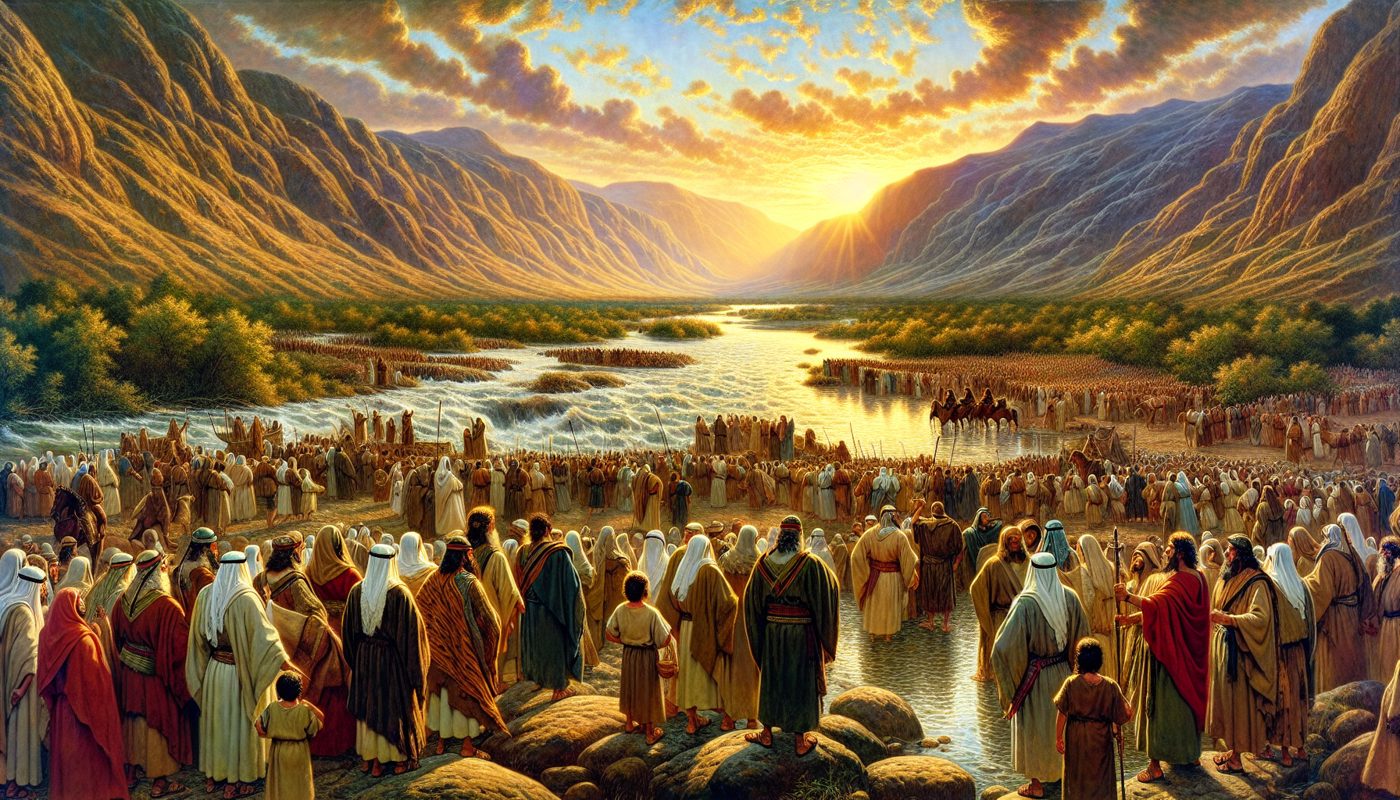
The crossing was complete. Every last Israelite stood on the western bank of the Jordan, and only then did the Lord speak to Joshua. The command was precise: choose twelve men, one from each tribe, and send them back into the riverbed. They were to lift twelve stones from the exact spot where the priests had stood with the ark, carry them to the night’s camp, and set them down there.
Joshua had already prepared the twelve men. He told them to go ahead of the ark into the middle of the Jordan, each man taking one stone on his shoulder. The stones were not random souvenirs. They were to become a sign for the generations. When children later asked what the stones meant, the fathers were to answer plainly: the waters of the Jordan were cut off before the ark of the covenant of the Lord when it passed over. The stones would be a permanent memorial for Israel.
The men did exactly as Joshua commanded. They went into the dry riverbed, picked up twelve stones, and carried them to the lodging place. But Joshua did something else as well. He set up twelve stones in the middle of the Jordan itself, at the place where the priests’ feet had stood. The text notes that those stones remained there to this day.
The priests carrying the ark did not move. They stood in the middle of the Jordan until every command the Lord had given through Joshua was finished—everything Moses had commanded Joshua. The people hurried across. Only when all the people had passed over did the ark and the priests cross, in full view of the nation.
The armed men of Reuben, Gad, and the half-tribe of Manasseh crossed ahead of the rest, about forty thousand ready for war, passing over before the Lord to the plains of Jericho. They were not spectators. They were the vanguard, already moving toward the battle that lay ahead.
That day the Lord magnified Joshua in the sight of all Israel. From then on, the people feared him as they had feared Moses, all the days of his life. The crossing had done more than bring them into the land. It had established Joshua’s authority beyond question.
Then the Lord spoke again. He told Joshua to command the priests bearing the ark of the testimony to come up out of the Jordan. Joshua gave the order, and the priests obeyed. The moment the soles of their feet touched the dry ground on the western bank, the waters of the Jordan returned. The river flooded over all its banks as it had before.
The people came up out of the Jordan on the tenth day of the first month and encamped at Gilgal, on the eastern border of Jericho. There Joshua set up the twelve stones that had been carried from the riverbed. He spoke to the people and gave them the words they were to say when their children asked, “What mean these stones?” The answer was to be direct: Israel crossed this Jordan on dry land. The Lord your God dried up the waters before them until they had passed over, just as he had done at the Red Sea.
The purpose was double. The stones were meant to teach all the peoples of the earth that the hand of the Lord is mighty. And they were meant to make Israel fear the Lord their God forever.
Comments
Comments 0
Read the discussion and add your voice.
Members only
Sign in to join the conversation
We keep comments tied to real accounts so the discussion stays clean and trustworthy.
No comments yet. Be the first to add one.