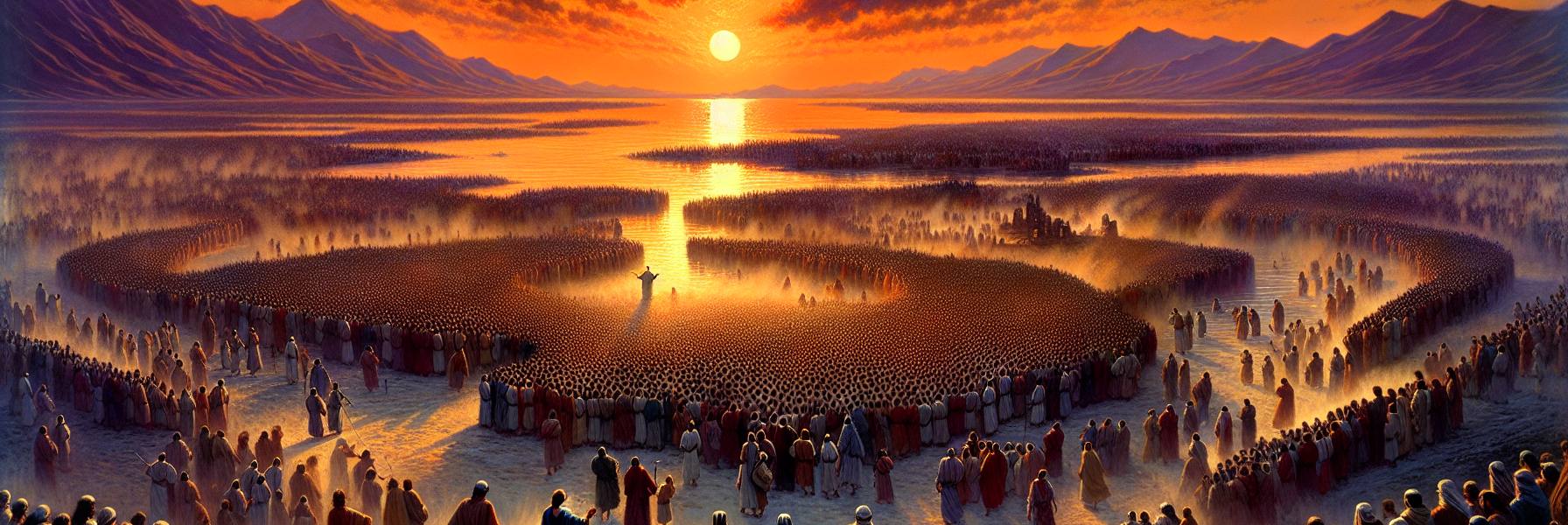

The sea had a particular smell when the wind shifted. It was a damp, briny scent that clung to the back of the throat, mingling with the dust kicked up by thousands of feet. They had been with him for three days now, this multitude that had materialized from the surrounding villages and the lonely hills of Decapolis. They had forgotten to bring provisions, caught up in the sheer, magnetic pull of his words and the things he did. He spoke of a kingdom that was like a seed, so small you could crush it between a fingernail and thumb, yet it could crack stone as it grew.
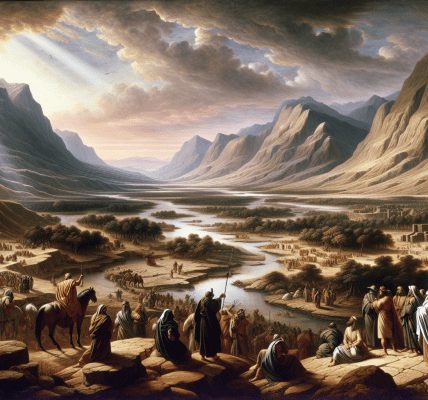
My stomach was a hollow knot. We were in a desolate place, and the sun was beginning its slow descent, painting the water with streaks of copper and bruised purple. I found myself standing near Philip, our shoulders almost touching as we watched the crowd. Their faces were a mosaic of hunger and hope.
“They’ve nothing left to eat,” I murmured, more to myself than to him.
Philip turned, his eyes wide with a kind of practical panic. “Two hundred denarii worth of bread wouldn’t be enough for each of them to get a bite.”
Then he was speaking to us, his voice low but carrying over the murmur of the people. “How many loaves do you have?”
There was a shuffling among us, a search through meager travel sacks. Andrew, his brother’s voice always a little rough, like un-sanded wood, spoke up. “There’s a lad here who has five barley loaves and two fish. But what are they among so many?”
He told us to have the people sit down on the green grass. It was a strange, peaceful command in the midst of our rising anxiety. They settled in groups, like garden plots, their colorful robes a contrast against the green. He took the loaves and the fish—the small, salted fish a boy had probably meant for his own lunch. He looked up, not at the sky in some grand, theatrical gesture, but with a quiet intimacy, as if speaking to a parent in the next room. He gave thanks. The words were simple. Then he began to break the bread.
The breaking sound was soft, a gentle tear. But the pieces kept coming. He handed them to us, and we carried them out into the seated crowds. My hands were full, then empty, then full again. I lost count of how many times I went back. The basket I carried never lightened. It was like dipping a cup into a well that never ran dry. The people ate. They didn’t just nibble; they ate until they were satisfied. Their chatter softened, replaced by the quiet sounds of contentment. The sharp edge of hunger that had been in the air was gone, replaced by a profound, shared fullness.
Later, as the last of the light bled from the sky, he insisted we gather the fragments. “Let nothing be lost,” he said. We moved through the twilight with our baskets, collecting the pieces. Twelve baskets full. One for each of us, I thought numbly. A tangible, heavy reminder of a miracle we could not explain.
We crossed the sea after that, the boat rocking in a familiar rhythm. The air was cold off the water. He was in the stern, his head resting against the wood, asleep. We were arguing, our voices hushed but intense. It was about the bread. We had forgotten to bring any, and the memory of those twelve baskets of fragments taunted us. How could we be worried about bread after that?
He stirred, his eyes opening. He wasn’t startled from sleep; it was more like he was returning from a great distance. “Why are you discussing the fact that you have no bread?” he asked. His voice was weary. “Do you not yet perceive or understand? Are your hearts hardened? Having eyes do you not see, and having ears do you not hear? And do you not remember?”
We fell silent, the lapping of water against the hull suddenly loud.
“When I broke the five loaves for the five thousand, how many baskets full of fragments did you take up?”
We mumbled in unison, “Twelve.”
“And the seven for the four thousand, how many baskets full of fragments did you take up?”
“Seven,” we said, the number hanging in the salt-tinged air.
“And do you not yet understand?”
It wasn’t about the bread. It was a chill that went deeper than the night air. We had been worried about yeast, about the practical leaven of the Pharisees and of Herod, their political and religious contaminations. And he was telling us we had missed the point entirely. We had witnessed the breaking of bread that defied physics, and we were still thinking in terms of a shopping list. The true leaven to fear was a hardness of heart that could witness the impossible and still only see an empty pantry.
The journey continued, away from the sea and toward the villages of Caesarea Philippi. The road was steep, winding through rocky outcrops and stands of pine. As we walked, he asked us a question, his voice casual, as if inquiring about the weather. “Who do people say that I am?”
We offered the rumors we’d heard. “John the Baptist,” I said. “And others say Elijah,” added another. “Still others, one of the prophets.”
He walked a few more steps in silence, the gravel crunching under our sandals. Then he stopped and turned to look at us, his gaze resting on each of our faces in turn. “But who do you say that I am?”
The question hung there, stark and unavoidable. It wasn’t about what the crowds thought, or the scholars in Jerusalem speculated. It was about us, here, on this dusty road.
Peter, always the first to speak, the words tumbling out before the thought was fully formed, said, “You are the Christ.”
The title echoed in the quiet of the hills. The Anointed One. The Messiah.
He didn’t smile. He didn’t congratulate Peter. His face grew stern, almost severe. He strictly charged us to tell no one about him. And then he began to teach us things that made no sense, that ran counter to everything we had ever hoped for in a Messiah. He spoke of suffering. Of being rejected by the very elders, chief priests, and scribes we assumed would crown him. He spoke of being killed. And then, after three days, rising again.
He said this plainly, not in a parable or a riddle. The words were clear, brutal stones dropped into the still water of our understanding.
Peter, his face flushed with a mixture of confusion and protective fervor, took him aside and began to rebuke him. “No, Rabbi. This will never happen to you.”
The look he gave Peter then was one I will never forget. It was not anger, but a profound, sorrowful gravity. He turned his back to Peter and looked at the rest of us, his disciples, who were all thinking the same thing Peter had said aloud.
“Get behind me, Satan!” he said, his voice cutting through the mountain air. “For you are not setting your mind on the things of God, but on the things of man.”
He called the crowd to us then, along with his disciples, and his voice rose, carrying over the slope. “If anyone would come after me, let him deny himself and take up his cross and follow me.”
The cross. A instrument of Roman torture, of public, shameful death. He was not speaking metaphorically. He was telling us that to follow him was to embrace the very rejection, the very suffering he had just described for himself.
“For whoever would save his life will lose it,” he continued, “but whoever loses his life for my sake and the gospel’s will save it. For what does it profit a man to gain the whole world and forfeit his soul? For what can a man give in return for his soul?”
We stood there, on the side of that mountain, the wind whipping at our cloaks. The confession of Peter, “You are the Christ,” still hung in the air, but it had been utterly redefined. It was no longer a title of earthly conquest, but a roadmap to a hill called Golgotha. The fragments of bread, the twelve baskets, the hardness of our own hearts—it was all part of the same lesson. He was not the king we expected. He was the one who would be broken, like the bread, so that we, and all the hungry multitudes, could be filled. And we were to take up our own crosses, our own instruments of death to self, and follow him into that mystery. The path ahead was no longer a road to Jerusalem’s throne, but to a place we did not yet know, and the cost was everything.