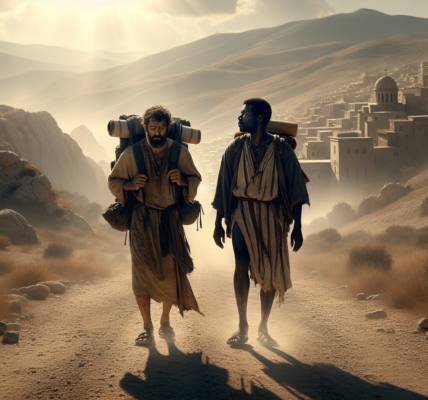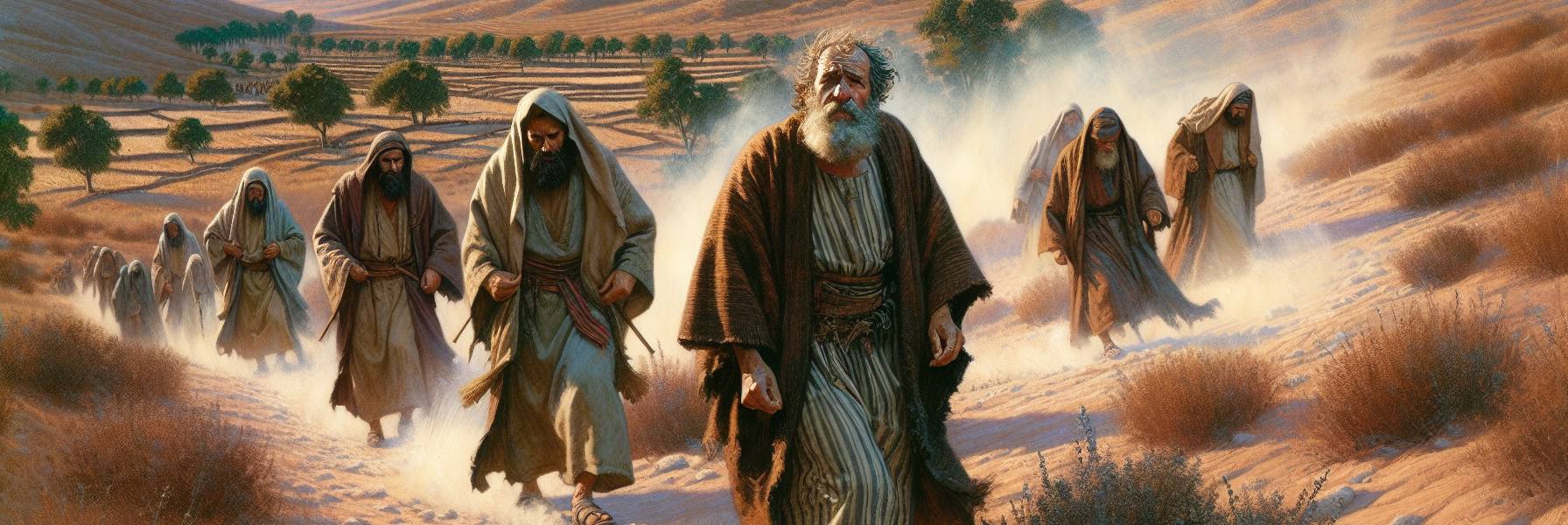

The dust rose in soft plumes around their sandals, a fine chalky powder that settled on wool robes and clung to sweating skin. For forty years they had known only wilderness dust, but this was different. This dust smelled of promise. It was the soil of Canaan, and Eli could taste the strangeness of it on the air—a mix of wild thyme, damp earth from the Jordan’s banks, and the distant, unsettling scent of woodsmoke from villages that were not theirs.
He walked beside his father, Malachi, whose face was a roadmap of sun and time. The old man’s eyes, usually set with the distant focus of a man listening for God, were now taking in the low hills, the stands of oak, the terraced vineyards already heavy with fruit they had not planted.
“It does not feel like a victory yet,” Eli murmured, more to himself than to his father.
Malachi did not turn his head. “The victory is the Lord’s. The feeling is our own burden to bear.”
They made camp that evening in a sheltered valley, the tents of the tribes spreading out like a sudden, colorful fungus sprung from the ground. The familiar routines were a comfort—the driving of tent pegs, the unrolling of sleeping mats, the kindling of fires. But the sounds that echoed back from the surrounding hills were foreign. The bleating of their own goats was answered by the different cries of Canaanite flocks. The wind carried fragments of unfamiliar songs.
It was around their own fire, after the flatbread was eaten and the last of the water shared, that Malachi gathered his family. Eli sat with his younger sister, Ziva, who clutched a small clay idol of a household god, a secret treasure she’d bartered for with a Hittite trader’s daughter days before. She hid it in the fold of her sleeve.
“The word has come from Moses,” Malachi began, his voice low and gravelly. “We are to break camp in the morning and begin the work of clearing the land.”
A ripple of excitement went through the children. Clearing meant battle. It meant plunder.
Malachi held up a hand, his face grim. “But it is not just the people we are to drive out. It is every trace of their worship.” He let his gaze sweep over them, pausing for a moment on Ziva, who looked down at her hands. “You will see their high places on every hilltop under every green tree. You will see their altars of stone, their pillars, their Asherah poles. You are to tear them down. Smash them. Burn them. Scatter the ashes.”
“Why not use them?” asked Eli, ever practical. “The stones are good. The sites are already holy. It would save us the labor.”
Malachi’s eyes flashed in the firelight. “That is the question the Accuser puts in your mouth, my son. They are not holy. They are defiled. Their gods are not gods, but demons and the inventions of desperate men. If you worship the Lord on a high place where a mother once laid her child in the arms of a metal god to be burned, what do you think your sacrifice becomes? It becomes an abomination. The very stones cry out with the memory of that horror. You cannot serve the Lord where other gods have been served. He will not share His altar, nor His people’s hearts.”
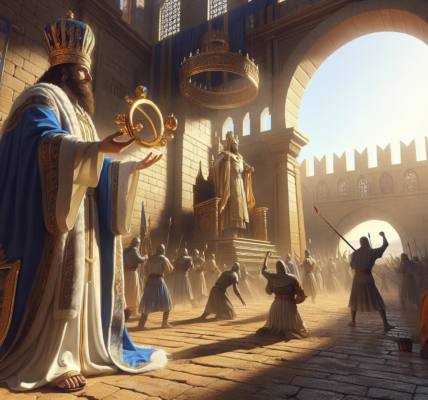
The next days were a blur of smoke and the sound of splintering wood. Eli worked alongside men from the tribe of Judah, their muscles straining as they pushed over a massive stone pillar dedicated to Baal. It fell with a ground-shaking thud, crushing the altar beneath it. The air was thick with the smell of burning wood from the sacred groves. He saw his father, face streaked with soot and sweat, using a heavy hammer to systematically break a row of small household idols, the terracotta faces shattering into meaningless shards.
One afternoon, Eli found himself on a high place overlooking a broad, fertile plain. The Canaanite altar here was old, the stones worn smooth by generations of hands. For a moment, in the quiet, he could almost hear the ghosts of their chants, see the phantom glow of their fires. It was a powerful place. His father’s words echoed in his mind, but a deeper, older instinct whispered that this was where the divine felt close. It was a seductive thought.
Weeks turned into months. The conquest was piecemeal, a slow chewing away of the land. They settled in areas they had secured. And a new restlessness began. A question started to form on the lips of the people, carried from tent to tent, from field to field.
*Where do we bring our offerings?*
They had the Tabernacle, of course, the magnificent tent of meeting that traveled with them. But it was for the priests, for the great national feasts. For the daily, personal sacrifices—the thanksgiving for a healthy child, the sin offering for a rash oath, the firstlings of the flock—they had no designated place. In the wilderness, the entire camp was holy. Here, they were scattered.
Men began to build altars of rough, uncut fieldstone. One here for a clan, another there for a village. They were built with good intentions, with hearts turned toward Yahweh. But the practice was uneven. Some were careful with the Law, others were not. Eli saw a man from a neighboring tribe offer a lamb with a blemish. He saw another mumble an invocation that sounded suspiciously like the name of a Canaanite god of the harvest, just to be safe.
It was a slow drift, a quiet dilution. The clean lines of the wilderness faith were beginning to blur at the edges, stained by the habits of the land.
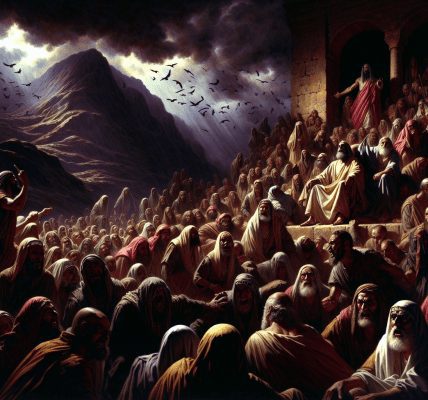
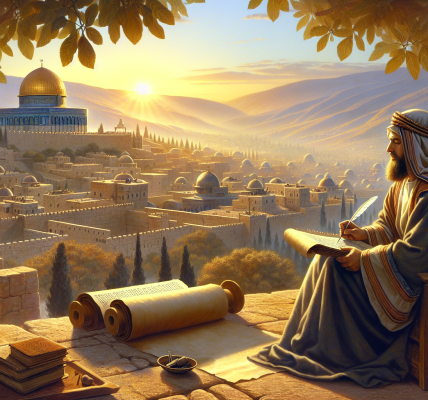
Then the word came again, clear and final, a command that cut through the confusion. It was read aloud in the new village square of their settlement, the scroll held taut by the Levite assigned to them.
“You shall not worship the Lord your God in that way,” the Levite’s voice rang out, strong and certain. “But you shall seek the place that the Lord your God will choose out of all your tribes to put his name and make his habitation there. There you shall go, and there you shall bring your burnt offerings and your sacrifices, your tithes and the contribution that you vow, your freewill offerings, and the firstborn of your herd and of your flock.”
A silence fell, profound and uncomfortable.
“One place?” a woman whispered behind Eli. “But my sister’s family is a ten-day journey from the Tabernacle. How will we offer?”
The Levite continued, anticipating the objection. “When the Lord your God enlarges your territory, as he has promised you, and you say, ‘I will eat meat,’ because you crave meat, you may eat meat whenever you desire. You may slaughter from your herd or flock… as I have commanded you. Only you shall not eat the blood; you shall pour it out on the earth like water.”
Eli listened, the implications unfolding in his mind like a map. They were not being restricted; they were being unified. The daily act of eating meat was to be secular, common, done in their own towns. But the act of worship, of sacrifice, of communal celebration—that was to be centralized. It was a masterstroke. It would prevent the slide into the local, syncretistic practices they were all flirting with. It would force them, several times a year, to make a pilgrimage. To leave their isolated farms and villages and journey to the heart of their faith, to be reminded that they were not twelve tribes, but one people.
He thought of the high place he had stood upon, of its seductive power. This new command was a rejection of that easy, localized magic. The God of Israel was not a god of a place, of a hill or a tree. He was the God of a People, and He would choose where to meet them. His presence would not be tied to the accidents of geography, but to His own sovereign will.
That evening, he found Ziva by the stream, turning the little clay idol over in her hands. She had kept it, hidden all this time.
“We are going to have one place,” Eli said softly, sitting beside her. “One place for the feasts. We will all travel there. Together.”
Ziva looked from the idol to her brother’s face. The idol was a fixed thing, a god you could hold, a god of this one stream, this one field. It was small. The God of their fathers was too vast for such a container. He required a journey.
Without a word, Ziva drew back her arm and threw the figurine into the deepest part of the stream. It sank without a sound, swallowed by the dark, moving water. It was not an act of anger, but of understanding. They were being called to a different kind of faithfulness, one not of convenience, but of deliberate, sometimes difficult, pilgrimage. The dust of Canaan was theirs, but their worship would have a single destination, a place where the heart of their nation would beat, once and for all, as one.