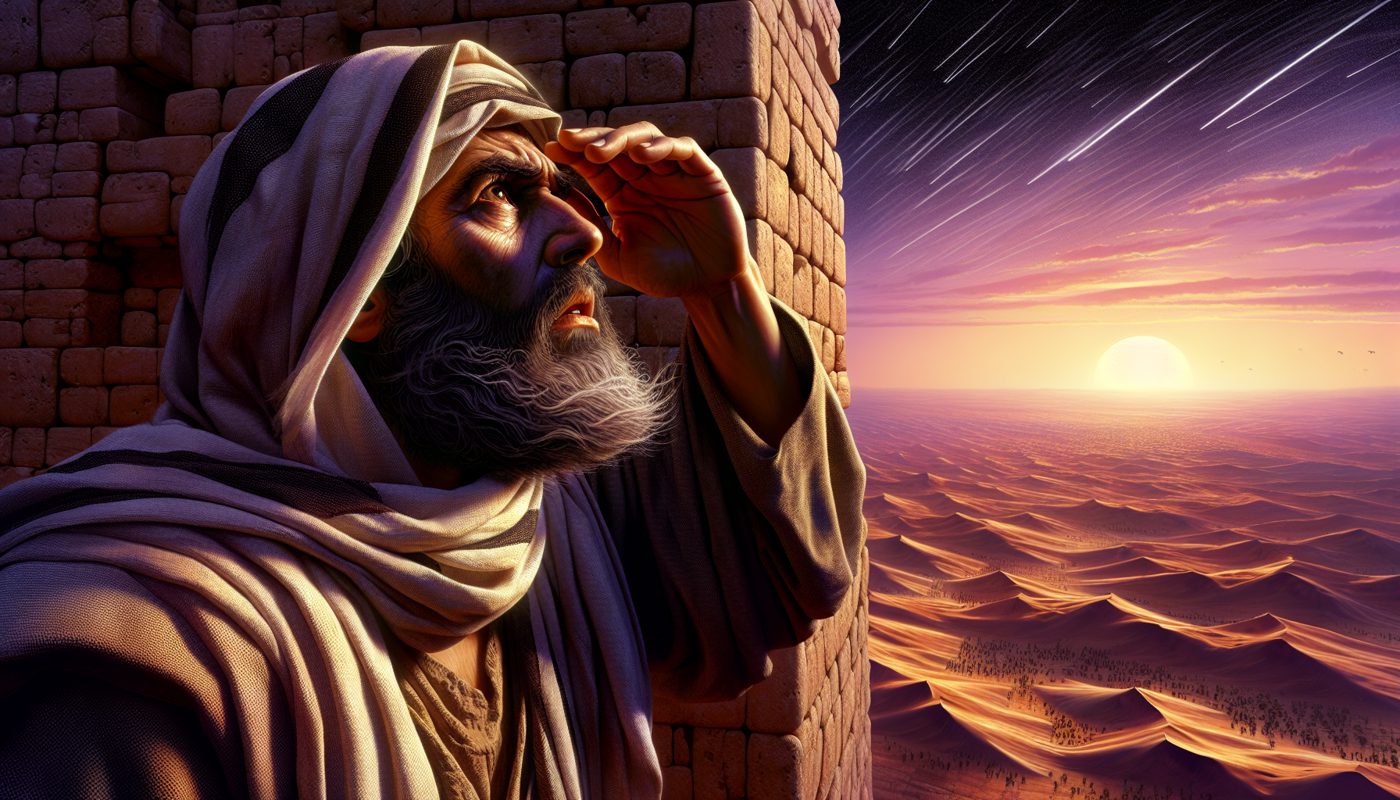
The prophet took his position on the watchtower, not as a guard watching for an army but as a man waiting for a word from the Lord. He had complained bitterly about the violence he saw in Judah and the Lord’s apparent silence. Now he stood ready to hear what would be said to him and what answer he should give to his own complaint.
The Lord answered directly. He told Habakkuk to write the vision down, to make it plain on tablets so that a runner could read it as he went. The vision had an appointed time. It would not lie. Though it seemed to delay, the prophet was to wait for it, because it would surely come and would not be late.
Then came the central statement of the chapter. The one whose soul is puffed up is not upright within him. But the righteous shall live by his faith. That sentence does not describe a general principle of religious devotion. It draws a line between the arrogant man who trusts his own strength and the righteous man who trusts the Lord’s promise, even when the promise has not yet arrived.
The Lord then turned to the fate of the arrogant, the ones who had plundered nations and built their houses by violence. The Lord pronounced five woes against them. The first woe fell on the man who increased what was not his, loading himself with pledges taken from the poor. His creditors would rise up suddenly and bite him. He would become plunder because he had plundered others.
The second woe struck the man who gained evil profit for his house, setting his nest high to escape disaster. He had devised shame for his own house by cutting off many peoples. The very stones of the wall would cry out against him, and the beams of the timber would answer the accusation.
The third woe condemned the man who built a town with blood and established a city by iniquity. The Lord of hosts had ordained that the peoples labor only for fire and weary themselves for nothing. The earth would not remain under the rule of violent builders. It would be filled with the knowledge of the glory of the Lord as the waters cover the sea.
The fourth woe was directed at the man who gave his neighbor drink laced with venom, making him drunk so he could look on his nakedness. That man would be filled with shame instead of glory. The cup of the Lord’s right hand would come around to him, and foul shame would cover his own glory.
The fifth woe addressed the man who trusted in carved images. The prophet asked what profit there was in a graven image that its maker had shaped, a molten image that taught lies. The craftsman trusted in his own dumb idol, overlaid it with gold and silver, but there was no breath in it. The man who said to wood, Awake, and to stone, Arise, was calling on something that could not teach or save.
The chapter closed with a single sentence that reversed the entire scene. The Lord was in his holy temple. The earth was told to keep silence before him. The vision had been given. The woes had been spoken. The arrogant would fall. The righteous would live by faith. And the earth would wait in silence for the Lord to act.
Comments
Comments 0
Read the discussion and add your voice.
Members only
Sign in to join the conversation
We keep comments tied to real accounts so the discussion stays clean and trustworthy.
No comments yet. Be the first to add one.