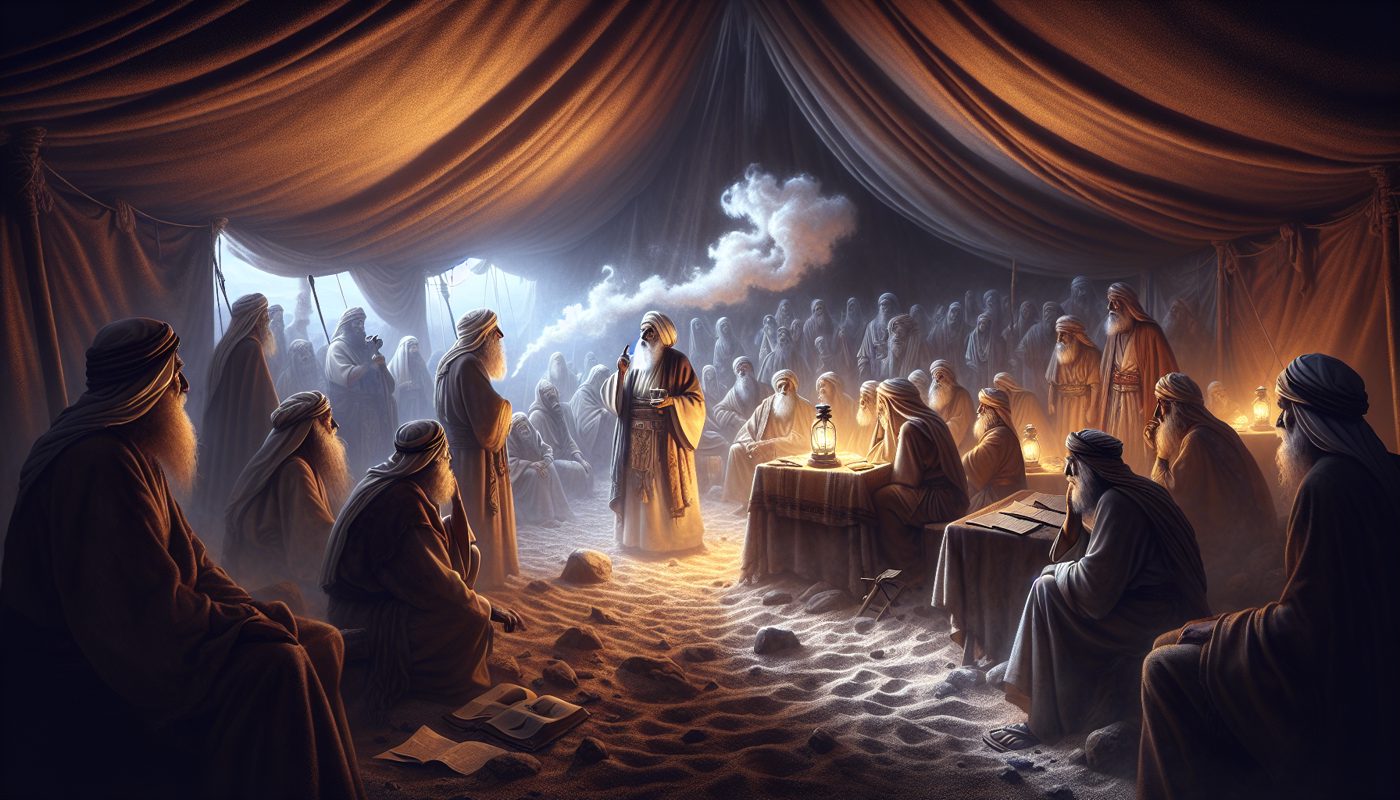
The rebellion that Korah led was not a sudden uprising. He was a Kohathite Levite, a man whose lineage placed him at the heart of the Tabernacle service, yet he saw Moses and Aaron as men who had seized more than their share of access to the Lord. He gathered Dathan and Abiram, sons of Reuben, and On, son of Peleth, along with two hundred and fifty princes of the congregation—men of renown, leaders called to the assembly. Their charge was direct: they told Moses and Aaron that the whole congregation was holy, every one of them, and that the Lord was among them all. Why, then, did Moses and Aaron lift themselves up above the assembly of the Lord?
Moses heard the accusation and fell on his face. He did not argue or defend his position. Instead, he told Korah and his company that the Lord would show who was holy and who would be allowed to come near. The test would be simple: each man would take a censer, put fire and incense in it, and present it before the Lord the next morning. The man the Lord chose would be the holy one. Then Moses turned to Korah and the other Levites with a sharper word. He asked them whether it was a small thing that the God of Israel had separated them from the congregation to serve the Tabernacle and to minister before the people. They had been brought near, and yet they sought the priesthood as well. Moses told them plainly that they had gathered against the Lord, not against him and Aaron.
Moses sent for Dathan and Abiram, but they refused to come. They accused Moses of bringing them out of a land flowing with milk and honey—they meant Egypt—only to kill them in the wilderness, and of making himself a prince over them. They said he had not brought them into a land of fields and vineyards, and they would not come up. Moses was very angry. He told the Lord not to accept their offering, and he insisted that he had never taken a single donkey from them or harmed any of them.
The next morning, Korah and his company took their censers, put fire and incense on them, and stood at the door of the tent of meeting with Moses and Aaron. Korah assembled the whole congregation against them there. Then the glory of the Lord appeared to all the people. The Lord told Moses and Aaron to separate themselves from the congregation so that he could consume them in a moment. But Moses and Aaron fell on their faces and cried out to the God of the spirits of all flesh, asking whether one man's sin should bring wrath on the whole assembly.
The Lord told Moses to speak to the congregation and tell them to get away from the tents of Korah, Dathan, and Abiram. Moses rose and went to Dathan and Abiram, with the elders of Israel following. He warned the people to depart from the tents of these wicked men and to touch nothing of theirs, lest they be consumed in their sins. The people moved away from the tents on every side. Dathan and Abiram came out and stood at the door of their tents, with their wives, their sons, and their little ones.
Moses then declared that the people would know the Lord had sent him to do all these works, and that he had not done them on his own. If these men died a common death, then the Lord had not sent him. But if the Lord made a new thing—if the ground opened its mouth and swallowed them alive into Sheol—then the people would understand that these men had despised the Lord. As soon as Moses finished speaking, the ground split apart beneath them. The earth opened and swallowed them, their households, all the men who belonged to Korah, and all their goods. They went down alive into Sheol, and the earth closed over them. They perished from among the assembly. All Israel who were nearby fled at the sound of their cries, afraid that the earth would swallow them too.
Then fire came out from the Lord and devoured the two hundred and fifty men who had offered the incense. The Lord told Moses to speak to Eleazar, the son of Aaron the priest, and have him take up the censers out of the burning and scatter the fire. The censers were holy because they had been offered before the Lord, even though the men who offered them were sinners against their own lives. Eleazar was to have them beaten into plates to cover the altar, as a sign to Israel that no stranger—no one not of the seed of Aaron—should come near to burn incense before the Lord, so that he would not end up like Korah and his company.
But the next day, the whole congregation of Israel murmured against Moses and Aaron, saying, "You have killed the people of the Lord." As the congregation assembled against them, the cloud covered the tent of meeting, and the glory of the Lord appeared. The Lord told Moses and Aaron to get away from the congregation so that he could consume them in a moment. Again they fell on their faces. Moses told Aaron to take his censer, put fire from the altar on it, lay incense on it, and carry it quickly to the congregation to make atonement for them, because wrath had gone out from the Lord and the plague had begun.
Aaron did as Moses said. He ran into the midst of the assembly, where the plague had already started among the people. He put on the incense and made atonement for them. He stood between the dead and the living, and the plague was stopped. Those who died by the plague numbered fourteen thousand seven hundred, besides those who died in the matter of Korah. Aaron returned to Moses at the door of the tent of meeting, and the plague was stayed.
Comments
Comments 0
Read the discussion and add your voice.
Members only
Sign in to join the conversation
We keep comments tied to real accounts so the discussion stays clean and trustworthy.
No comments yet. Be the first to add one.