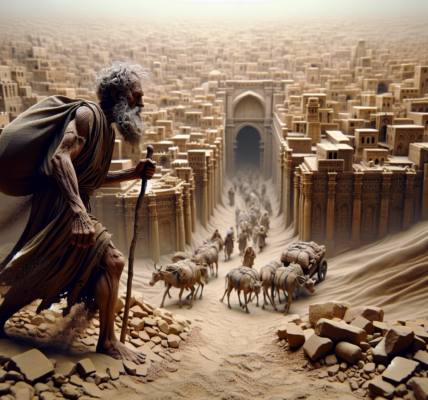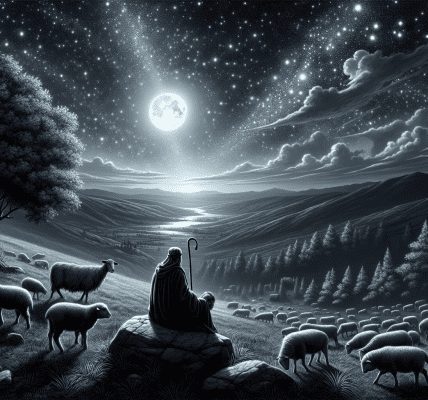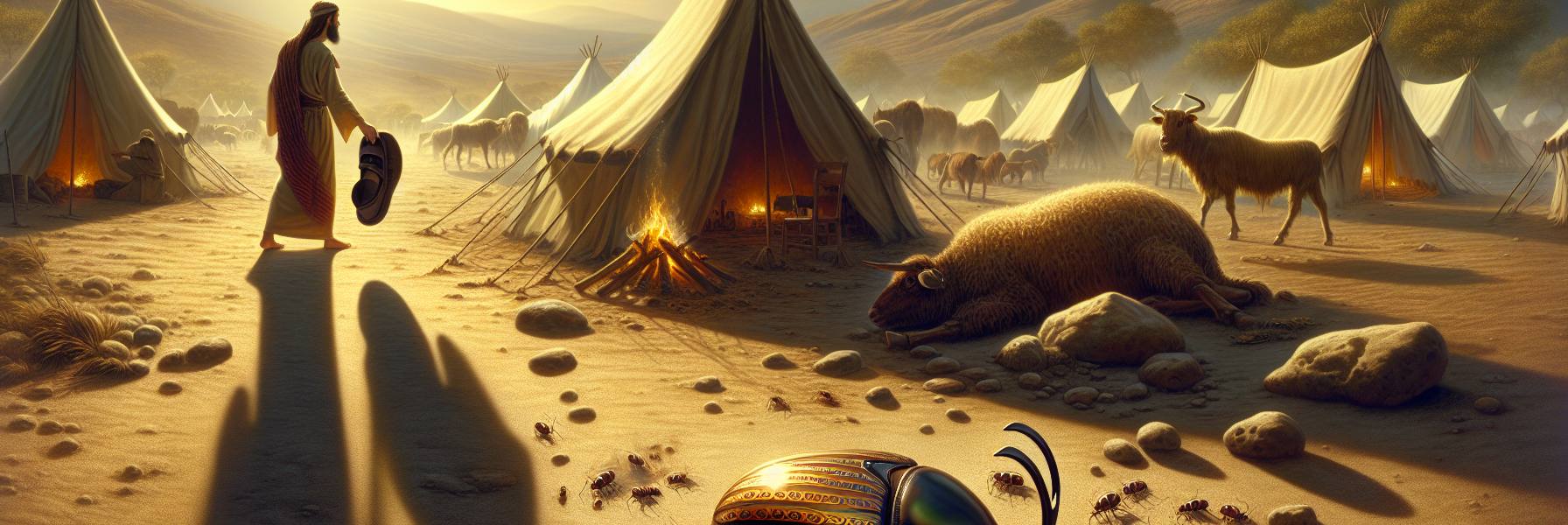

The dust rose in soft plumes around Eleazar’s sandals as he walked the perimeter of the camp. It was late afternoon, and the sun hung heavy and golden over the wilderness, casting long, distorted shadows from the tents of Israel. The air smelled of baking earth, of smoke from a hundred cooking fires, and beneath it all, the faint, familiar scent of the herd animals—the wool of sheep, the warm, grassy breath of the oxen.
His sandal scuffed against the hard, segmented shell of a dead beetle. He paused, looking down at the iridescent carapace, already being investigated by a line of industrious ants. It was a creature of the ground, a swarming thing that moved on its belly with many legs. Unclean. The word surfaced in his mind not as a harsh judgment, but as a simple, sobering fact, like the fact of the desert sun or the scarcity of water. It was a boundary, as real and tangible as the stones that marked a field.
He thought of the gathering that morning. The tent of meeting had been thick with the presence of the Lord, a holy weight that made the very air seem to shimmer. Moses’s face had been grave as he relayed the words, the statutes that would now govern their pots and their plates, their hunts and their harvests. Eleazar, the son of a priest, had listened with a heart that was both reverent and deeply curious.
The instructions were not arbitrary. They were a lesson in discernment, a daily, physical practice in separating the holy from the common. It was about more than food; it was a schooling of the soul.
Later, by his own tent, his young son, Ittai, had come running, his small hands cupped around something. “Abba, look! A hare! I saw it by the rocks!”
Eleazar took his son’s hands gently in his own and opened them. The boy had not caught the animal, only its likeness, a smooth, grey stone worn by the wind into a shape that vaguely suggested long ears and a hunched back.
“A clever find,” Eleazar said, his voice soft. “But remember the words spoken today. The hare chews the cud.”
Ittai’s brow furrowed. “But it does, Abba! I’ve seen it. Its mouth is always moving.”
“It does,” Eleazar agreed, kneeling down to his son’s level. The dust of the ground felt warm through his robe. “But that is only half the law. The Lord said it must also have a split hoof, completely divided. Look at the creature’s foot.” He traced a line in the dust. “The hare’s foot is not like the ox’s. It is not divided. It is one. So, though it seems to do one right thing, it lacks the other. It is unclean to you.”
The boy looked from the drawing in the dust to the stone in his hand, his young mind wrestling with the duality. “So we cannot eat it.”
“We cannot. The Lord is teaching us to look closely, Ittai. Not just at one sign, but at the whole of a thing.”
The memory faded as Eleazar continued his walk. He passed a group of men returning from a scouting trip. One held up a magnificent bird, its wings a splash of crimson and black, its beak hooked and cruel. A griffon vulture. The man was proud of his shot. Eleazar felt a pang of sympathy, but he shook his head.
“It is forbidden, Jamin,” he said, his voice carrying no condemnation, only certainty. “Any bird of prey, that which scavenges and tears flesh with its talons—the eagle, the vulture, the osprey—they are an abomination. Their way is the way of death, not of life. They are not for our sustenance.”
Jamin’s face fell, but he nodded, accepting the judgment. He would not take the bird home to his pot. The law was the law.
Eleazar’s gaze drifted to the sky, where other birds wheeled. He picked out the swifts and the swallows, their flight a frantic, chittering dance. These were permitted. They ate the insects that rose from the earth, not the carcasses of the fallen. It was a distinction of essence, of the fundamental nature of their existence.
He came to the edge of the camp, where the ordered chaos of the Israelite tents gave way to the raw, untamed wilderness. Here, the rules of the camp did not apply to the wild things, but they still applied to the people of God. He thought of the creatures that teemed in the waters. The great fish of the sea, with their fins and scales, flashing silver in the deep—these were given for food. They were creatures of their proper realm, moving with purpose and structure. But anything in the waters that lacked both fin and scale—the sluggish catfish with its naked skin, the slithering eel, the crawling things of the seabed—these were to be detestable. They were an abomination. They inhabited the water but were not truly of it, not in the way the Lord had ordained for clean food. They were liminal, ambiguous, and thus, set apart.
The most profound lesson, he felt, was in the swarming things. The locusts, the beetles, the crickets. These, which moved in teeming, mindless multitudes, were largely forbidden. They represented chaos, the undifferentiated mass. Yet, even here, the Lord in His wisdom had provided a distinction. Those among them that had jointed legs for leaping—the locust, the cricket, the grasshopper—these specific ones, you may eat.
It was a startling grace. In the very heart of the creeping, swarming chaos, a line was drawn. A few specific forms were redeemed, made permissible. It was a lesson that holiness was not about rejecting the world, but about engaging with it through God’s precise and loving categories. It was about finding order in the chaos by submitting to the divine pattern.
As the stars began to prick the deep violet of the evening sky, Eleazar turned back towards the lights and sounds of the camp. He saw the fires, heard the bleating of the clean flocks, smelled the stews made from the meat the Lord had provided. He understood now, more deeply than before, that every meal was a sacrament. Every choice to eat this and not that was a reaffirmation of the covenant, a physical act of obedience that set them apart as a people holy to the Lord.
It was not a burden. It was a gift. A way of walking through the world with awake and discerning eyes, of seeing the Creator’s wisdom in the division of the hoof and the leaping of the grasshopper, of being made different, not by their own merit, but by the gracious, defining Word that had called them out of Egypt and was now teaching them how to be His own.