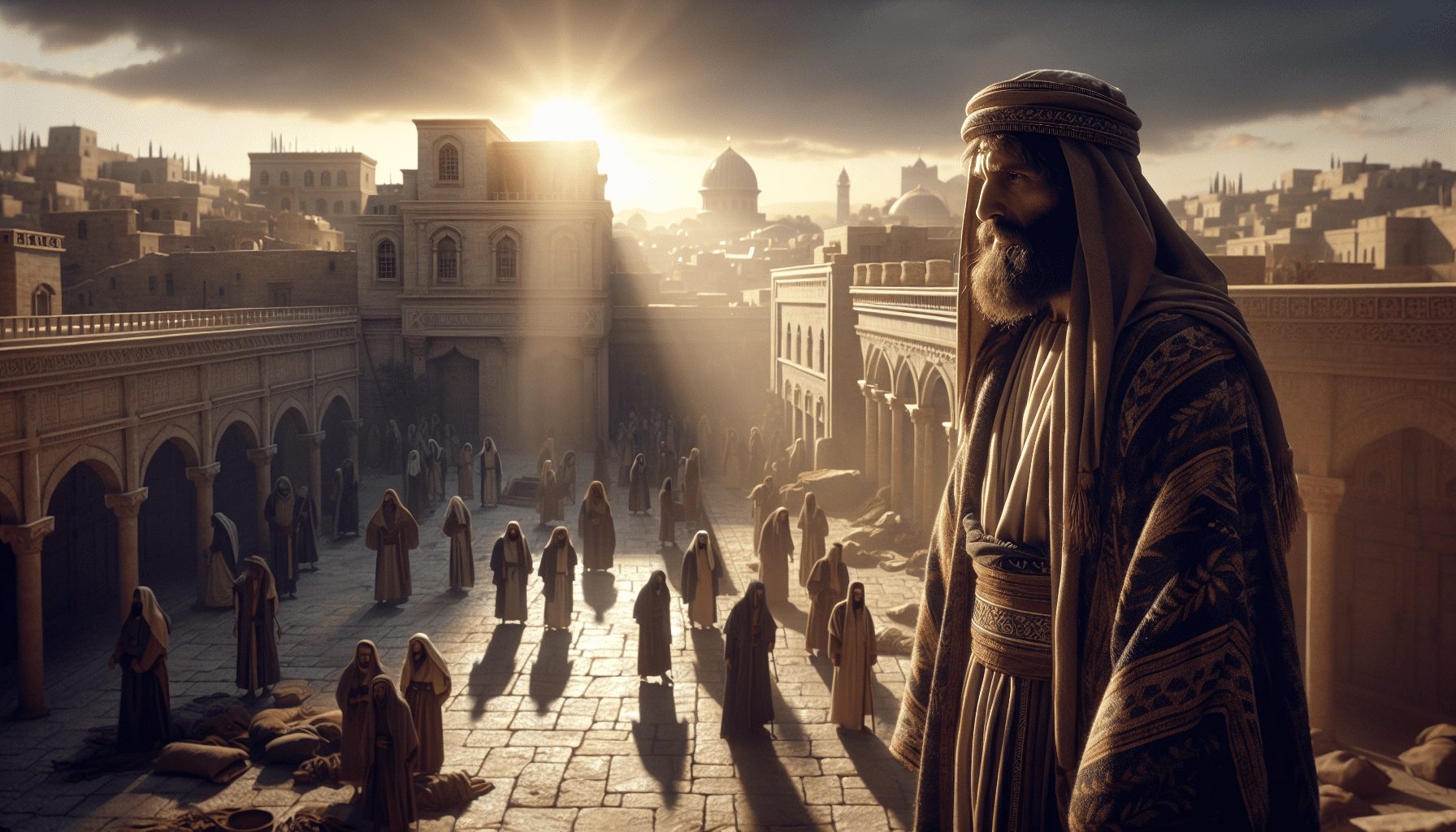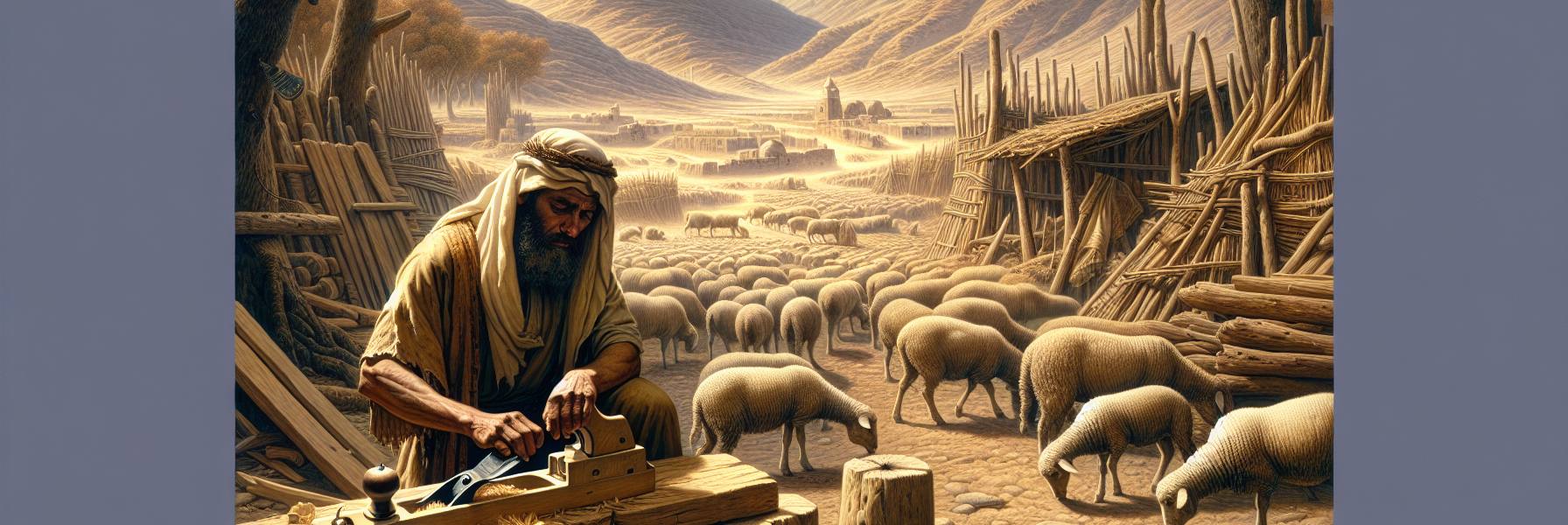

The heat had settled over the hills of Judah like a wool blanket, thick and suffocating. It was the kind of drought that made the stones groan, the vines wither into brittle brown threads, and the sheep crowd listlessly into whatever meager shade the twisted oaks could offer. In the town of Moresheth, a day’s walk southwest of Jerusalem, the air tasted of dust and despair.
Micah sat in the doorway of his house, not his own, but one he was repairing for a widow whose sons had gone to seek work in the capital. The calloused heel of his hand pushed a plane along a length of olive wood, the shavings curling and falling to the dry earth like pale, fragrant tears. He was a man of the land, his forearms corded from the work, his face lined from the sun, but his mind was a tempest. Words churned within him, words that were not his own, a terrible, beautiful, devastating music. It had been building for weeks, this pressure behind his eyes, this ache in his bones that had nothing to do with labour.
It began not with a voice, but with a vision of the earth itself. He saw it not as solid ground, but as a thin crust over a hidden fire. He saw the Lord, not as the priests in Jerusalem described Him in their gold and smoke, but as a force of nature, descending. Not to the temple, not to the holy mountain, but to the high places, to the rooftops of Samaria. The vision was so vivid the plane slipped from his grasp, thudding dully against the dirt.
He stood, leaving his tools, and walked out of the town, drawn towards the barren hills. The people he passed moved slowly, their eyes hollow. They spoke of the failed rains, of the Ammonites raiding the eastern flocks, of the heavy tributes demanded by King Jotham to fortify the cities. They did not speak of the altars they had built on every hilltop to gods of field and fertility, the small teraphim hidden in their homes, the silent compromises with the ways of the Phoenicians and the Philistines. But Micah saw it. He saw it as clearly as the cracks in the earth.
Reaching a rocky promontory that looked north, he stood still. And the word of the Lord broke upon him.
It was a seeing, a hearing, a feeling all at once. The Lord was coming forth from His place. He would tread upon the high places of the earth. And the mountains would melt under Him, like wax before a fire, and the valleys would burst open, like waters poured down a steep slope. It was for the transgression of Jacob, for the sins of the house of Israel. What was the transgression of Jacob? Was it not Samaria? And what were the high places of Judah? Were they not Jerusalem?
Samaria. The very name tasted of opulence and decay. He had been there once, as a young man, delivering a flock. He remembered its arrogant beauty built on a hill, its walls inlaid with ivory from the great trade routes, its people soft with wine and the strange, alluring cults from across the sea. He saw it now in his spirit, not as a city, but as a festering wound. The Lord’s judgment was not an abstract decree; it was a physical, unraveling reality. He saw Samaria’s idols ground to powder, her wealth given to the fire, her stones tumbled into the valley below, her foundations laid bare. She was a harlot, and her hire would be burned with fire.
A sound escaped Micah’s lips, a ragged groan of grief. This was not a distant prophecy about a hated northern rival. Samaria’s disease had seeped south. It had crept down the trade roads and into the hearts of Judah’s rulers. It was in the market squares where the scales were dishonest, in the mansions of Jerusalem built with blood and iniquity, in the hollow rituals performed by priests who winked at injustice.
The vision turned, relentless, towards his own homeland. “Therefore I will make Samaria a heap in the open country,” the word thrummed within him, “a place for planting vineyards.” He saw it, vividly: not a majestic ruin, but a tumbledown pile of rubble, where one day a poor farmer would grub out stones to plant a vine. The utter, complete reduction of pride to utility.
And it would not stop at the border. The malignancy had spread. “For her wound is incurable; it has come to Judah.” The judgment was a flood, reaching to the very gate of Jerusalem itself. The names of his own world, the towns of the lowland he knew so well, became mourners in a funeral dirge.
He spoke them aloud, his voice cracking in the dry air, each name a play on words of coming doom. “Tell it not in Gath,” he muttered, but the weeping would be in Beth-le-aphrah—‘House of Dust.’ He saw the citizens rolling themselves in dust. “You who live in Shaphir—‘Beautiful Town’—will go away stripped and shamed.” The inhabitants of Zaanan—‘Going Out’—would not dare to go out. The lamentation of Beth-ezel—‘House of Removal’—would mean its very support was removed.
On and on the terrible litany went, a map of sorrow drawn over the familiar landscape. Maroth—‘Bitterness’—waiting for good, but only evil came. Lachish, that proud, fortified city, the beginning of sin to Zion, for there they first adopted the ways of the nations. He saw swift horses harnessed to chariots of flight, but they would be useless. Moresheth-gath, his own region, would receive a parting gift from its conquerors. Achzib—‘Deception’—would prove a deceptive brook that runs dry in summer to the kings of Israel.
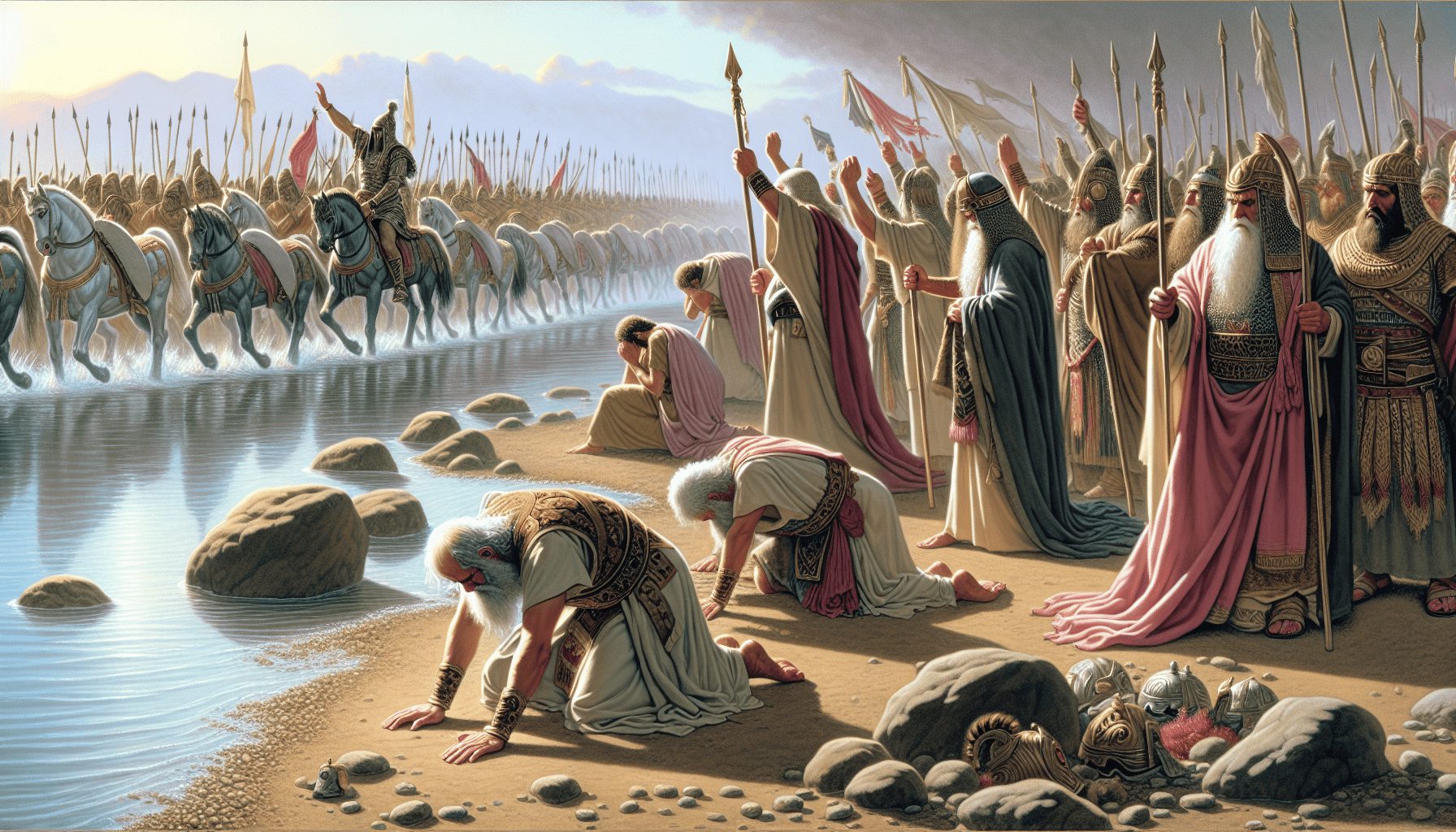
Finally, his inner sight turned to Mareshah, a mighty fortress. He saw a glory, a conqueror, coming to Adullam. And the call was piercing: “Make yourselves bald and cut off your hair for the children of your delight; make yourselves as bald as the vulture, for they shall go from you into exile.”
The vision lifted. The heat of the day returned, pressing in on him. Micah sank to his knees, his shoulders shaking. This was not the eloquent, polished prophecy of court seers. This was ripped from the soil and the soul. It was the cry of the land itself against those who defiled it, the anguish of a God who had planted a vineyard and found only wild, sour grapes.
He stood, eventually, legs unsteady. He turned his back on the northern view and began the slow walk down to Moresheth. The people were still moving slowly in the streets. The widow asked if the doorframe was finished. He looked at her, and his eyes were pools of a grief too large for his face. He did not speak the words yet. They were a fire shut up in his bones. But he knew they would come. He would have to walk to Jerusalem, to stand before the great and the powerful, and speak of melting mountains, of Samaria’s rubble, of Lachish’s shame, and of a ploughman one day scratching at the stones of a fallen civilization.
He picked up his plane again. The familiar grain of the wood under his fingers was the only solid thing in a world that had just been revealed to be as fragile as a clay pot. He worked in silence, the weight of the future pressing down on him, a man marked by a word he could not un-hear, a witness to the terrible, tread-down approach of the Holy One of Israel.