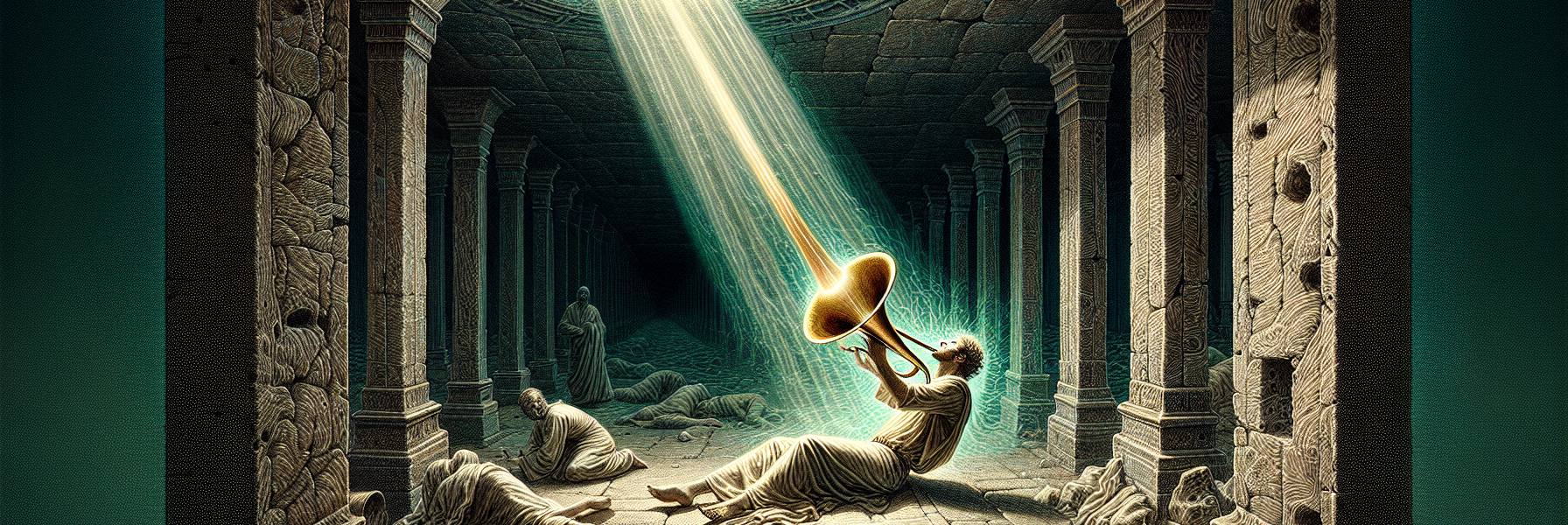

The air left my lungs, not in a gasp, but in a quiet, final sigh, as if the very act of breathing had become a trivial thing. One moment, I was tracing the cracks in the ceiling of my cell, the rough stone cold against my back. The next, there was a sound—not around me, but *within* me, like the deep, resonant note of a trumpet heard in the marrow of one’s bones. It wasn’t a call to battle, but a summons. “Come up here,” it said, and the words were both sound and meaning, bypassing the ear entirely.
And then I was no longer in the cell.
It is difficult to speak of what happened next in the sequence of time, for time itself seemed to fray at the edges. There was a transition, a sense of being drawn through the fabric of things, and then… sight. Not the sight of eyes, but the comprehension of a reality laid bare.
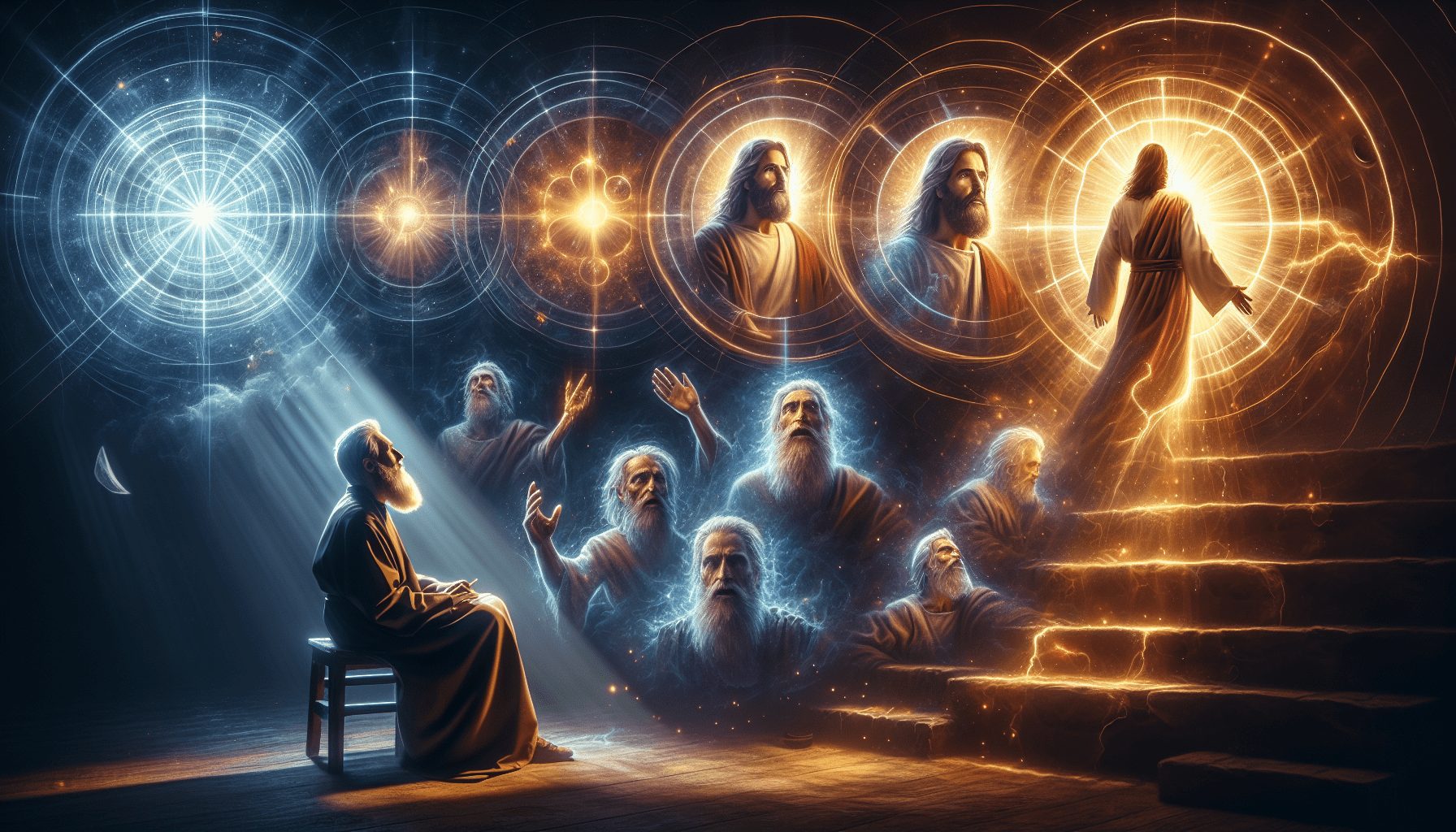
Before me was a throne. To call it magnificent would be to call the sun warm—true, but a laughable understatement. It was the fixed point, the axis around which all creation quietly turned. It was high, and set in heaven, yet its presence made heaven seem merely its footstool. From it emanated a light that was not so much seen as known—a soft, terrifying, glorious radiance that was the source of all other lights. It was the color of jasper, but a jasper on fire from within with a thousand shifting hues of gold and crimson; and of sardius, a deep, blood-red warmth that pulsed like a living heart. And around the throne was a halo, an emerald rainbow that shed a cool, perpetual twilight of green, a mercy to the eyes that could not bear the direct glory of the center.
Around this central throne were twenty-four other thrones, lesser only in comparison, and upon them sat twenty-four elders. They were clothed in white garments, so pure they seemed woven from captured moonlight, and upon their heads were crowns of gold. Their faces were wise and weathered, bearing the marks of long journeys ended, and their eyes held the stillness of deep waters. They did not fidget, nor speak, but sat in a perfect, attentive silence, their gaze fixed on the center of all things.
And from the throne came flashes of lightning, and rumblings and peals of thunder. This was not the chaotic storm of earth, but the ordered, powerful speech of sovereignty, the audible expression of a will that could shatter galaxies with a whisper. Before the throne, seven torches of fire blazed, which were the seven spirits of God—not separate flames, but one fire in seven distinct manifestations, dancing and intertwining.
But it was the creatures that held my attention, the four living ones. They were in the midst of the throne, and around it, part of its reality. The first was like a lion, but its majesty was that of regal authority, not mere predation; its golden mane was a cascade of living light. The second was like an ox, its strength the patient, enduring power that bears burdens and turns the wilderness into a field. The third had a face like a man, its countenance alight with intelligence and compassion, the image of the Creator himself. The fourth was like a flying eagle, its gaze piercing to the farthest horizons, seeing the end from the beginning.
Each of them had six wings. This detail struck me with peculiar force. With two they covered their faces, for not even these glorious beings could gaze directly upon the fullness of Him who sat on the throne. With two they covered their feet—or what served as feet—in a gesture of humility, acknowledging that even their service was unworthy. And with two they flew, ceaselessly, not to travel from place to place, but in a perpetual motion of readiness, of energized worship.
And they did not rest, day or night. Their voices filled the spaces between the thunder, a chant that was the foundation of all other songs. “Holy, holy, holy,” they said, “is the Lord God Almighty, who was, and is, and is to come.” The word “holy” did not sound three times, but was a single, three-fold truth, echoing into eternity past and future. It was a holiness of utter separation, of absolute moral fire, of a nature so other that to stand in its presence was to understand, for the first time, what it meant to be created.
Whenever the living creatures gave this glory and honor and thanks to Him who sat on the throne, who lives forever and ever, the twenty-four elders would move. In a slow, synchronized motion born of perfect reverence, they would rise from their thrones. They would lay their crowns before the great throne, the gold clinking softly on the crystal-like sea that spread before it—a sea not of water, but of glass, clear as crystal, holding the reflections of the glory above. This was not a loss, but the ultimate fulfillment of their rule: to return all authority to its source.
And falling down before Him who sat on the throne, they would worship Him who lives forever and ever. Their voices, deeper and layered with the weight of lived experience, would join the angelic chant, but they added a reason, a testimony: “Worthy are you, our Lord and God, to receive glory and honor and power, for you created all things, and by your will they existed and were created.”
The song never ceased. It was a symphony without a final cadence, a river of praise flowing from the creatures to the elders and back to the throne, rising and falling like breaths. The lightning and thunder were its percussion; the shimmer of the emerald rainbow its ambient harmony. I realized, with a clarity that was both crushing and liberating, that this was not a special event. This was the constant, unending reality of the center of all things. My prison cell, my island of Patmos, the Roman Empire, the whole spinning world—they were the periphery, the fleeting shadow. *This* was the living core.
I do not know how long I was there, for there was no “long.” There was only “is.” The weight of the glory was immense, a pressure on the soul that would have been annihilation were it not also the source of its very existence. It was terrifying beauty. It was love as a consuming fire.
Then, as gently as I had been taken, the focus shifted. The trumpet-note within me faded to a memory. I felt the rough stone of my cell against my back once more. The smell of damp earth and old straw replaced the scent of ozone and incense. But nothing was the same. The silence in my cell was now a deafening thing, for it was the absence of that eternal song. The darkness was not just the lack of light, but the lack of *That* light.
I sat in the straw, trembling not from cold, but from the aftermath of a vision that had rewired my understanding of reality. I had seen the throne. And having seen it, I knew that every other power, every emperor, every chain, every threat, was a temporary noise against the everlasting, thunderous silence of His sovereignty. The One who sat on the throne was, and is, and is to come. And that, I knew as I began to scratch words onto wax in the dim light, changes everything.