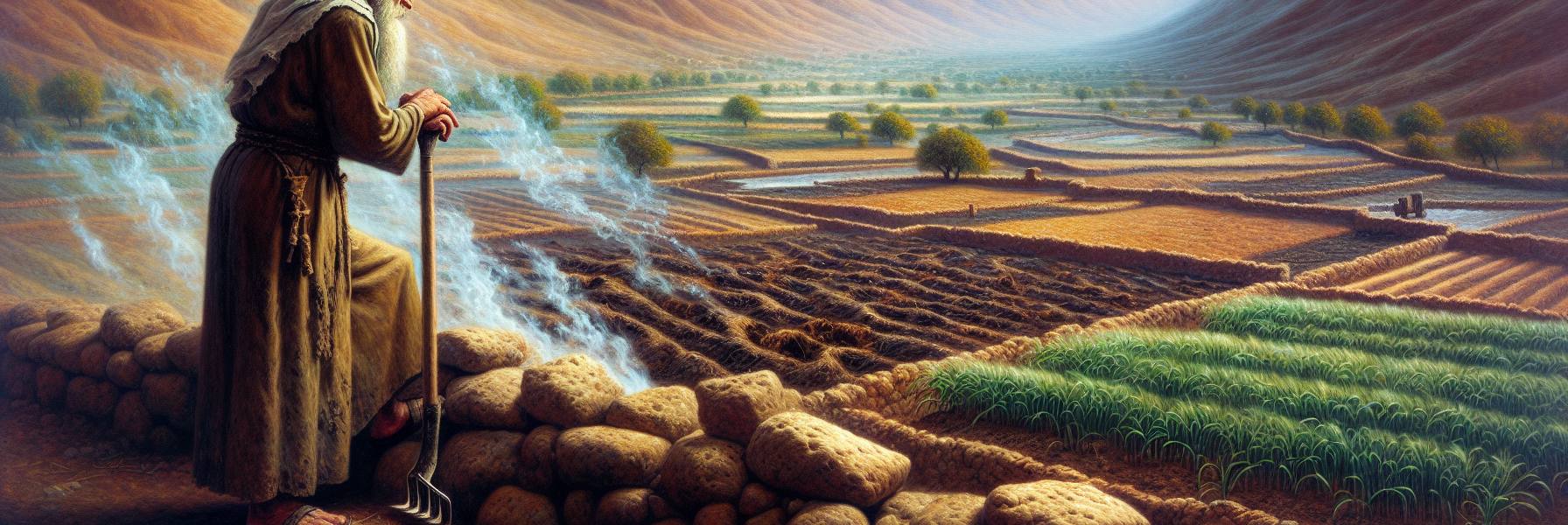

The air in the valley still carried the smell of old smoke. It wasn’t the sharp, acrid scent of a fresh fire, but something deeper, woven into the soil and the stones—the memory of burning. Asher leaned on his hoe, the wooden handle smooth and dark from generations of hands, and looked out over the fields. They were patchy. Clumps of green barley struggled against the persistent brown of scorched earth and stubborn weeds. It was a land in remission, neither fully healed nor wholly broken.
His grandfather, Eleazar, sat on a low stone wall at the field’s edge, his eyes not on the struggling crops, but on the western hills. His voice, when it came, was like the sound of those stones grinding together.
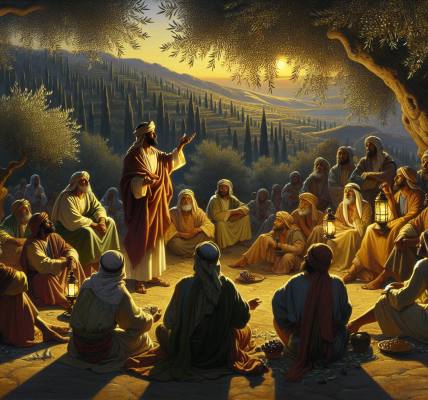
“You know, boy, this dirt remembers.” He didn’t turn. “It remembers when it laughed. When the furrows were dark and deep, and the grain stood taller than a man’s waist. The ground shouted with abundance. That was when His favor was like a clear sun, warming everything without burning.”
Asher wiped his brow. He’d heard fragments of this before—the “Before Times,” a hazy golden age painted in stories. It felt less like history and more like a dream of another country.
“What happened?” Asher asked, not because he didn’t know the broad strokes, but because he needed to hear it here, on this half-dead field.
Eleazar was silent for a long moment. A breeze, dry and tasting of dust, rattled the few olive leaves left on a gnarled tree.
“We grew proud in the shade of that sun,” the old man said, his words measured. “We took the gift for the Giver. The prayers became habits, the feasts became parties, and justice… justice became a commodity for the market square. We forgot the tune of the song He’d taught us. So He withdrew His hand. Not in rage, no. Like a father who steps back to let a stubborn child feel the full weight of their own choice.”
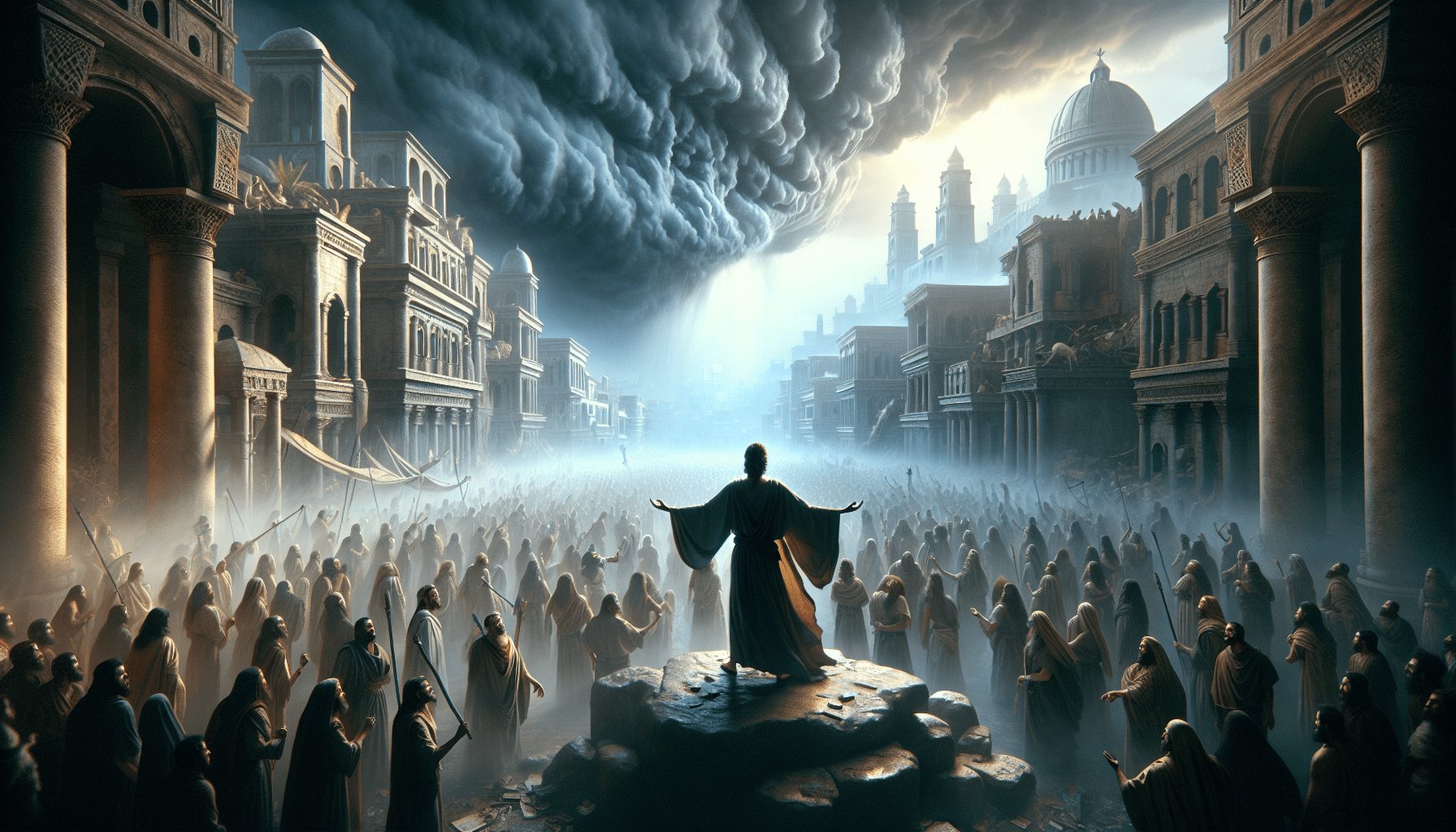
He finally looked at Asher, his eyes milky but piercing. “And we felt it. The armies came not as a foreign invasion, but as a consequence. The smoke we smelled then was fresh. The shouting wasn’t from the harvest, but from the streets. He poured out His wrath. He was angry with our prayers.”
Asher shivered despite the heat. He looked at his own hands, calloused from trying to wrest life from this reluctant ground. This was the inheritance: not just the land, but the lingering silence.
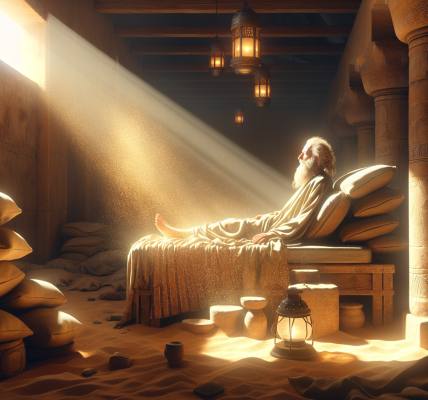
That evening, in the small house that still bore a charred mark on one lintel, Eleazar did something he hadn’t done in years. He took the old scroll, its leather casing cracked, and unrolled it gently. He didn’t read it aloud at first. His gnarled finger traced the script, his lips moving silently. Asher watched, the last of the daylight bleeding through the single window.
“Will you be angry with us forever?” Eleazar’s voice was a whisper, but it filled the room. “Will you prolong your anger through all generations?” He paused, the question hanging in the dusty air. It wasn’t recited; it was dug up from some deep place within him. “Will you not revive us again, that your people may rejoice in you?”
It was a plea, but not a desperate one. It was weathered, like the old man himself. It carried the weight of the charred lintel, the patchy fields, the empty places at the table.
“Show us your unfailing love, Lord,” Eleazar continued, his voice gaining a fragile strength. “Grant us your salvation.”
The words weren’t magic. They didn’t shake the house. A moth battered itself against the oil lamp. But something settled in the room. A shift, subtle as the change from day to deep twilight. The prayer wasn’t about erasing the past; it was about navigating the bleak, ongoing present.
Days turned. Asher worked. One morning, he noticed a thicker cluster of barley near the old wall. It wasn’t miraculous, just a lucky spot where moisture collected. But as he looked at it, his grandfather’s words about “steadfast love and faithfulness meeting” echoed strangely. They were just words from a scroll. Yet, watching a bee stumble clumsily from one barley head to another, they felt less like poetry and more like a description of something slowly, quietly at work.
Peace wasn’t a trumpet blast. It wasn’t the sudden absence of struggle. Peace, Asher began to see, was the capacity to kneel in the dirt, plant a seed in soil that had known fire, and trust—not in a guaranteed harvest, but in the character of the One who gave the seed and the soil and the rain. It was righteousness and peace kissing in the messy, uncertain middle of things, not at some pristine, far-off conclusion.
Weeks later, the first real rain came. It wasn’t a storm, but a slow, soaking drizzle that fell steadily for a day and a night. Asher stood in the doorway, breathing in the petrichor—the scent of dust finally being forgiven. Eleazar stood beside him.
“Truth springs from the earth,” the old man murmured, almost to himself. “And righteousness looks down from the sky.”
Asher looked out. The greening fields seemed to push up a little more bravely. The hills in the distance, hazy with rain, seemed less like barriers. The path forward wasn’t a road back to some lost golden age. It was a trail through a recovering land. God would give what was good. Their job was to prepare the ground for it, to walk the path of faithfulness, however clumsily, one foot in front of the other. The yield would not be forced, but given. A gift, not a wage.
The old smoke smell was finally gone, washed away. What remained was the clean, damp scent of possibility, and the quiet, unshakable promise that the Lord’s footsteps were somewhere ahead, on this very same path.