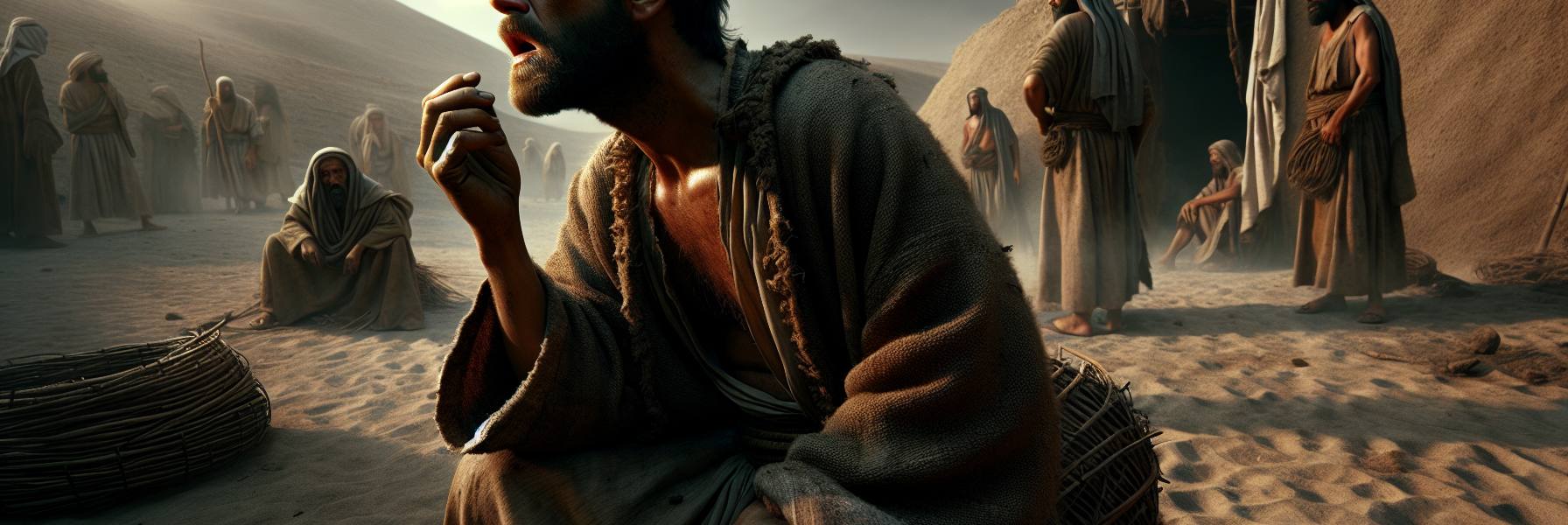

The heat had settled into the bones of the earth, a dry, pressing thing that made the air over the ash heap shimmer. Zophar the Naamathite shifted where he sat, the rough wool of his robe scratching against his impatience. He had listened, and listened, and the words of Job had become like a constant, grating wind—a wind that spoke of injustice and a hidden God. It was too much. The tidy world Zophar understood, a world of clear cause and consequence, was being smeared by Job’s relentless, suffering truth.
He cleared his throat, a sound like stones grinding. His companions turned weary faces toward him.
“Therefore,” Zophar began, and the word was heavy, a door slamming shut on speculation, “my troubled thoughts make me answer, and this is why I feel agitated.” He wasn’t a poet like Job; his speech was a tool for building walls, not windows. “I have heard a rebuke that dishonors me, but my understanding prompts my reply.”
He leaned forward, his eyes not on Job’s ruined face, but on some middle distance where his logic stood pure and untouchable. “Do you not know this, something established since antiquity, from the time humanity was placed on earth? That the triumph of the wicked is brief, the joy of the godless momentary?” He said it as if reciting a law of nature, like the rising of the sun. “Though his pride touches the clouds and his head reaches the heavens, he will perish forever, like his own dung; those who have seen him will say, ‘Where is he?’”
Zophar’s voice took on a rhythmic, driving quality. He painted a picture not with beauty, but with a brutal, visceral certainty. The wicked man, he said, would vanish like a dream, chased away like a vision of the night. Eyes that glimpsed him would do so no more; his very place would disown him. His children would be forced to seek the favor of the poor, and his own hands would have to give back his ill-gotten wealth. The vigor of his youth would be buried in the dust.
“Though evil is sweet in his mouth, and he hides it under his tongue,” Zophar continued, his own mouth twisting as if tasting something foul, “though he savors it, letting it linger on his palate, yet his food will turn in his stomach; it will become the venom of asps within him.” The metaphor was ugly, digestive. It spoke of a corruption that began as pleasure and ended as a killing rot inside. “He has swallowed riches, but he will vomit them; God will force them from his belly.”
There was no mercy in Zophar’s vision, only mechanics. He described a man sucked dry by greed he could never satisfy, a man who, because he crushed and abandoned the poor, seized a house he did not build. “There will be no ease in his appetite; nothing he desires will remain. When his table is full, disaster will strike him; when he thinks himself secure, the full force of misery will come upon him.”
His words came faster now, painting the inevitable end in stark, elemental colors. “Let his belly be filled with the fury of God; let Him rain down His censure upon him. Though he flees from an iron weapon, a bronze-tipped arrow will pierce him through. It is drawn and comes out of his back, the gleaming point from his gall. Terrors come over him.”
Zophar’s eyes finally swept over Job, lying in the dust. “Total darkness is reserved for his treasures. A fire fanned by no human hand will consume him; it will devour what is left in his tent. The heavens will expose his guilt, and the earth will rise up against him. A flood will sweep away his house, torrents on the day of God’s wrath. Such is the portion God allots to the wicked, the heritage decreed for him by God.”
He stopped. The last word hung in the hot, still air. He had built his case, stone by heavy stone, a tomb of theology for the living man before him. He had spoken of hidden venom, of swallowed wealth vomited up, of darkness and unquenchable fire. He sat back, his own agitation momentarily spent, convinced he had not just spoken truth, but had enacted a kind of justice simply by declaring it. The silence that followed was not peaceful, but thick and charged, waiting for the wounded man in the center to stir, to speak again, and to shatter, once more, the clean, terrible edifice Zophar had just constructed.