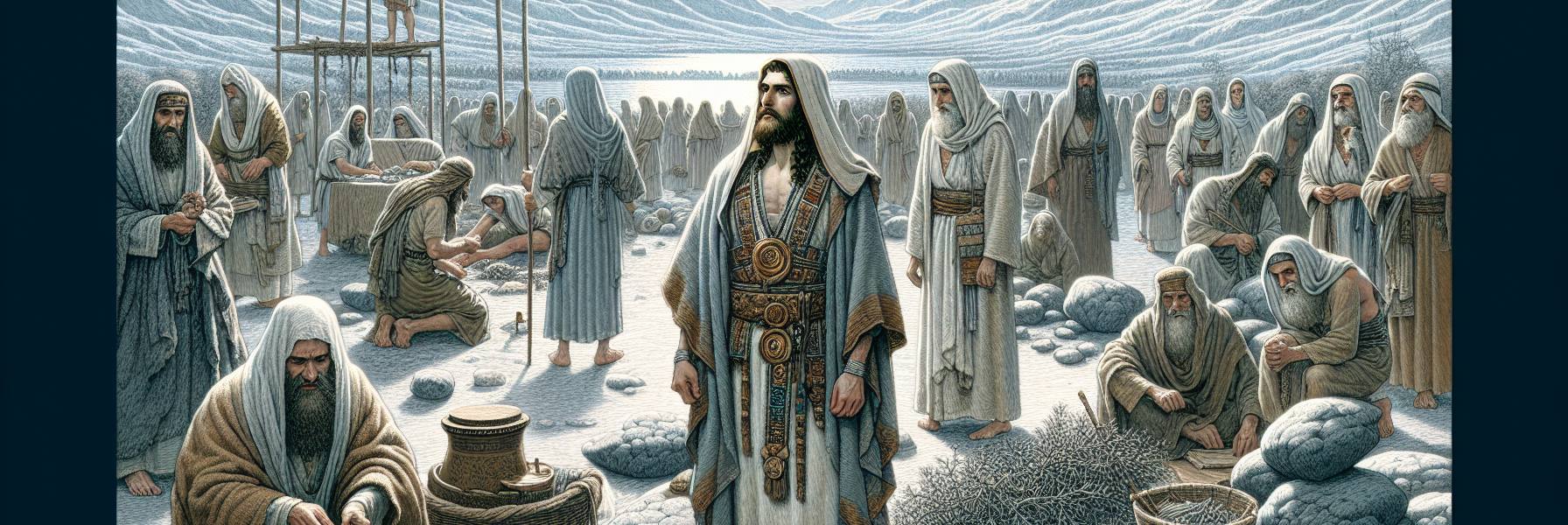

The sun was a pale, heatless coin in a white sky the morning they brought the leper to the camp’s edge. Eliav heard the commotion long before he saw the man—a brittle rattle of stones underfoot, the low murmur of a crowd keeping its distance. He had been sorting hyssop, the sharp, green scent clinging to his fingers, when the message came. His father, the priest, was ill with a fever. The duty fell to him.
He walked slowly, feeling the weight of the linen robes, the ephod unfamiliar on his shoulders. The law was a map in his mind, its pathways strict and unyielding. He knew Leviticus fourteen. He had copied it, studied it, heard it recited since boyhood. But knowing the words was not the same as standing before the brokenness they sought to mend.
The man waited beyond the last tent, where the wilderness began. He stood apart as the law demanded, a figure swathed in rags that fluttered like grey leaves. His head was bowed, but as Eliav approached, he lifted it. The disease had been kind in its cruelty; it had taken two fingers on his left hand and left a smooth, pinkish patch like spilled wax across his jaw, but it had spared his eyes. They were dark, deeply set, and held a stillness that was neither hope nor despair, but a terrible, waiting patience.
“Show me,” Eliav said, his voice sounding too young in his own ears.
The man, named Jareb, as Eliav would later learn, obeyed without a word, moving his garments aside. Eliav examined the marks, his own breath tight in his chest. The flesh was clean, no longer raw or spreading. The sickness had gone quiet. He felt no revulsion, only a profound sense of solemnity. This was not a man, in this moment; he was a question posed to heaven, and Eliav was the tongue to speak the ritual answer.
“It is healed,” Eliav announced to the distant watchers. Then, to Jareb, he recited the first command. “You will be brought two live, clean birds, cedar wood, scarlet yarn, and hyssop.”
The items were fetched. The ritual was a stark, strange poetry. Eliav took one bird over an earthenware vessel filled with fresh, running water from the spring. He killed it, letting the blood trickle and mix with the water. A childhood memory flashed—his father teaching him how a life given could make a medium for cleansing, not defilement. He dipped the second bird, alive and fluttering, into the bloodied water, along with the cedar, the scarlet thread, and his bundle of hyssop. He sprinkled the mixture seven times upon Jareb. The blood-flecked water struck the man’s forehead, his hands. He did not flinch. Then Eliav released the living bird into the open field. It flew, a swift, erratic dash toward the horizon, carrying the symbol of the malady away into the emptiness.
“He shall wash his clothes, shave off all his hair, and bathe in water,” Eliav instructed. “Then he may enter the camp, though he must remain outside his tent for seven days.”
He watched Jareb turn toward the river. His steps, at first hesitant, grew longer, quicker. He was not yet clean, not yet restored, but the bird was gone. The symbol had flown.
A week passed. Eliav visited his father, studied, tried to pray. On the seventh day, he found Jareb again. The man was transformed. His hair and beard were gone, shaved to the skin, giving him the vulnerable look of a newborn. He had washed. He stood straighter.
The second act of the ritual was more complex, a slower weaving of the man back into the fabric of community and covenant. Eliav brought him to the entrance of the Tent of Meeting. The air smelled of dust and hot stone and the faint, perpetual scent of smoke from the altar.
Two male lambs, one for a guilt offering, one for a burnt offering. A ewe lamb for a sin offering. Three-tenths of an ephah of fine flour mixed with oil for a grain offering. And a log of oil. The wealth of restoration was not insignificant. It cost something to be made whole.
Eliav placed his hands upon the head of the guilt offering, transferring Jareb’s liability, the debt of his isolation. He slaughtered it. Taking some of its blood, he daubed it on the ridge of Jareb’s right ear, on the thumb of his right hand, on the big toe of his right foot. Touch, work, walk—every faculty dedicated anew. He repeated the motions with the oil, pouring a measure into his own palm, anointing the blood-marked spots, then sprinkling oil seven times before the Lord. The rest he poured upon Jareb’s head. It ran in slow, glistening tracks down his bare scalp and onto his shoulders, a lubricant for a life grinding back into gear.
The sin offering, burnt offering, and grain offering followed, their smoke rising in a placid column. The procedure was meticulous, a physical liturgy. Eliav’s movements became less studied, more fluid, as if the ritual itself was moving through him. He understood it then, not just as law, but as narrative. The blood spoke of a life laid down to touch a defiled one. The oil spoke of consecration, of the Spirit’s touch. The offerings spoke of atonement, dedication, and gratitude. It was all one story—a story of return.
“You are clean,” Eliav said finally, his voice hoarse from the smoke and the chanting.
Jareb looked at his own hands, at the gleaming oil on his thumb. He looked at Eliav, and the stillness in his eyes had broken into a brightness that was almost unbearable. He said nothing. He didn’t need to. He simply turned and walked, not toward the wilderness, but into the heart of the camp, toward a tent where a woman stood weeping in a doorway, her hands pressed to her mouth.
Eliav stood alone by the altar, the smell of smoke and oil and blood around him. He was weary. His father would recover and resume his duties. But Eliav knew he would never forget the feel of the oil in his hand, the sight of the bird’s frantic freedom, or the sound of a woman’s weeping joy from within the camp. The law was not a cold list. It was a door, heavy and cumbersome, swinging open on tired hinges. And on the other side was a man, coming home.