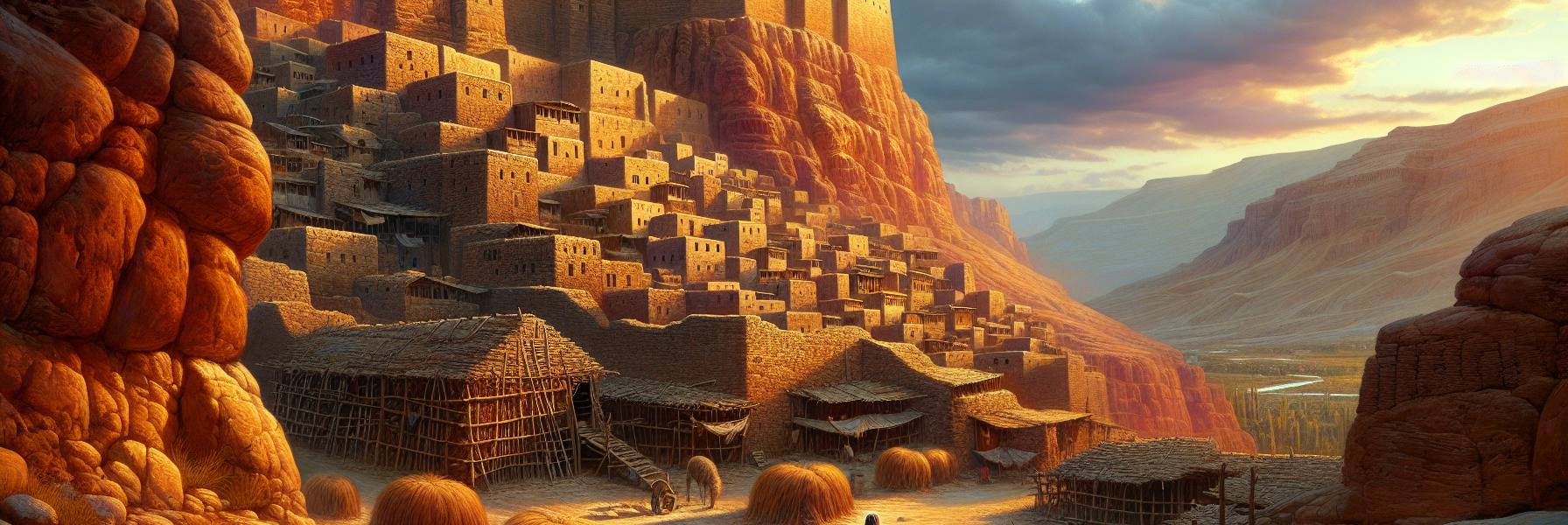

The walls of Jericho were not just stone; they were a presence. They loomed over the clay-brick houses huddled at their feet, a declaration of permanence carved from the very bones of the earth. Up close, their surface was a tapestry of weather and time, pocked and streaked, warm to the touch even as the evening chill descended from the hills of Moab. It was against this warm, rough stone that Rahab leaned, listening to the city breathe its last easy breaths.
Her house was part of the wall, a fact of commerce and convenience. From her upper room, the flat roof was just a few steps away, a place to dry flax stalks that lay in neat, fragrant bundles, their pale stalks gleaming in the fading light. The view was of two worlds: inward to the tangled, smoky lanes of the city, and outward to the vast, darkening plain of the Jordan, where the river wound like a sluggish, bronze serpent.
She heard the gate tensions before she saw the men. A shift in the rhythm of the guards’ calls, a hardening in the questions barked at the dwindling traffic. Strangers. She knew the sound of it. By the time the heavy fist beat against her door, she had already calculated the risk. Strangers meant coin. Strangers also meant attention, a currency more dangerous than silver in a city whispering with fear.
She opened the door not with a flourish, but with the weary practicality of a woman who has seen every kind of man. They stood there, dust-ground and tense, trying to wear the casual air of traders but failing. Their eyes held the hollowed look of men who have been running, not walking. Canaanite, but not from any city she knew. She took in the cut of their clothes, the subtle difference in their sandals.
“The night is cold,” she said, her voice flat. “Come in. The wine is thin, but it will warm you.”
They entered, and she barred the door. No words were needed. The king’s men came not long after, their arrival announced by the scattering of children and the sudden silence of the street. The knock was authoritative, final.
“Bring out the men who came to you,” the voice from outside demanded. “They are spies of the Israelites.”
Rahab felt the two men freeze in the shadow of the inner room. She did not look at them. Instead, she moved to the door, opening it just enough to show her face, painted with credible annoyance.
“Yes, the men came to me,” she admitted, wiping her hands on her skirt. “But I did not know where they were from. And truly, they left at dusk, just as the gate was about to be shut. I do not know which way they went. If you hurry, you might catch them.”
She let the lie sit, simple and complete. The captain’s eyes searched hers for a heartbeat, then he barked an order. The soldiers’ footsteps clattered away, rushing toward the fords of the Jordan, chasing phantoms into the wilderness.
She closed the door and leaned against it, the thud of her own heart loud in the sudden quiet. Then she climbed the steps to the roof where the men now stood, poised for flight. The stalks of flax lay between them like a quiet promise.
“I know,” she said, her voice low, all pretense gone. “I know that the Lord has given you this land. A great dread has fallen on us. We have heard how the Lord dried up the waters of the Red Sea for you when you came out of Egypt, and what you did to Sihon and Og, the two kings of the Amorites east of the Jordan. Our hearts melted. There is no courage left in any man because of you. For the Lord your God, He is God in the heavens above and on the earth beneath.”
The words hung in the cool air. It was not flattery. It was the weary confession of a woman who had listened to the tavern terror of soldiers and had seen the hollow eyes of priests offering sacrifices to gods who seemed suddenly small and silent. She had pieced together a truth from the frayed edges of rumor, and it had led her to a faith that was, in that moment, more solid than the walls around her.
“Now then,” she said, her tone turning practical once more, “swear to me by the Lord that you will show kindness to my family. Give me a sure sign that you will spare my father and mother, my brothers and sisters, and all who belong to them.”
The men, shaken by the raw conviction in her voice, agreed. “Our lives for yours,” they said. “If you do not tell of this business, we will deal kindly and faithfully with you when the Lord gives us the land.”
Then she let them down by a rope through the window, for her house was built into the city wall. But first, she gave them instructions. “Go to the hills,” she said, “so the pursuers will not find you. Hide yourselves three days until they return. Afterward, you may go on your way.”
They handed her a length of scarlet cord. “Tie this in the window through which you let us down,” the older one said. “Gather your father and mother, your brothers, all your family into your house. If anyone goes out of the doors of your house, his blood shall be on his own head. But if a hand is laid on anyone who is with you in the house, his blood shall be on ours.”
She nodded, the rough cord feeling alive in her hands. “According to your words, so be it.”
She watched them disappear into the bruised shadows of the ravine, two specks swallowed by the gathering night. Then she tied the cord. It was a foolish thing, really—a splash of red against the dun-colored clay, a tiny, defiant signal invisible to anyone not looking for it. She stood there for a long time, the sounds of the city—a baby crying, a donkey braying, a snatch of drunken song—floating up to her. They were the sounds of a world living on borrowed time.
Inside, the cord was just a piece of dyed rope. But in her mind, it was a boundary, a promise etched in blood-red thread. It marked the line between the old world, which was passing away in terror, and a terrifying, hopeful new one, born from a God who split seas and made the hearts of kings melt. She had staked everything on a story heard from a distance. Now, all she could do was wait, and gather her family, and watch from a window framed in scarlet.