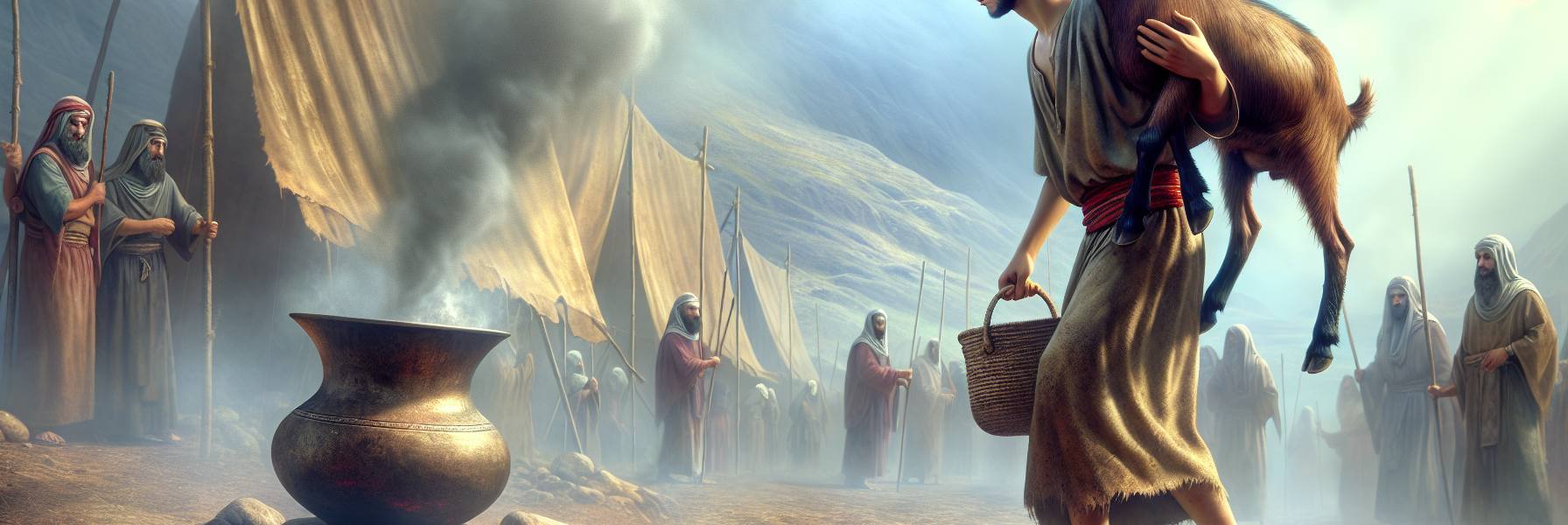

The air in the court of the Tabernacle was thick, a compound of dust, animal musk, and the faint, iron scent that always lingered near the altar. Eliah adjusted the young goat on his shoulders, feeling its warmth through his tunic, the steady, slowing beat of its heart against his neck. It was a good animal, unblemished, its coat a smooth brown. He had chosen it himself from the flock, running his hands over its legs, checking its eyes for clarity. This was not an offering for atonement, not exactly. This was something else, something rarer and, in its own way, more intimate. A peace offering. A *shelamim*.
His sandals scuffed the hard-packed earth as he approached the bronze altar. Smoke rose in a grey column, flattening against the brilliant blue of the sky. He could hear the low chant of the priests, the crackle of the sacred fire, the distant murmur of the camp beyond the linen curtains. His cousin, Aaron’s son Eleazar, met him with a nod, his linen robes stained with the work of the day. No words were needed; the ritual was a known path.
“Your hands, Eliah,” Eleazar said, his voice calm but carrying over the ambient noise. Eliah placed his hands heavily on the animal’s head, pressing down. The goat stood still, strangely docile. In that moment, the weight was more than physical. It was the weight of a silent vow, a gratitude he couldn’t quite articulate, a peace he sought not from God, but *with* God. He was not pushing his guilt onto the beast; he was joining himself to it, presenting their shared life before the Presence.
With a swift, practised motion, Eleazar drew the flint knife. The act was not brutal, but solemn, deliberate. A life given, not taken lightly. The blood, when it came, was caught in a bronze basin. Eliah watched, his throat tight. Eleazar moved quickly, flicking the blood against the sides of the altar with two fingers, a rhythmic splatter that painted the bronze with dark, running streaks. The blood, the life, was given directly to the holy space.
Then the work of separation began. The fat, the suet that covered the entrails, the long lobe of the liver, the two kidneys with their delicate casing of fat—all these Eleazar carefully removed with his hands and knife. Eliah watched, fascinated as ever by the specificity. It wasn’t the meat, the muscle, that was demanded first. It was the inward parts, the richest, most vital reserves of the creature’s body. The fat was peeled away in pearly sheets, gleaming in the harsh sunlight. Eleazar laid it all gently on the altar, atop the wood already blazing.
The smell changed then. The earlier scents of dust and blood were overpowered by a richer, deeper aroma. It wasn’t the smell of burning meat; it was sweeter, almost nutty. The fat hissed and sputtered, melting instantly into the flames, sending up a smoke that was thicker, whiter, more fragrant. “A food offering, a pleasing aroma to the Lord,” Eleazar murmured the familiar words, but to Eliah they felt new. This smoke was his gratitude made visible, his desire for peace turned into a scent that ascended.
Later, after the holy portions had been consumed by the fire, Eleazar brought back portions to Eliah: the breast, the right thigh. These were the priest’s share, and his own. The ritual had become a meal. Eliah carried the meat home, the warmth of it still palpable through the clean linen wrapping.
That evening, outside his tent, his family gathered. The fire was smaller, domestic. His wife, Miriam, roasted the thigh meat on a flat stone at the fire’s edge. The fat dripped and sizzled, and the smell, though similar, was different here—mingled with the smell of their bread, of the wild onions she had gathered. They ate until they were full, a rare and profound satisfaction. There was laughter. His youngest son, still unsteady on his feet, clutched a piece of meat in his greasy fist.
Eliah looked around the circle of fire-lit faces, then up at the first stars piercing the twilight. The peace of it settled in his bones. It wasn’t that the offering had bought peace, like a transaction. It was that the offering had *enacted* it. It had drawn a line from the thrumming, terrifying holiness of the Tabernacle court right to the heart of his own family, his own fullness. The goat’s life, given, had become their sustenance. God’s portion had gone up in sweet smoke; their portion now strengthened their bodies and their bonds.
He leaned back, listening to the quiet talk of his family, the crackle of their own small fire. The peace offering, he understood in a way that bypassed thought, was a bridge. It transformed the abstract concept of peace with the Almighty into something you could smell on the altar, taste on your tongue, and feel in the satisfied quiet of your own tent. It was a shared table, with God as the host who received the finest part, and left the rest for the joy of his children.