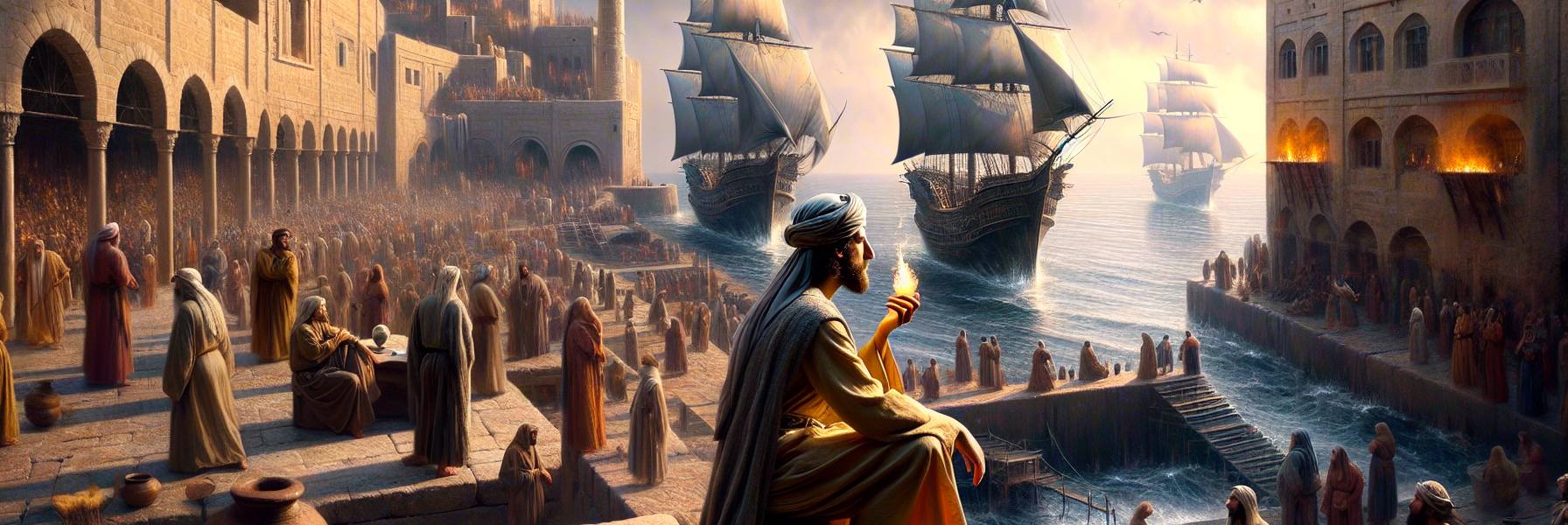

The heat in the port of Jaffa was a physical weight, a wool cloak soaked in brine and draped over the shoulders. I, Agur, son of Jakeh, felt it press upon my skull as I watched the Phoenician ships, sleek as hunting dogs, slide into the harbour. I was a man adrift, though my feet were planted on solid stone. The words of the sages in Jerusalem felt distant here, polished proverbs that rang hollow against the clamour of haggling merchants and the shriek of gulls.
My journey had been one of unlearning. I had gone to the wise men expecting answers, and found only more intricate questions. I had sat in the courts and heard the polished maxims, but they seemed to me like beautiful boxes—elegant, lacquered—but when opened, empty of the substance I craved. A weariness settled in my bones, a dust that no amount of water could wash away. It was in this state that I found myself muttering to the relentless sky and the relentless sea.
“I am weary, O God, I am weary and worn out.” The confession was not poetic. It was the grating sound of a millstone with no grain to grind. “Surely I am too stupid to be a man. I have not the understanding of a man. I have not learned wisdom, nor have I knowledge of the Holy One.”
The admission was a relief, a draining of a bitter cup. To claim ignorance was, in that moment, the only truth I possessed. I looked at the world—the intricate treachery of the merchant’s scales, the hidden alliances in a captain’ crew, the silent, desperate struggles in the eyes of the slaves—and I understood none of it. The proud certainty of other men seemed to me a castle built on mist.
I took shelter in a taverna, a dim room smelling of fish oil and sour wine. In the corner, two men argued with a feverish intensity. One, his fingers stained with ink, was a scribe from the court. The other, calloused and sun-cracked, was an old sailor missing two fingers. The scribe spoke of the mysteries of the divine name, of chariots and thrones in the heavens. The sailor spat on the packed-earth floor.
“You speak of what you have never seen,” the sailor growled. “Tell me this, scholar of scrolls: who has gathered the wind in his fists? Who has wrapped the waters in a garment? Who has established all the ends of the earth? Name him, if you know his name!”
The scribe blustered, quoting lineage and tradition. The old man just shook his head, a sad smile on his leathery face. “His name is a strong tower. The righteous run into it and are safe. You cannot speak it; you can only flee to it.”
His words, rough and salt-cured, struck me deeper than any temple hymn. This was a different kind of knowing. It was the wisdom of the limits. I left the taverna and walked up into the rocky hills beyond the town, the cicadas screaming in the olive groves. The questions began to form, not as challenges, but as prayers shaped by what I had seen.
*Two things I ask of you; deny them not to me before I die.* The thought was clear, a pebble dropped into a still pool. *Remove far from me falsehood and lying. Give me neither poverty nor riches; feed me with the food that is needful for me, lest I be full and deny you and say, “Who is the LORD?” or lest I be poor and steal and profane the name of my God.*
It was a plea for the narrow, difficult path. I had seen wealth warp the soul in Jaffa, turning brothers into rivals. I had seen the desperation of poverty grind a man’s honour into dust. I wanted only the portion that would keep my eyes clear and my heart dependent.
As dusk bled into the sky, I sat on an outcrop. Below, the world presented its relentless, enigmatic parade. I saw a line of ants, indefatigable, storing up summer harvest in their tiny granite halls. I saw the coneys, the rock badgers, creatures of no great strength, yet they made their home in the unshakeable cliffs. I saw a locust swarm in the distance, a brown cloud without a king, yet they advanced in perfect, devastating ranks. And I saw a lizard—you could catch it in your hand—yet it lived in the king’s palace itself, skittering over marble that cost a fortune.
Four things small, yet infinitely wise. Their wisdom was in their nature, in their acceptance of their design. They did not strive to be eagles; they perfected the art of being what they were.
The night came on, vast and star-pierced. The air cooled. From the palace gardens below, carried on a sudden breeze, came the sound of strutting, a clucking, arrogant noise. I peered down. There was a cock, magnificent in plumage, pacing before the hens. He knew his dominance, his place. And then I saw the he-goat, leading the flock with a stately, bearded arrogance. And then, a sight that made me catch my breath: a king, whose name I will not utter, being carried through the streets on a litter, surrounded by guards. The people made way, not out of love, but out of a fear as instinctive as that of a hen for the hawk. Three things with stately stride, four that are stately in their going: the cock, the he-goat, a king, and… my mind fumbled.
I waited. The answer came not from philosophy, but from observation. The final image rose in my mind from tales I’d heard in the desert: a creature none can tame, whose power is pure, unadorned sovereignty. The lion, mighty among beasts, who does not turn back before any.
Here was the hierarchy of the earth, written not on scrolls but in flesh and feather and claw. And it was all held in the hand of the One whose name I did not know.
The final warning came to me then, sharp as the scent of ozone before a storm. It was about a generation—my generation, any generation—that could lose its way. The eye that mocks a father and scorns a mother—the ravens of the valley will pick it out, and the young eagles will eat it. The poetry was fierce, terrible. It spoke of a natural order, a moral ecology as real as the one that sustained the ant and the locust. To scorn the source was to be plucked out by the clean, cruel agents of consequence.
And so my recording ended. I had not ascended to heaven. I had not descended into the deep. I had simply walked through a noisy port and sat on a dusty hill. I had looked, truly looked, at ants and lizards and kings. And in their silent, relentless being, I heard the echo of a wisdom so vast it could only be approached through the admission of my own smallness. The words I scratched later on my scroll were not mine. They were the world’s, whispered to a weary man who had finally stopped talking long enough to listen. They were a map of wonders, drawn not with borders, but with questions, pointing always to a centre that could be named only by saying, “I do not know.” And in that not-knowing, for the first time, I found I could rest.