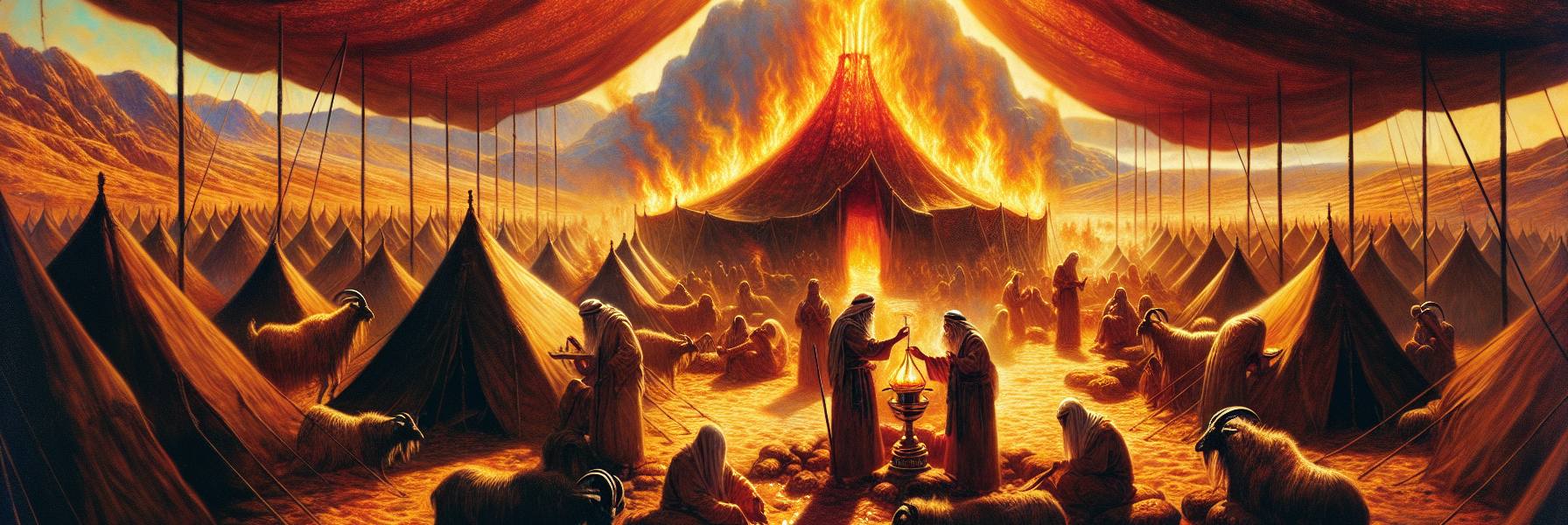

The heat in the camp was a living thing. It rose from the pale dust of the Sinai in visible waves, shimmering over the goat-hair tents, pressing down until even the flies grew sluggish. Inside the Tent of Meeting, the air was cooler, thick with the scent of olive oil and incense, but it carried its own weight—the heavy, silent weight of holiness.
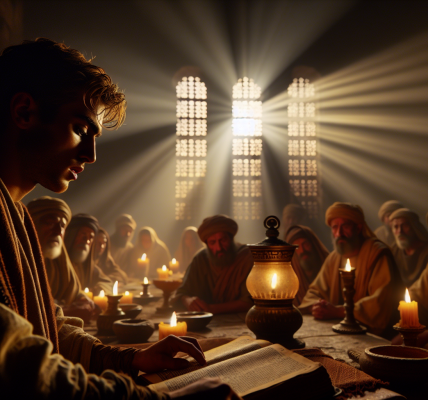
Every morning, without fail, old Ahiam would shuffle in. His hands, mapped with veins like dry riverbeds, would perform the same ritual. He never spoke during it. He’d take the hammered gold lampstand, its seven branches like an almond tree caught in flame, and he would tend to the lamps. He used only the clear oil, beaten from olives, not pressed. I remember watching him once, as a boy, thinking it was a waste of effort. Why beaten? Why not just pressed? My father, grinding barley nearby, had cuffed my ear gently. “The first light, for Him, must be pure. No crushing weight. Only the free offering.” The lesson was in the doing, not the explaining.
Ahiam would trim the wicks—black, charred curls falling silently onto a bronze plate—and fill the shallow cups with the golden oil. Then, with a small fire-pot carried from the altar outside, he would light them. Not all at once, but one by one. The light didn’t burst forth; it grew. It started as a fragile, dancing tongue on one branch, then another, until the whole structure glowed, casting complex, moving shadows on the blue and purple and scarlet curtains. “A statute forever,” Moses had called it. An perpetual light before the Lord. In the stark desert, where night was a vast, consuming blackness, this small, persistent flame in the tent felt like a promise. A fragile, beating heart of light in the middle of nowhere.
The regularity of it was a comfort. The manna appeared with the dew, the cloud settled or lifted from the Tabernacle, and Ahiam lit the lamps. Life was woven through with these threads of commandment. It was the lattice that held us together in the wilderness.
Then the fight broke out near the outskirts of the camp, where the mixed multitude had pitched their tents. A man whose mother was Israelite, from the tribe of Dan, but whose father was Egyptian, got into a vicious argument with a full-blooded Israelite. It began over a space at the watering point, something stupid and hot, the way arguments always are in the heat. Words flew, sharp and cutting. But then the Israelite man, in a final, scornful thrust, shouted something about the other’s parentage, about his nameless Egyptian father and his mother who had married outside.
And the half-Egyptian man, his face contorted with a rage that seemed to come from a deep, old well of hurt, did the unthinkable. He cursed. But not just any curse. He used *the Name*. The Name we only whisper in prayer, the Name that hovered over the golden lamps in the Tent. He blasphemed it, flinging it into the dust of the argument like a weapon.
A terrible silence fell, colder than the desert night. The scuffle stopped. The men who had been holding them back let go, stepping away as if from a leper. They seized him, not roughly now, but with a kind of dreadful solemnity, and brought him before Moses.
We all waited. The camp hummed with a low, anxious murmur. Moses put him in custody, “until the will of the Lord should be made clear to them.” The phrase hung in the air. We knew the law. We knew about curses. But this was different. This was the Name.
The word came down the next day. Moses, his face like stone, gathered the people. The Lord’s judgment was direct, terrible in its clarity. “Whoever blasphemes the name of the Lord shall surely be put to death. All the congregation shall stone him.” There was more—the principle of fracture for fracture, eye for eye, tooth for tooth. A stark, balanced justice that left no room for the fever of vengeance. It was simply the law, laid bare like bones in the sun.
They led the blasphemer outside the camp. His mother’s name, Shelomith, daughter of Dibri, was known now to everyone, a sad footnote to infamy. The witnesses, the ones who had heard the awful words, went first. They had to lay their hands on his head. I saw them do it—a quick, almost reluctant touch, transferring the burden of testimony from themselves to him. Then the whole congregation began.
It was not a riot. It was a grim, quiet duty. The stones were not huge. You could hold one in your palm. The first ones thrown seemed tentative, clattering on the ground near him. Then one struck his shoulder. A gasp, not from him, but from the crowd. Then another found its mark. Soon there was a rhythm to it, a dreadful, pounding rain of rock. He fell. The sound changed from thuds to a wetter, softer sound. It didn’t last long.
Afterwards, the silence was absolute. The men dropped their remaining stones, their hands dusty. They walked back to the camp, not looking at each other. The broken body lay outside the boundary, a stark reminder of the line between the holy and the profane.
That evening, I watched Ahiam light the lamps again. The procedure was unchanged. The pure, beaten oil, the careful trimming, the gentle lighting of each flame. The light grew, just as before, pushing back the gathering darkness inside the Tent. But it looked different to me now. That perpetual flame wasn’t just a promise of guidance. It was a warning. The same holiness that gave us light, that ordered our days with the quiet rhythm of oil and wick, was a fire. It could warm and guide, but it could also consume. It demanded a reverence that was as absolute as the desert sky. The law was the vessel that carried it, and the vessel had to be clean, or it would shatter.
I walked back to my family’s tent, the smell of incense still clinging to my tunic. The camp was quiet, the day’s terrible lesson sinking into the collective soul. The light from the Tent glowed behind me, a small, unwavering point in the vast, dark wilderness. We were learning, stitch by painful stitch, what it meant to be a people who carried that light with them.