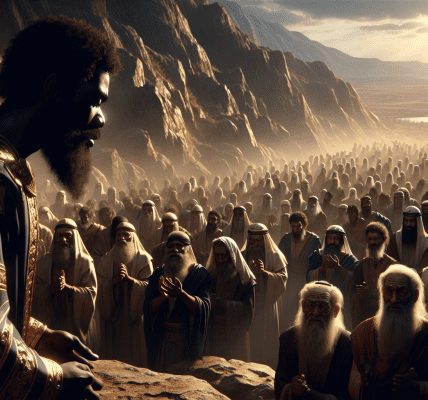

The heat in Anathoth was a living thing that summer. It shimmered above the packed earth of the threshing floor and clung to the linen of Eliab’s tunic like a second skin. He wiped his brow with a rough forearm, his eyes scanning the golden sea of wheat stalks, the rhythmic thud of the flails a steady heartbeat in the afternoon. He was a man who found comfort in the law, in its clear lines and measured judgments. The words of Moses, rehearsed weekly at the gate, were the timbers of his world.
His younger brother, Micah, had not been such a man. Micah had laughed easily, his eyes crinkling at the corners, a man more inclined to mend a neighbor’s fence than argue over a boundary stone. The fever that took him two years past had been swift and brutal, leaving behind a young widow, Ruth, and a hollow silence where his laughter had been. And it left Eliab with a duty that sat in his gut like a cold, heavy stone.
The law was clear, from the very scrolls they would read tomorrow at the city gate: *If brothers dwell together, and one of them dies and has no son, the widow shall not be married outside the family to a stranger. Her husband’s brother shall go in to her and take her as his wife, and perform the duty of a husband’s brother to her.* Eliab knew the verses that followed, the shame of the sandal-removing, the spitting, the terrible, public label: *The house of him who had his sandal pulled off.*
He watched Ruth now, across the field, bringing a skin of water to the laborers. Her grief had hardened into a quiet, resilient strength. She worked Micah’s parcel of land with a fierce determination that commanded respect, but her eyes, when they met his, held a question he could not yet answer. To take her as his wife felt, in his heart, not an act of devotion to his brother, but a betrayal of his brother’s memory—a clinical fulfillment that had no place for the affection Micah had borne her. Yet to refuse was to break the covenant, to let Micah’s name be blotted out from Israel.
The conflict turned within him as he walked back to the village at dusk. He passed the marketplace, empty now but for a few boys chasing a dog. His gaze fell on the set of worn stone weights Old Caleb used in his olive oil stall. Another law from the same portion whispered in his mind: *You shall not have in your bag two kinds of weights, a large and a small. You shall have a full and just weight.* Eliab’s own father had often grumbled about Caleb’s “heavy thumb,” how the weights he used to buy were always just shy of the mark, while the ones he sold with were overly generous to himself. A small dishonesty, but one that eroded trust like dripping water on stone.
It was all connected, he realized. The just weight and the just act. The integrity of the measure and the integrity of the family. Both required a heart that did not look for the advantage, the loophole, the easier path.
The next morning, the elders gathered in the shaded space of the city gate. The air was thick with the smell of dust and dung and ripening figs. A case was being heard—a violent brawl between two farmers. The presiding elder, a grizzled man named Joab, invoked the law: *If men get into a fight with one another… and the wife of the one draws near to rescue her husband… and seizes him by the private parts, then you shall cut off her hand. Your eye shall have no pity.* A murmur rippled through the onlookers. It was a severe, almost forgotten statute, a stark reminder that the foundations of society, even in its rawest conflicts, were sacred. Boundaries existed. Some lines, once crossed, could not be uncrossed.
Eliab felt the weight of all these threads—the just weights, the protected boundaries, the levirate duty—pressing on him. His own dilemma was another kind of boundary. The law drew a line, and he was standing on its edge, looking into an abyss of personal failure no matter which way he stepped.
He found Ruth later that afternoon at the well. She was drawing water, the muscles in her arms corded with the effort.
“Ruth,” he said, his voice sounding foreign to his own ears.
She straightened, wiping her hands on her skirt. “Eliab.”
“The elders read the law today. At the gate.”
“I know what they read,” she said quietly. There was no accusation in her tone, only a weary acceptance.
“I have… I have delayed. Forgive me. It is not out of disregard for you, or for Micah’s memory.”
She studied his face, the deep lines of care around his mouth that were so different from Micah’s laugh lines. “What is it out of, then?”
He struggled for the words. “Fear,” he finally admitted. “Fear that in doing the duty, I would do it poorly. That it would become a transaction, a settling of a debt. Micah loved you. You brought light to him. I cannot… I cannot simply *perform* that.”
Ruth was silent for a long moment, looking past him to the terraced hills. “The law also says,” she said softly, “that when you reap your harvest and forget a sheaf in the field, you shall not go back to get it. It shall be for the sojourner, the fatherless, and the widow.”
Eliab blinked, confused by the shift.
“My point is,” she continued, “the law is not only about taking. It is also about leaving. Leaving a space for grace. For the forgotten sheaf.” She met his eyes. “Perhaps the duty is not just about a name. Perhaps it is about not leaving me as a forgotten sheaf in the field.”
Her words unraveled the knot in his chest. He had seen the law as a rigid command, a weight to bear. She saw it as a form of provision, a leaving of dignity. It did not erase his awkwardness, or magically conjure a bridegroom’s passion. But it framed the duty as an act of *leaving*—leaving behind his own comfort, his own fears, to provide a space for her life to continue within the family. It was just. It was a full measure.
“Will you come to the gate with me tomorrow?” he asked, his voice firmer.
“To what end?”
“To fulfill the law. Before witnesses. To say that I will perform the duty of a brother.”
A faint, sad smile touched her lips. It was the first he had seen since Micah died. “And if you do not?” she asked, invoking the terrible ritual.
“Then you may pull the sandal from my foot and spit in my face,” he said, the ancient words feeling less like a threat and more like a shared burden. “But I will not leave you as a forgotten sheaf, Ruth.”
The following day, they stood before the elders at the gate. Eliab stated his intent plainly, without flourish. Ruth stood beside him, her head covered, a picture of solemn resolve. The elders nodded, a few murmuring approval. Old Caleb, leaning on his staff, watched with an unreadable expression. There was no celebration, no feasting. It was a legal and theological necessity, acknowledged in the stark daylight of the communal court.
As they turned to leave, Eliab saw Caleb fumbling with the weights at his stall. The old man caught his eye, held it for a moment, then slowly, almost reluctantly, took a smaller stone weight and tossed it into the dust behind his booth. It was not a grand gesture. No one else noticed. But Eliab saw it. It was a man, in his own small way, striving for a just measure.
Walking back with Ruth, the weight was still in Eliab’s gut, but it had changed. It was no longer the cold stone of dread, but the sober, substantial weight of a chosen obligation. The law had not become easier, but it had become clear. It was the threshing floor where the wheat of human life was separated from the chaff of selfishness, a call to a full and honest measure in the marketplace, in the family, in the secret places of the heart. And sometimes, fulfilling it began with the simple, difficult act of not walking away.