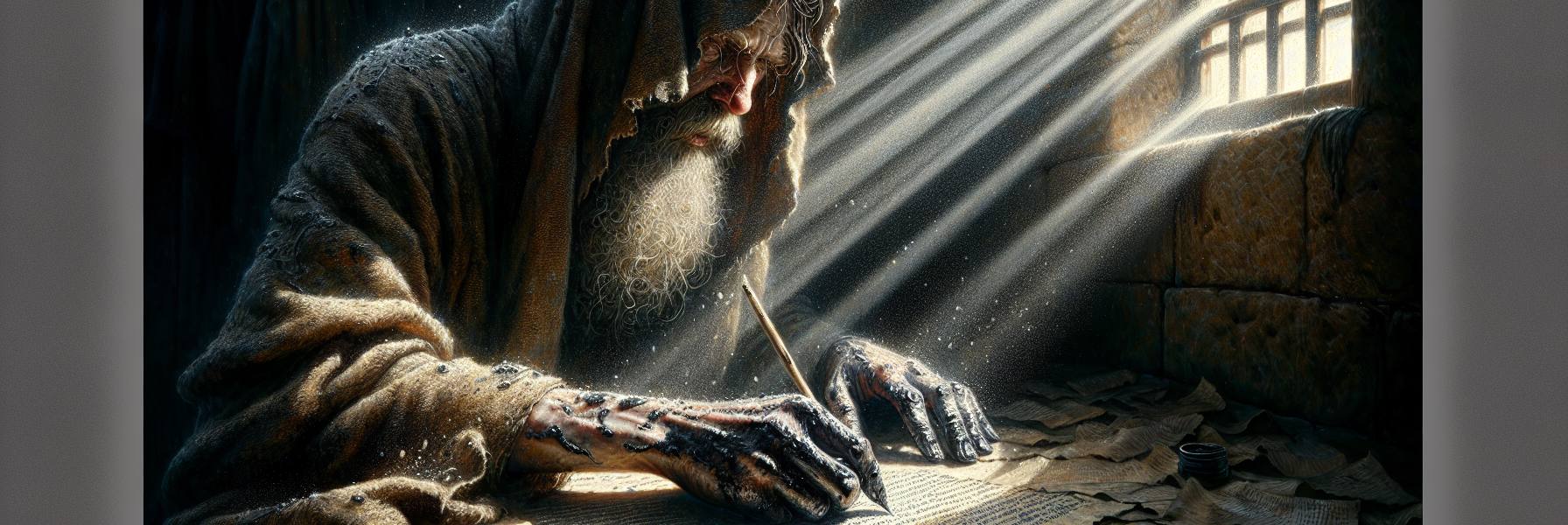

The ink was thick, almost gritty, between his fingers. Jeremiah wiped them on the coarse weave of his robe, leaving greyish smudges on the brown wool. The afternoon light in his chamber at Anathoth was the colour of weak broth, filtering through a high, small window and catching the motes of dust that rose from the parchment. It was a still, heavy day, the kind that pressed on the spirit. The words had come again, not in a thunderclap, but as a slow, insistent pressure in his bones, a dull ache behind his eyes that only found relief through the reed pen.
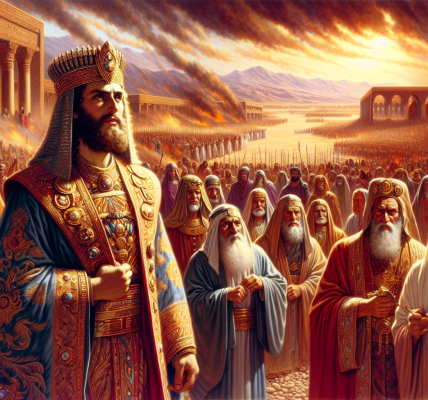
He had been writing of the terror—the “time of Jacob’s trouble.” His hand had cramped describing the cries of men clutching their sides as if in labour, the faces pale with a dread that was not of this world. The siege, the desolation, the end of the familiar rhythm of life in Judah. It was all there, dark and indelible. The ink seemed blacker for it.
He paused, rolling his stiff shoulders. A donkey brayed somewhere in the village, a lonely, ordinary sound. He picked up the scroll again, his eyes tracing the fresh lines. But the word had shifted. He could feel it, a turning in the current of the divine breath that carried the message. It was always this way. The pronouncement of the wound always contained, within its very utterance, the promise of the bandage.
He dipped the pen. The next strokes came slower, not with the fever of warning, but with the deliberate, sure hand of a mason laying a cornerstone.
*Thus says the Lord: Do not fear, O Jacob my servant…*
The very name, Jacob. The supplanter. The one who wrestled. Not the noble “Israel” of victories, but the raw, struggling namesake of the nation in its humanity. A servant, nonetheless. *My* servant. The possessive was a raft in a flood.
Jeremiah described the salvation he saw, not as a vague hope, but with the concrete detail of a man remembering a lost home. He wrote of the yoke on their neck being shattered, of foreigners no longer making slaves of them. He saw, and his pen recorded, the people of Jacob returning to quiet and ease, with none to make them afraid. It was a picture of such profound normality it was heartbreaking: security in their own land, the simple peace of unbroken walls and unthreatened harvests.
But then the ink flowed toward a sharper, deeper mystery. *I will discipline you in just measure… Your hurt is incurable, your wound is grievous.* He did not shy from it. There was no healing that bypassed the truth of the injury. A physician must name the disease. The faithless shepherds, the vile gods, the city sick with sin—these were the causes of the incurable wound. The balm would come, but not before the cleansing fire.
His writing took on a rhythm now, a back-and-forth like the tide. Punishment and restoration were not two separate scrolls; they were intertwined on this one parchment, the dark threads and the gold in a single tapestry. *For I will restore health to you, and your wounds I will heal.* The very same wounds he had just declared grievous. That was the Lord’s way. He named the darkness, then called forth the light from within it.
Jeremiah’s mind went to the kings, the princes. The proud cedar of the palace, soon to be a broken stump. But the pen moved again: *And their prince shall be one of themselves; their ruler shall come out from their midst.* No more foreign tyrants. A leader from the heart of the people. He saw a man, humble, approaching the Lord without the gaudy pomp of kings, drawing near of his own will. *And you shall be my people, and I will be your God.* The old covenant, shattered by them, would be repaired by Him. The core promise, like a durable seed, would survive the fire.
The final part was fiercest, a storm of wrath directed not at Judah, but at the nations who had devoured her. The relentless enemies who saw God’s chastisement as licence for their own cruelty. They would be consumed. Their own gods would perish. The rod used for discipline would itself be snapped and burned.
Jeremiah set down the pen. The ache in his bones had subsided, replaced by a profound, weary stillness. The scroll lay before him, a record of a fracture that ran through the very heart of creation, and of a mending that would be God’s own work. It was a story of two exiles: one forced, into Babylon, born of sin; the other a voluntary return, born of a promise that could not be broken.
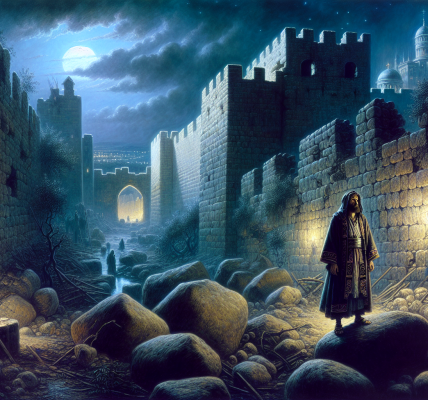
He looked at his ink-stained hands. The message was relentless in its logic. The love was in the discipline. The freedom was on the far side of the broken yoke. The new beginning was inseparable from the honest end. He did not feel triumphant. He felt heavy with the truth of it, a truth as complex and layered as the life of the stubborn, beloved people outside his window. The sun was lower now, the light in the room a deep gold. He would let the ink dry. Then he would go out, into the brooding stillness of the evening, and wait. The word was written. The waiting, and the living of it, was just beginning.