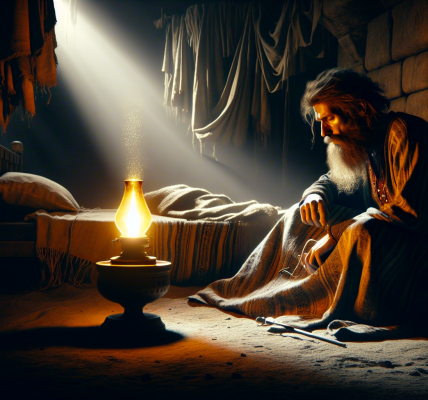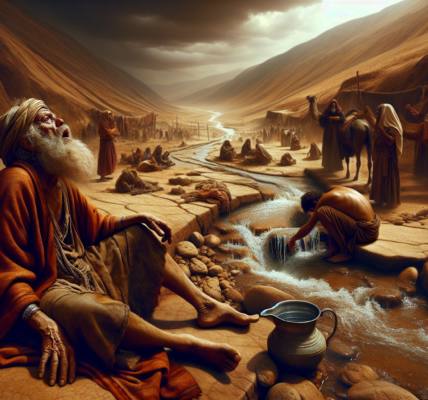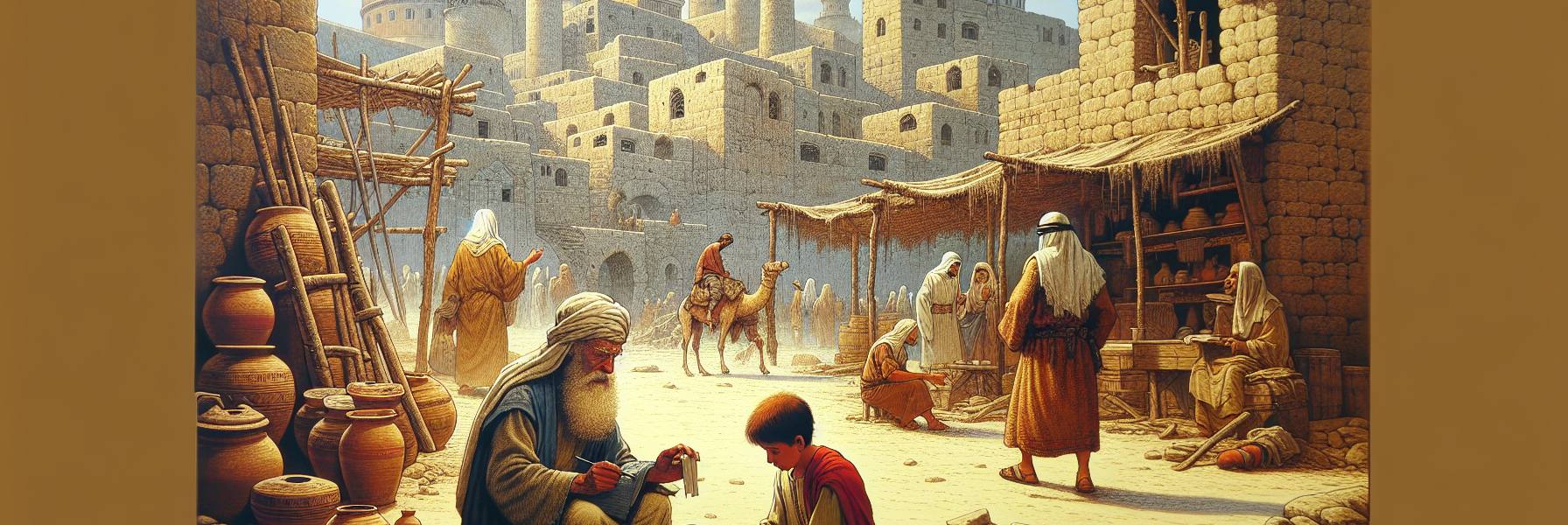

The heat in Jerusalem that summer was a thick, woolen blanket, heavy with the dust of despair. It settled in the courtyards and clung to the robes of those few who still moved with purpose. Among them was Benaiah, an old man now, his back curved like a bowed olive branch. He had been a young scribe when the first warnings came, decades ago. Now, he simply waited.
He found himself most afternoons in the chamber of his grandson, Eliab, a boy of ten with eyes too wide for the crumbling world. The child was piecing together a broken storage jar, his fingers careful with the shards.
“Why does Babylon stand, Grandfather?” Eliab asked, not looking up. “If their gods are nothing, and our God is everything, why do their towers still scratch the sky?”
Benaiah didn’t answer at once. He watched a gecko scuttle across the sun-baked stone of the windowsill. The question hung in the air, the same one that choked the prayers of the exiles by the rivers of a foreign land. Then, a strange clarity descended upon him, not a voice, but a *knowing*, as if a scroll unfurled behind his own eyes.
“Let me tell you a story, Eliab. Not of what is, but of what will be. It is a story of a golden cup.”
The boy looked up, his hands still.
“Far from here, where the rivers are great and slow, there is a city,” Benaiah began, his own voice sounding distant to his ears. “It is not just a city. It is a mountain of human pride, piled stone upon jeweled stone. They call it Babylon, ‘the gate of the gods.’ And for a time, the True God used it. He took it in His hand like a hammer and swung it against nations grown hard with rebellion. It was His instrument.”
Eliab frowned. “A hammer?”
“Yes. But a hammer does not know the hand that wields it. It only knows the shattering. And Babylon began to love the shattering. It looked at the nations it had broken—Judah among them—and it drank deep of their terror. It grew drunk on its own strength. It said in its heart, ‘I am, and there is no one besides me.’ It became a golden cup, Eliab, beautiful and intricate, passed from the Lord’s hand… but filled to the brim with the wine of His wrath.”
Benaiah closed his eyes, and the visions came not as ordered pictures, but as flashes of sensation and sound. He spoke them as they came.
“I see a sound. A sound from the north. Not the cry of an army, but the grinding of a millstone. A great, rough stone turning, and between it and its mate, the grain of Babylon is being ground to powder. The kings of the Medes, their faces like flint, they are that stone. They are stirred, not by their own ambition, but by a purpose older than their kingdoms.”
He shifted, his joints aching. “The warriors of Babylon, they are weary. They sleep a final sleep. Their captains, their mighty men, they have become like women, their strength curdled to fear. For their gods are a fraud. Bel and Nebo, dragged on carts, beasts of burden themselves. They cannot save; they are themselves headed for captivity.”
Eliab had abandoned his jar, his full attention seized. “What happens to the city?”
“It will be like the threshing floor at harvest,” Benaiah whispered, a sharp edge in his tone. “The time to tread her has come. Her vast walls, which seem eternal, will be shown for what they are: a child’s sand wall before the tide. The sea will rise over her—a sea of voices, of nations—and she will be sunk, silent. Never to be found again. The jackals will make their den in her palaces, and the swamp birds will stand in her gatehouses.”
He opened his eyes, fixing them on the boy. “The cup. The beautiful, golden cup. It will be seized from Babylon’s arrogant hand. And it will be dashed against the rocks. A sudden, shocking violence. One moment, a vessel of unimaginable luxury. The next, a shower of glittering, useless fragments. That fast, Eliab. That complete.”
A long silence filled the room, broken only by the buzz of a fly. The vision faded, leaving Benaiah hollow and tired.
“But why tell us?” Eliab’s voice was small. “If we are here, and it is there, and it is all to come?”
Benaiah reached out, his gnarled hand covering the boy’s. “So you will know the hammer is broken. So the exiles will know their prison has a key, and the key is forged in heaven’s justice. So you will understand that pride is a city doomed from its foundation. And faithfulness… faithfulness is a seed that survives the fire.” He paused, searching for the final piece. “It is written, Eliab. It is written that when you see these things, your heart will leap, even in the dust. For the God of Jacob is our stronghold. His ways are not a circle, but a line. And the line leads home.”
The boy looked down at the broken jar in his lap, then back at his grandfather. He didn’t fully understand, but he felt the weight of the true story, a weight that made the present hardship feel different—not permanent, but part of a vast, terrifying, and hopeful rhythm.
Benaiah leaned back. The prophecy was spent. It was no longer a fiery scroll in his mind, but a quiet certainty in his bones. Outside, the oppressive heat of Jerusalem lingered. But for the first time in years, Benaiah felt a different air stirring, faint and far off, like the first, cool breeze from the north, heralding a storm that would cleanse the world. He said no more. The story was told. It was enough.