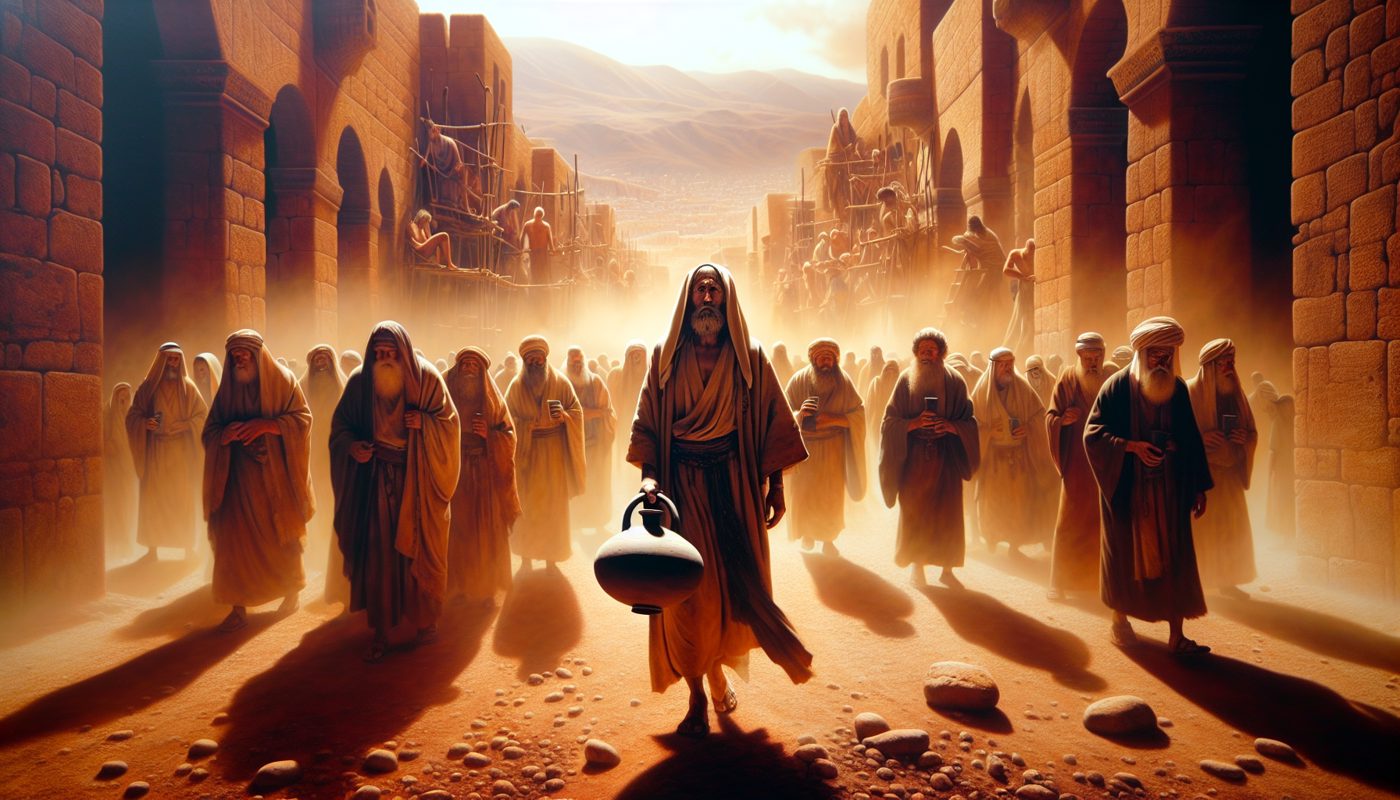
The Lord told Jeremiah to buy a potter's earthen bottle, then take some of the elders of the people and some of the elders of the priests, and go out to the valley of the son of Hinnom, near the entry of the Harsith Gate. It was a specific command with a specific route, and the witnesses were not volunteers. They were summoned to see what the prophet would do and to hear what he would say.
The Lord gave Jeremiah the words to proclaim there. He was to address the kings of Judah and the inhabitants of Jerusalem directly. The message was not subtle: the Lord of hosts, the God of Israel, said He would bring such evil upon that place that everyone who heard of it would feel their ears tingle. That phrase—ears tingling—was a warning of something so terrible it would leave a physical shock in anyone who heard the report.
The reason for the judgment was laid out plainly. The people had forsaken the Lord. They had estranged that very place, burning incense in it to other gods that neither they nor their fathers nor the kings of Judah had known. They had filled the place with the blood of innocents. They had built the high places of Baal to burn their sons in the fire as burnt offerings to Baal—something the Lord said He never commanded, never spoke, and never even let enter His mind.
The days were coming, the Lord said, when that place would no longer be called Topheth or the valley of the son of Hinnom. It would be called the valley of Slaughter. The name change was not symbolic. It described what would happen there.
The Lord said He would make void the counsel of Judah and Jerusalem in that place. He would cause them to fall by the sword before their enemies and before those who sought their lives. Their dead bodies would become food for the birds of the heavens and the beasts of the earth. The city itself would become an astonishment and a hissing—everyone passing by would be astonished and hiss at the plagues that had struck it.
The worst of it came next. The Lord said He would cause them to eat the flesh of their sons and the flesh of their daughters, and every man would eat the flesh of his friend, in the siege and the distress that their enemies would bring upon them. That was not a metaphor. It was a specific horror that would arrive when the city was shut tight and starvation became absolute.
Then Jeremiah was told to break the bottle in the sight of the men who had come with him. He was to say that the Lord of hosts would break this people and this city just as one breaks a potter's vessel—so thoroughly that it could not be made whole again. They would bury in Topheth until there was no room left to bury. The Lord would make this city like Topheth. The houses of Jerusalem and the houses of the kings of Judah, defiled by incense burned on their roofs to the host of heaven and by drink offerings poured out to other gods, would become like that valley of refuse and death.
After delivering that prophecy in the valley, Jeremiah came back from Topheth and stood in the court of the Lord's house. He spoke to all the people there, repeating the same message: the Lord of hosts, the God of Israel, would bring upon this city and all its towns every evil He had pronounced against it. The reason was not complicated. They had made their neck stiff so that they would not hear His words.
The broken flask was the final image. It could not be mended. There would be no second chance to refire the clay. The judgment was not a threat designed to scare them into better behavior—it was a sentence already carried out in the prophetic act, waiting only for the siege engines to arrive and make it visible.
Comments
Comments 0
Read the discussion and add your voice.
Members only
Sign in to join the conversation
We keep comments tied to real accounts so the discussion stays clean and trustworthy.
No comments yet. Be the first to add one.