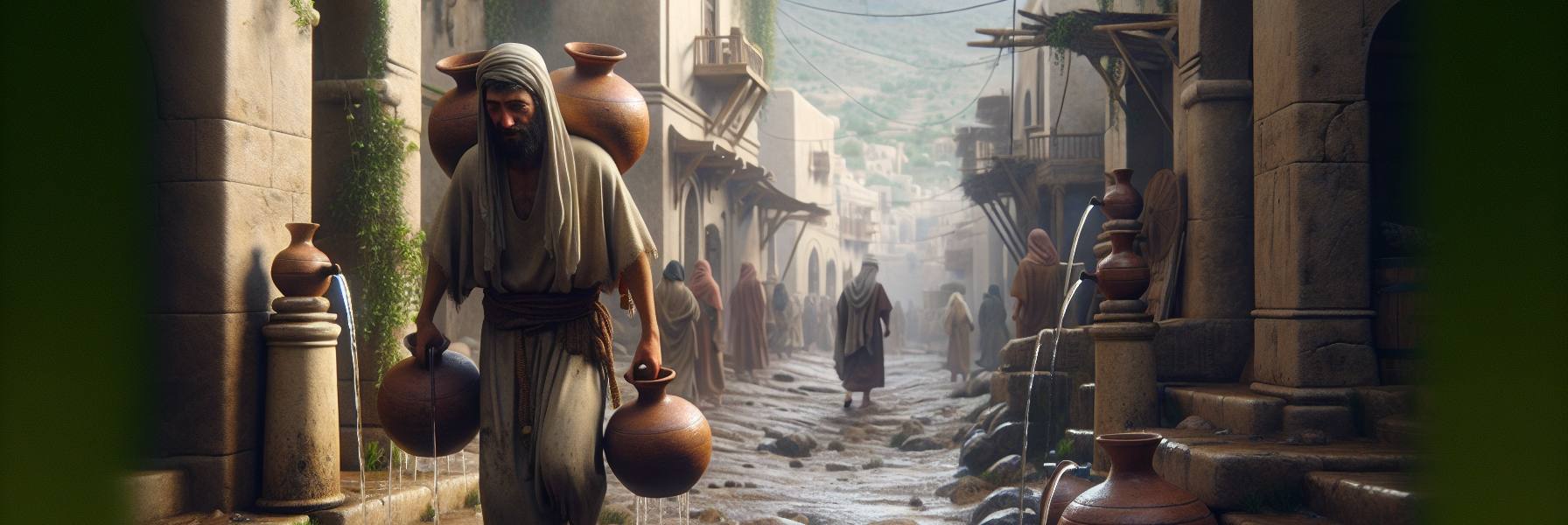

The rain had finally stopped, but the smell of wet earth and crushed herbs hung thick in the air of the narrow street. Asher shifted the yoke on his shoulders, the clay pots swinging gently, their contents—olive oil of dubious purity—sloshing quietly. He was tired. Not just from the walk up from the Kidron valley, but from a deeper weariness that sat behind his eyes. The morning’s argument with his brother over a boundary stone, the thin gruel his wife had managed to stretch for their supper, the persistent ache in his lower back—it all coalesced into a grey fog through which he moved.
He passed the public square. There, by the new Hellenistic-style fountain that never quite worked, a crowd had gathered. A herald, his voice a bored monotone, was reading a decree from some distant official. Asher didn’t bother to stop. The words were always the same: taxes, conscriptions, the glory of some name he would never see. He glanced at the faces in the crowd—the eager young merchant calculating profit, the old widow looking bewildered, the soldier leaning on his spear with practiced indifference. *One event happens to them all*, he thought, the old phrase from the Teacher’s scrolls echoing in his mind without him quite summoning it deliberately. The same sun baked them, the same rain soaked them, and one day, the same dust would claim them. The herald’s voice faded behind him, swallowed by the din of the market.
His destination was a large house near the upper city wall, belonging to Rekem, a grain merchant. Rekem’s cook had ordered the oil. The servant who took the pots at the kitchen gate was curt, handing over a few small coins without a word. The transaction was simple, devoid of honor or disgrace. Asher pocketed the coins, feeling their meager weight. In the shaded courtyard, he saw Rekem himself, reclining on a couch under a fig tree, laughing with two friends. Platters of figs, cheese, and roast lamb lay between them. The smell of the meat and of wine, rich and fruity, was a physical presence. Asher’s own stomach clenched. He watched the merchant tear a piece of bread, dip it in oil, and gesture broadly as he told a story. *The living know they will die*, Asher mused, turning away, *but the dead know nothing*. And in that moment, under the weight of the yoke, the merchant’s laughter seemed a feeble, brave noise against a great and coming silence.
His route home took him past the city gate. A commotion there—shouts, the clatter of hooves. A royal courier, his horse lathered, was pushing through. “Make way! Dispatch for the garrison commander!” The people scattered, then closed in again like water. The message, Asher knew, could be anything: news of a battle won or lost, a political alliance, a royal birth. It would be discussed feverishly in the taverns for a day, then forgotten, just another thread in the endless, meaningless tapestry. He remembered a story his own grandfather told, of a small, wise city besieged by a great king. A poor, wise man within it devised a deliverance. But no one remembered that poor man afterward. His wisdom was despised, his words unheeded until the moment of crisis, then just as swiftly discarded. The reward for his cleverness was oblivion. Asher hawked and spat into the dust by the road. *Better is wisdom than weapons of war*, he thought, *but one sinner can destroy much good*. The courier vanished into the fortress. The crowd dispersed, the moment’s drama spent.
Back in his own small, dark house, the weariness settled into his bones. His wife, Leah, was mending a tunic by the last of the daylight at the door. She gave him a look that held no blame, only a shared exhaustion. He placed the coins on the low table. They looked smaller here, in the dimness.
“Enough for barley tomorrow,” she said, not as a question.
He nodded, then did something unexpected. He went to the storage nook and felt for the small, sealed jug he kept there. He broke the seal, poured a measure of the wine he had been saving for a festival—a wedding, a circumcision, something that felt like it would never come—into two clay cups. He handed one to Leah. She looked at him, surprised.
“It is not a feast day,” she said.
“No,” Asher replied, his voice rough. “But our lives are a vapor. And our portion under the sun is toil. And also…” He lifted his cup. “To eat our bread with enjoyment, and to drink our wine with a merry heart. For the Teacher said that is from the hand of God.”
A slow smile touched Leah’s worn face. It was a rare sight, like sunlight breaking through a crack in a heavy wall. She took her cup. They drank. The wine was rough and strong, warming a path through the cold fatigue. It was not an answer to the boundary stones, or the taxes, or the ache, or the great, yawning silence that awaited every man, great or small, righteous or wicked. It was not a defense against the time of chance that overtakes all, like fish caught in a net or birds trapped in a snare.
But for that moment, in the quiet of their poor house, with the taste of sour wine on their tongues and the faint scent of the coming night air, it was a portion. It was a small, defiant act of living, a conscious savoring of the simple, fleeting gift of being alive before the long darkness. Asher looked at his wife’s face in the twilight and thought no grand thoughts. He simply knew he was here, now, and for now, it was enough. The rest—the futility, the injustice, the forgotten wisdom, the final, certain end—could wait for tomorrow.