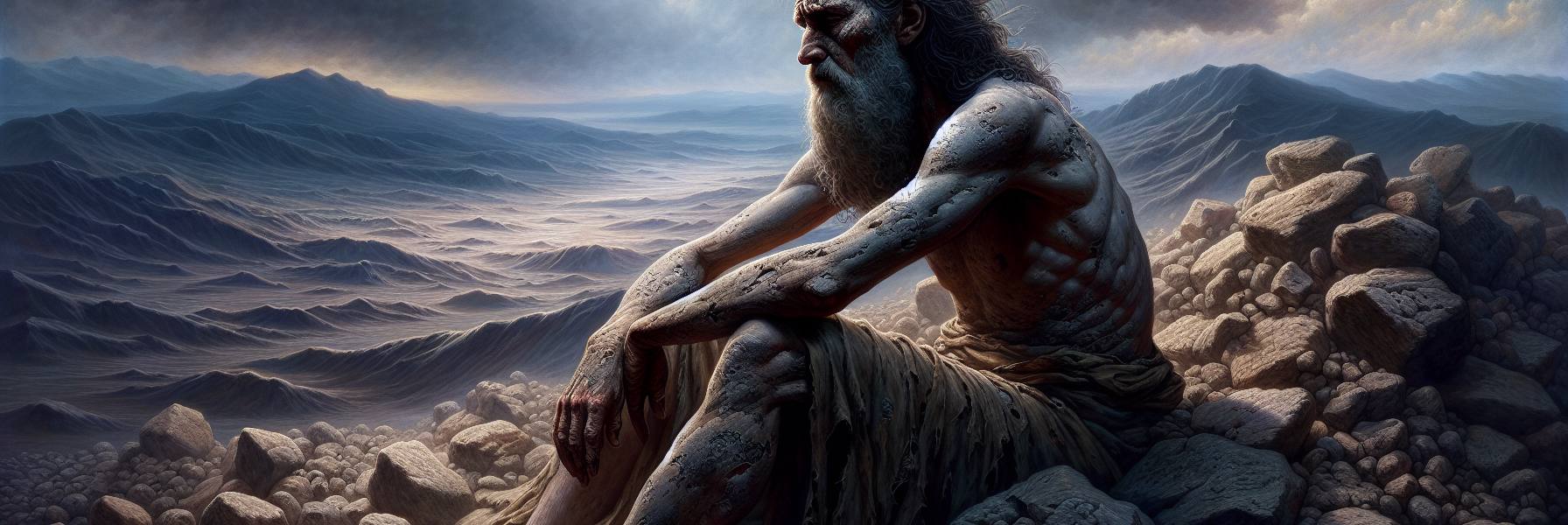

The air did not clear so much as it changed. The last echoes of the whirlwind’s voice seemed to seep into the very stones of the ash heap, leaving behind a silence so profound it rang in Job’s ears. His skin was raw from the wind, his lungs still felt the pressure of the storm. He was a man hollowed out, every argument, every plea, every scrap of his righteousness scoured away by that relentless, magnificent litany of creation. He had covered his mouth once. Now he felt the gesture was inscribed upon his soul.
A silence stretched, not empty, but heavy. It was the silence of held breath, of a world waiting. The voice, when it came again, did not boom from the clouds. It emerged from the quiet itself, a low, resonant thread woven into the fabric of the air around him.
“Shall a faultfinder contend with the Almighty? He who argues with God, let him answer.”
Job did not look up. He stared at the grime caked under his broken fingernails, at the gritty dust between the tiles of the shattered pottery he sat upon. The words were not a shout, but they carried the immense weight of a mountain placed gently upon his chest. To ‘answer’ now seemed a concept from a childish past, like trying to bail out the sea with a cracked cup. What was his integrity, his famed blamelessness, against the foundation of the earth? Against the storehouses of snow, the leash of the Pleiades, the wild freedom of the onager?
He drew a shuddering breath, the air scraping his throat. He spoke to the ground, his voice a dry rustle.
“I am insignificant. What can I reply to you? I place my hand over my mouth. I have spoken once… and I will not answer. Twice, but I will proceed no further.”
He expected the voice to cease, to accept his surrender as an end. The silence returned, but it was a waiting silence. It asked more.
Then, the voice came, and it was closer, not in volume but in presence, as if the speaker had knelt in the dust beside him.
“Gird up your loins now like a man; I will question you, and you will inform me.”
The charge was terrible, not for its anger, but for its solemnity. It was a call to stand, not in defiance, but in the awful dignity of being addressed. Job slowly, painfully, pushed himself up from the ash heap. His muscles screamed in protest. He stood, a thin, ruined figure against the immense canvas of the sky.
“Will you indeed annul my justice? Will you condemn me so that you may be in the right?”
The questions hung, not as accusations, but as stark, unadorned realities. To claim his own innocence required, in the final arithmetic of the cosmos, the indictment of God. Job saw the terrible symmetry of it. His demand for a hearing implied a judge above the Judge. A cold clarity washed over him.
The voice continued, its tone shifting from the cosmic to the intimately concrete. “Do you have an arm like God’s? And can you thunder with a voice like his?”
Job’s own arms, stick-thin and scarred, hung useless at his sides. His own voice had been reduced to a whisper.
“Adorn yourself with majesty and dignity; clothe yourself in glory and splendor. Pour out the overflowings of your anger, and look on everyone who is proud and abase him. Look on everyone who is proud and bring him low, and tread down the wicked where they stand. Hide them together in the dust; bind their faces in the hidden place. Then I myself will acknowledge to you that your own right hand can save you.”
The challenge was a devastating portrait of divine prerogative. It was not about power alone, but about the right to wield it—to administer the moral architecture of the world, to wear majesty as a garment, to execute the sentence on evil. Job was silent. He possessed none of it. He could not even keep his own children safe.
Then the voice turned, and its attention focused on a single point within the creation, as if directing Job’s gaze.
“Consider now Behemoth, which I made as I made you.”
The name was not an introduction; it was a revelation. It spoke of a primal, foundational thing.
“He eats grass like an ox.”
The simplicity of the detail was arresting. Not a demon, not a chaos monster from myth, but a creature that fed, mundane as cattle.
“See now, his strength is in his loins, and his power in the muscles of his belly. He stiffens his tail like a cedar; the sinews of his thighs are knit together. His bones are tubes of bronze; his limbs are like bars of iron.”
Job’s mind’s eye, so long filled with images of his own loss and pain, was now filled with this. He saw not a symbolic beast, but an actual, breathing reality—the colossal, slow-moving bulk of it, a living mass of engineered power. The cedar-tail spoke of balance, grandeur. The bronze and iron were not metaphors for invincibility, but descriptors of a biological fact. This was a creature of God’s direct, deliberate making.
“He is the first of the ways of God; the one who made him provided his sword.”
‘The first of the ways.’ The phrase resonated. This was no afterthought, but a cornerstone of God’s creative purpose. A being of immense, peaceful power, yet whose very existence—its ‘sword’—was endowed by its Maker.
The narrative painted a scene of tranquil, unstoppable dominion. “Indeed, the mountains yield produce for him, where all the wild beasts play. Under the lotus plants he lies down, in the covert of the reeds and the marsh. The lotus trees cover him with their shade; the willows of the wadi surround him.”
Job saw it: the great beast submerged in the green, murky water, shaded by broad leaves, utterly at home in the lush, fecund chaos of the marsh. It was a picture of an authority so inherent it looked like repose.
“If the river rages, he is not alarmed; he is confident, though the Jordan gushes into his mouth. Can anyone capture him by his eyes, or pierce his nose with snares?”
Here was the point. This creature, for all its might, lived within a set boundary. It did not fear the floods that would terrify any man. Its security was absolute, derived from its place in the created order. And it was untamable. No hunter’s trick could master what God had established in such sovereign freedom.
Job stood, and the sun was warm on his back. The vision of Behemoth settled in him. It was not an answer to his suffering. It was something else entirely—a removal of the answer to a different plane. His questions of justice and injustice had not been驳倒. They had been surrounded, swallowed by a reality so vast and so meticulously ordered that they seemed like the complaints of a child who could not see the borders of the map.
He had asked for a contest of righteousness. He had been shown the architect of the hippopotamus, wallowing in its river, unassailable and content.
The voice had ceased. The wind was just the wind again, moving over the wilderness. Job did not sit back down. He remained standing, a man stripped of everything but the immense, quiet, and terrifying knowledge that he was seen, he was addressed, and his story was held within a Story whose first chapters were written in the sinew of Behemoth and whose author wore the thunder as a garment. He had no answer. For the first time, the lack of one felt not like a defeat, but like the beginning of a different kind of understanding.