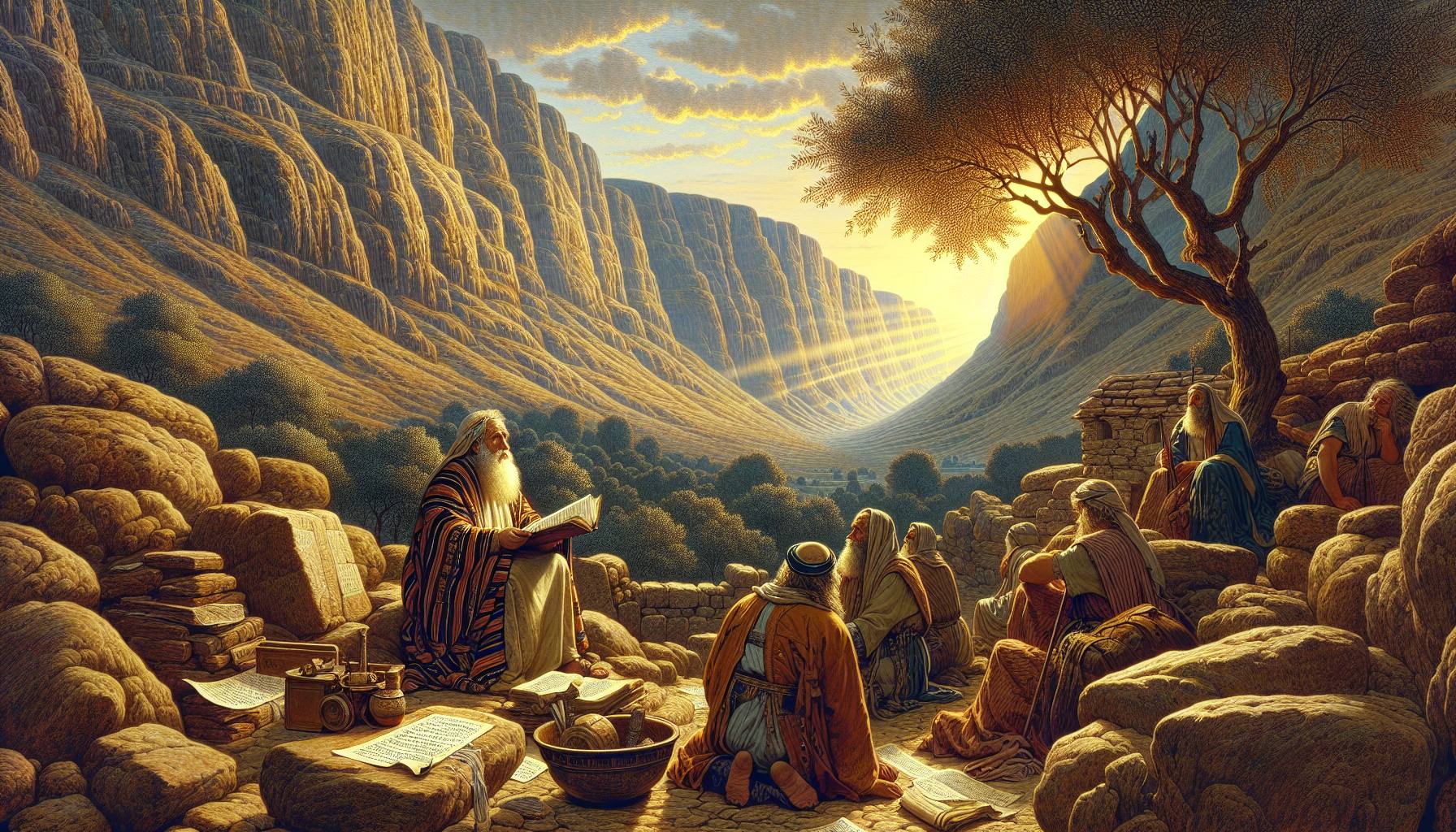
The road to Bethlehem was dust and old stones, and the prophet’s feet knew every one of them. Samuel felt the weight of the journey not in his legs, which were still strong for his years, but in his spirit. The grief for Saul was a raw, private thing—a kingly hope that had curdled like milk left in the sun. And now this new instruction from the Lord, so fraught with danger. “I have provided for myself a king among the sons of Jesse,” the voice had said. Samuel could still feel the echo of it in his bones, a tremor of something new and terrifying. If Saul heard of a prophet anointing a new king in Judah… well, it would not end with words.
The elders of Bethlehem met him at the town gate, their faces tight with a fear that mirrored his own. Their greetings were too loud, their bows too deep. “Do you come in peace, seer?” The question hung in the dry air.
“In peace,” Samuel said, and the words tasted like ash. “I have come to sacrifice to the Lord. Consecrate yourselves and come with me.” He saw the flicker of relief in their eyes. A religious duty. Perhaps not a political one. They did not need to know the sacrifice had horns and a heart, and a name already chosen by God.
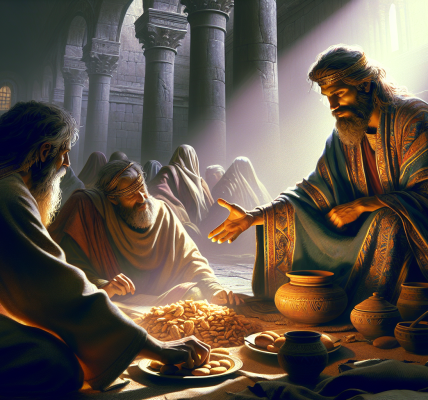
The consecration was a hurried affair of water and silence. Then, in the flat space before the high place, with the fire laid and the people gathered, Jesse and his sons arrived. Samuel watched them approach, a procession of male pride. Eliab led them, tall as a cedar of Lebanon, shoulders broad, his face all stern, handsome lines. Samuel’s old heart gave a familiar thump. *Surely this is the Lord’s anointed.* The prophet could already see the crown on that noble brow, the people rallying to such a figure.
But the Lord’s voice was a whisper that cut through thought. *Do not look on his appearance or on the height of his stature, because I have rejected him. For the Lord sees not as man sees: man looks on the outward appearance, but the Lord looks on the heart.*
The rebuke was gentle but absolute. Samuel felt chastened, his old assumptions laid bare. One by one, the sons passed before him. Abinadab, Shammah, four others whose names blended in the tension of the moment. Strong sons, fine sons, the kind of men you would pick for a king’s guard. And to each one, the same silent, certain verdict in Samuel’s spirit: *No. This is not he.*
A confusion, thick and awkward, settled over the ritual. The fire crackled. The elders shifted. Jesse stood, his pride visibly deflating as son after son was passed over. Samuel cleared his throat. “Are all your young men here?”
Jesse’s brow furrowed. “There remains yet the youngest, but he is with the sheep.” He said it almost as an afterthought, a dismissal. The keeper of the flocks, the boy of no account, not even worth the walk to the sanctified gathering.
Samuel’s voice left no room for argument. “Send and bring him, for we will not sit down until he comes here.”
So they sent, a runner scrambling up the path out of town toward the rolling hills where the grass was thin and the rocks plentiful. And they waited. The silence stretched, punctuated by the lowing of the sacrificial bullock from its pen. Samuel kept his eyes on the southern ridge.
He came not with a run, but with an easy, wind-blown stride, as if he had absorbed the patience of the hills themselves. He was ruddy, this youngest one, with eyes that seemed to hold the clarity of the wide sky. His hair was tousled, and the smell of the field—of earth, animal wool, and open air—came with him. He was not slight, but lean, the sinewy strength of a sapling that bends in the wind but does not break. This was David.
And the whisper came, not as sound, but as a settled knowing deep within the prophet’s chest. *Arise, anoint him, for this is he.*
Samuel did not hesitate. The horn of oil was in his hand, simple and unadorned. He motioned the boy forward. There was no grand speech, no fanfare for the bewildered family and townsfolk looking on. The oil, rich and golden, caught the sunlight as Samuel poured it upon the brown, untidy hair. It ran down David’s forehead, tracing a path through the dust of the fields.
In that moment, nothing visible changed. No thunderclap, no shimmering light. The boy still smelled of sheep. The elders still looked on in polite confusion. But Samuel felt it—the rushing, silent arrival of the Spirit of the Lord, taking up residence upon David from that day forward. And as the prophet watched, he knew, with a certainty that both thrilled and grieved him, that the Spirit had departed from Saul, leaving the king to a different, more terrifying companion: a harmful spirit from the Lord, to torment him.
The meal that followed was quiet, the conversation stilted. They ate the sacrificial meat, but the taste of destiny was stronger. Soon after, David, the anointed shepherd, wiped the oil from his brow with the back of his hand, nodded to his father, and walked back up the path to the sheep. The kingdom of Israel had its future king, and he was out watching for wolves, humming an old tune to the ewes, with the scent of holy oil lingering in his hair.