
The work was done. The Tabernacle, that tent of meeting, that strange and glorious echo of heaven’s own architecture, stood complete in the heart of the camp. The cloud had settled upon it, a silent, brooding presence that made the very air feel thin and charged. The anointing oil, rich with myrrh and cinnamon, had been poured over every acacia board and linen curtain, sealing it all, setting it apart. It was a finished thing. Yet, as Moses stood in the doorway, the smell of fresh-cut wood and dyed yarn still clinging to the air, he felt not an end, but a beginning.
The leaders of Israel came then, the heads of their fathers’ households, the same chiefs who had overseen the census and the ordering of the tribes. There was a gravity to their steps, a collective holding of breath. They brought gifts, but not in a clamorous heap. They brought them with a slow, deliberate solemnity that spoke of long consultation and deep, unspoken longing.
“The Lord has spoken,” they said to Moses, their voices low. “But the altar stands empty. Let us bring its dedication.”
What they brought first were wagons. Six strong, wooden-wheeled carts, weathered from the desert trek but sound, each yoked to two oxen whose hides were dusted with the fine silt of the wilderness. They rolled forward with a creak of axles and the snort of beasts, a practical, earthly sound in that holy space. Moses received them, his hands resting on the rough wood of a cart-bed. He gave them to the Levites, to the sons of Gershon and Merari for the transporting of the Tabernacle’s heavy frames and sockets and curtains. But to the Kohathites, who bore the sacred furniture on their shoulders with poles, he gave none. Their burden was not for wheels; it was for the bone and muscle of consecrated men.
Then the offerings began. Not all at once, but day by day, tribe by tribe, in an order that mirrored the arrangement of the camp itself. It was Judah first, Nahshon son of Amminadab stepping forward on that initial morning when the dawn lit the goat-hair roofs with a fringe of fire.
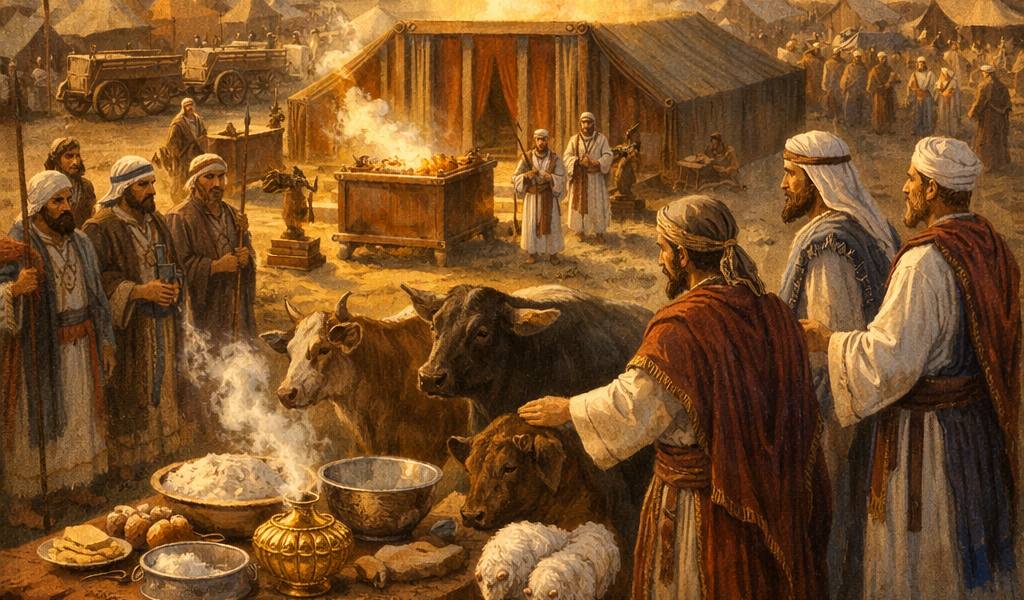
He did not rush. His offerings were laid out before the Tent: a silver dish, its weight a full 130 shekels, polished to a soft gleam like a still pool. A silver basin, 70 shekells by the sanctuary weight, for the blood of rites. Both were filled with fine flour mixed with oil, a grain offering that smelled of earth and sustenance. A golden dish, so small it could fit in a palm, yet heavy with its full ten shekels of incense—a fragrance so potent it prickled the nostrils with hints of frankincense and storax. Then the animals: a young bull, its coat dark and sleek, a ram, a male lamb in its first year, each perfect, each breathing clouds in the cool air. A goat for a sin offering, its head bowed as if aware of its role. And for the peace offerings, two oxen, five rams, five male goats, five male lambs. A wealth of life, a torrent of potential blood.
And Moses did not merely tally them. He watched as Nahshon’s hands, calloused from leading a people through wilderness, rested for a moment on the bull’s flank. He saw the man’s eyes lift to the silent, clouded presence over the Most Holy Place. This was not a transaction. It was a language. The silver spoke of redemption, the grain of daily dependence, the incense of prayers meant to ascend where eyes could not see, the blood of atonement and communion. It was a grammar of grace, repeated.
The next day, Issachar. Then Zebulun. Reuben, Simeon, Gad. The days unfolded, one after another, in a rhythm that became the new heartbeat of the camp. The same offerings, tribe after tribe. A modern reader might skim the chapter, seeing only repetition. But to be there was to feel something else entirely.
It was in the slight differences, the human texture. The way the silver dish from the tribe of Ephraim had a tiny, almost invisible dent on its rim, a story untold. The way the sons of Benjamin presented their male lamb with a particular tenderness. The sweat on the brow of the men from Dan as they led their two oxen forward, beasts that were a true portion of their wealth. The scent of the grain offering began to hang perpetually in the air, mingling with the sharper, constant tang of blood from the altar, which now, day by day, was consecrated not with oil alone, but with use, with purpose.
For twelve days it continued. The priests, Aaron and his sons, their hands growing stained, moving in a solemn dance of slaughter and sprinkling, burning and offering. The pile of ashes at the altar’s base grew. The fat smoke of the burnt offerings became a permanent column, twin to the cloud above, a signal of ceaseless surrender.
On the final day, Ahira son of Enan brought the offering of Naphtali. The same silver, the same gold, the same unblemished animals. And when the last prayer, the last handful of incense had been cast upon the fire, a profound silence fell, deeper than before. The cumulative weight of it all settled over the assembly. It was not the weight of monotony, but of completeness. Every tribe, from the greatest to the least, from the first-born to the youngest, had spoken the same full sentence of devotion. No tribe was silent. No family was unrepresented in this chorus of giving.
That evening, Moses went into the Tent to speak, as was his custom. The air inside was thick with the lingering perfume of incense and the smell of the anointing oil. And there, in the heavy silence of the Holy Place, lit by the steady flame of the lampstand, he heard a voice. It came from above the mercy seat, from between the cherubim on the ark of the testimony. It was a voice that did not sound in thunder, but in intimate clarity.
And the Lord spoke to him.
The offerings were complete. The altar was dedicated. The people had spoken, as one, in the only language they fully knew—the language of sacrifice, of costly, identical, trusting gift. And now, God answered. The narrative does not record what was said in that moment following chapter seven. But the fact of the speaking was everything. The pattern of the days, the patient, tribal procession, the repeated gifts—they had built a throne from which grace could speak. The people had given their all, tribe by tribe. And God, in the quiet of a tent filled with the echoes of their giving, drew near and replied.